Rice
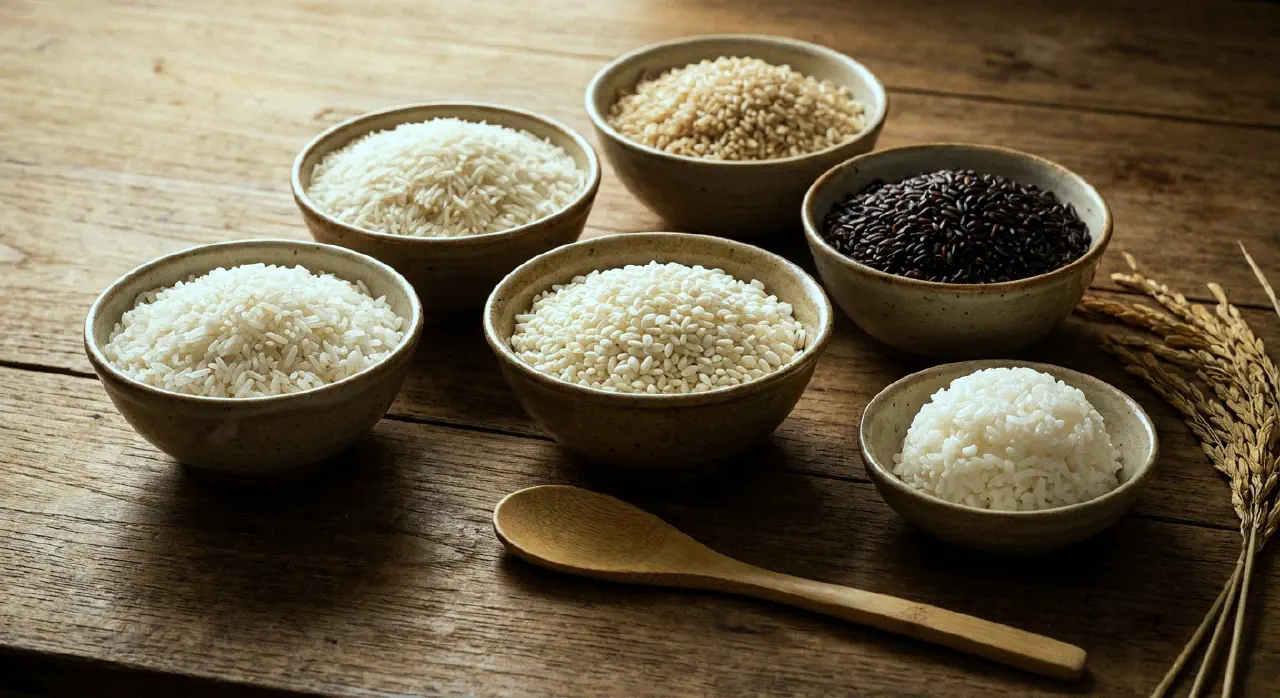
Principal food for roughly half the world’s population - in Bangladesh and Cambodia, a single crop providing nearly 75% of daily energy - rice illustrates the amylose/amylopectin principle more clearly than any other grain. The starch ratio determines whether cooked grains separate or cling, firm up dramatically when cold or stay tender, and whether a dish becomes risotto or sticky rice. Understanding that single variable predicts most of rice’s kitchen behavior.
The amylose divide: indica vs japonica
Over 100,000 varieties worldwide, but nearly all fall into two subspecies:
Indica (long-grain): Lowland tropical varieties (most Chinese, Indian, and American rices). High amylose (~22%) - stable, tightly bonded starch granules requiring a 1.7:1 water-to-rice ratio. Cooked grains separate and spring back; become distinctly hard when refrigerated as amylose retrogrades rapidly. Most rice sold in the U.S. is long-grain indica.
Japonica (short-grain): Temperate and upland varieties (Japan, Korea, Italy, California). Lower amylose (~15%) - requires less water, produces tender, slightly clingy grains that stay softer when cold. Preferred in north China, Japan, and Korea. Italian Arborio and Carnaroli are japonica varieties.
Sticky/glutinous rice: Almost pure amylopectin; requires only 1:1 water ratio; very clingy and readily disintegrates. Not sweet despite the name “sweet rice.” Standard in Laos and northern Thailand; often steamed rather than boiled.
Aromatic and specialty rices
Basmati: Long-grain indica with unusually high volatile compound concentration. The popcorn-like note (acetylpyrroline) is shared with screwpine leaves, bread crust, and cooked popcorn - it’s volatile, so aroma loss during cooking is significant. Pre-soaking shortens cooking time and minimizes this loss.
Jasmine: Unusual - long-grain but low-amylose, like a japonica. Thai; tender and slightly clingy despite its length.
Pigmented rices: Red and purple-black bran layers rich in anthocyanins. Partly milled versions retain color traces with shorter cooking times.
Brown rice: Any variety left unmilled - bran, germ, aleurone intact. Takes 2–3× longer to cook. Chewy, nutty aroma; higher oil (3% vs 0.5% white), making it susceptible to rancidity. Best stored refrigerated.
Parboiled/converted rice: Steeped in water then boiled or steamed before hulling and milling - a 2,000-year-old Indian and Pakistani technique. Nutrients from bran and germ diffuse into the endosperm during soaking. The starch gelatinizes then anneals (like bulgur), hardening the surface: cooked parboiled rice is distinctly separate and firm. Develops vanillin and related compounds from partial lignin breakdown during soaking - a characteristic nutty flavor.
Cooking methods
Different traditions have optimized rice cooking for different objectives:
Indian method: Boil in excess water, pour off when done. Produces intact, separate grains - suited to long-grain basmati.
Chinese/Japanese method: Exactly the right water in a closed pot. Produces clingy, chopstick-friendly grains - suited to short-grain japonica.
Iranian method (most sophisticated): Partly boil long-grain rice in excess water, layer with cooked meats/vegetables/dried fruits/nuts, then gently steam to finish. The bottom layer forms the prized tahdig - a golden crust formed by controlled Maillard browning against the pot bottom.
Risotto: Uses medium-grain japonica. Constant stirring abrades the softened endosperm from grain surfaces, releasing surface starch into the cooking liquid to form a creamy sauce. The key is friction throughout cooking - not just at the end. Restaurant technique: cook to just-underdone, refrigerate (retrogradation firms grains, makes them more resilient), finish with hot broth just before service.
Flavor
White rice aroma: green, mushroomy, cucumber-like, fatty notes from 6–10 carbon aldehydes; slight popcorn note. Brown rice adds vanillin and sotolon (maple-sugar-like) from the bran layer. Aromatic rices concentrate acetylpyrroline - the compound also responsible for screwpine (pandan) and bread-crust aroma.
Rice preparations
Rice flour: ~90% starch; smallest starch granules of major cereals (½ to ¼ the size of wheat starch). Produces exceptionally fine texture in thickened sauces. Japanese tempura batter uses rice flour for its crispness (no gluten to go chewy). Cannot make raised breads without added gum.
Mochi: Sticky rice steamed then pounded into an elastic paste, or kneaded from sticky rice flour. The pounding organizes amylopectin molecules into an intermeshed network that resists structural change - hence mochi’s distinctive springy texture.
Wild rice (Zizania palustris): Not true rice; a cool-climate North American water grass and the only North American cereal to become a significant human food. Long grains (~¾ inch) with distinctive earthy, tea-like, nutty flavor. Parching over fire gelatinizes and anneals starch (like parboiling), making it hard and requiring long cooking. Pre-soaking significantly helps.
Food safety: Bacillus cereus
Raw rice almost always carries dormant spores of Bacillus cereus, which produces powerful gastrointestinal toxins. Spores survive cooking and germinate at room temperature within a few hours. Cooked rice left out is a genuine hazard. Serve promptly; refrigerate leftovers. Japanese sushi rice is protected by its vinegar-and-sugar coating - effective antimicrobials at the surface. Rice salads should be acidified.
See also
- seed-biology - amylose vs amylopectin mechanics, gelatinization, retrogradation
- grains - other cereals for comparison; corn, oats, rye, barley
- wheat - the other dominant grain; gluten elasticity vs rice’s starch-only texture
- starch-gelatinization - detailed gelatinization and sauce-making principles
- plant-preservation - fermented rice (lao chao), rice vinegar
- maillard-reaction - tahdig browning, parboiled rice vanillin
- precision-rice - cooking rice at precise temperatures for target textures