Boilover Physics
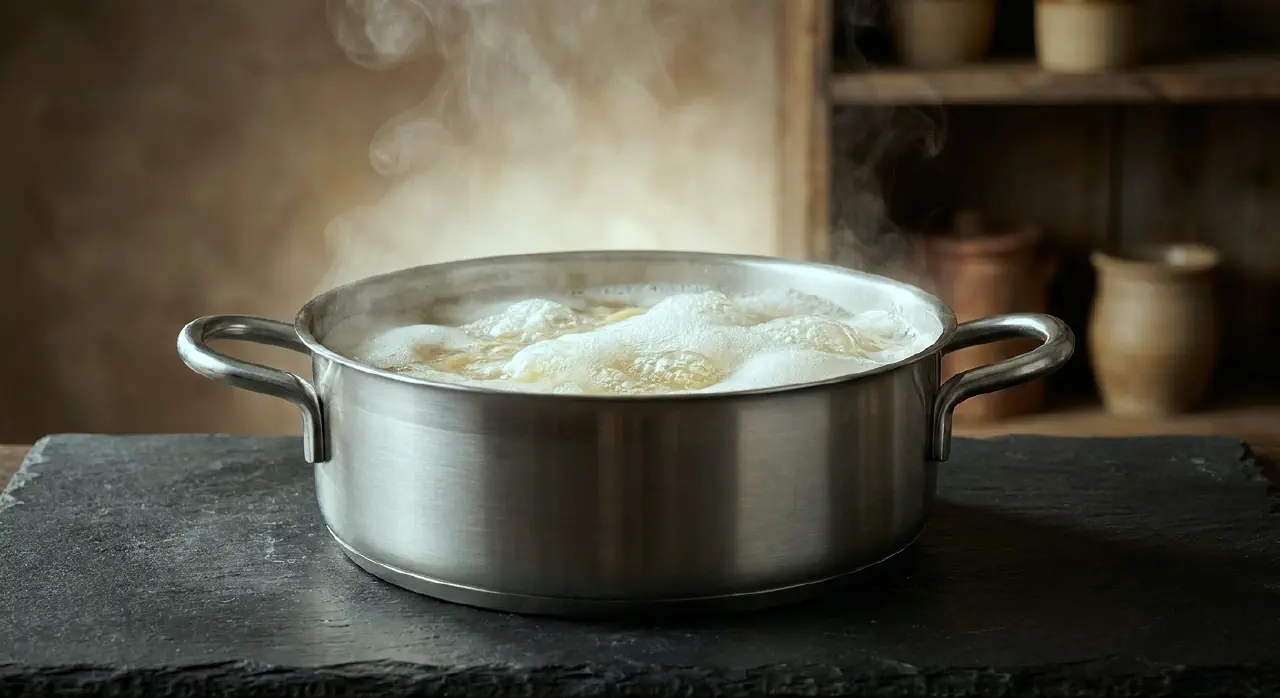
Boilover is not just an annoyance or a stove-cleaning catastrophe - it is a combined starch chemistry and temperature control problem. The foam is created by starch acting as a surfactant; the overflow is caused by binary on/off heating that dumps excess energy into violent steam production. Understanding both mechanisms reveals practical solutions.
The Foam Chemistry
When potatoes or pasta boil, starch granules swell and burst, releasing amylose and amylopectin into the water. These starch molecules create thin, flexible films around steam bubbles. In pure water, steam bubbles pop immediately at the surface. In starchy water, the films stabilize bubble structure - bubbles stack and trap additional bubbles, building a stable foam layer. This foam acts as an insulating lid, trapping steam underneath, which lifts the entire foam mat up and over the pot rim.
The more starch in the water, the more robust the foam. This is why pasta water foams more dramatically than potatoes water - pasta sheds more starch per unit volume.
The Binary Heating Problem
Traditional hobs are dumb on/off systems. At maximum power, once water hits 100°C it cannot rise higher - excess energy converts entirely into latent heat of vaporization, producing massive steam surges. This rapid steam inflates starch-stabilized bubbles explosively. The cook sees foam, panics, and drops to low power - now underpowered, boiling stops, foam collapses. Turn back up, overshoot again. This babysitting loop makes the cook the missing feedback sensor.
The hob has no way to know that the pot reached target temperature; it continues dumping full power into an already-boiling system, creating pressure waves instead of gentle boiling.
The Precision Solution
Soft landing into 100°C: monitor temperature continuously, throttle power as water approaches boiling. Once at 100°C, supply only maintenance power - enough for gentle boiling (continuous small bubbles), never enough for steam spikes. Target ~103°C at pot bottom (accounts for ~3°C side-loss gradient) to maintain ~100°C at surface. Foam may form but never inflates violently. Result: unattended, predictable boiling without panic or mess.
The key insight: the transition into boiling should be gradual, not abrupt. A precision temperature controller bridges the hob down as it approaches 100°C, maintaining a smooth curve instead of a cliff edge.
Foam Reduction Techniques
Traditional tricks that work:
- Oil on surface: A thin layer of oil breaks starch-based surface tension, causing foam to collapse. Works but imparts flavor; not ideal.
- Wooden spoon: Laying a wooden spoon across the rim disturbs foam as it rises. Works temporarily but requires attention.
- Lid: A lid traps steam and foam, preventing overflow. Works but traps heat, extending cooking time and creating pressure buildup.
The precision approach eliminates all three workarounds by preventing violent steam production entirely.
See also
water-science, starch-gelatinization, carbohydrate-overview, precision-cooking, precision-rice, cooking-temperatures, pasta-noodles