Chocolate Cooking
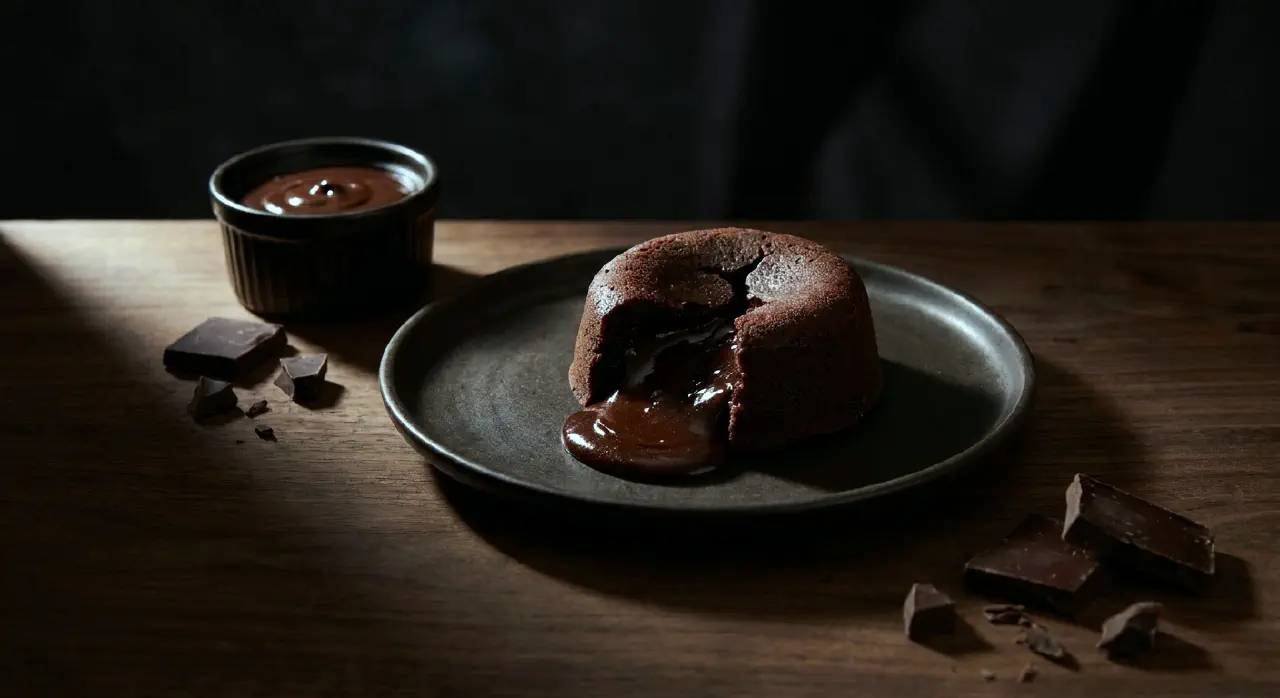
Working with chocolate in the kitchen means working with cocoa butter - a fat with unique crystalline properties that give well-made chocolate its snap, gloss, and smooth melt. Cocoa butter can solidify into six different crystal forms, only two of which produce the qualities we want. Tempering is the controlled thermal cycle that selects for the right crystals. Beyond tempering, chocolate’s behavior when melted, combined with liquids, or baked into batters follows from its dual nature as a fat-continuous suspension of solid particles.
Cocoa butter polymorphism
Cocoa butter’s fat molecules are remarkably uniform - mostly saturated, constructed from just three kinds of fatty acids. This regularity enables dense, compact crystal packing but also means the molecules can arrange themselves in six different crystalline patterns (polymorphs). The two stable forms produce the dense network of interlocking crystals responsible for chocolate’s desirable properties: silken surface, hardness at room temperature, clean snap when broken, and smooth melting at body temperature. The four unstable forms produce a looser network with more liquid fat between crystals - the chocolate feels greasy, soft, and mottled.
When chocolate melts and resolidifies without control (near a hot stove, in a warm car), unstable crystals predominate. This is bloom - the dull, grayish surface that signals disordered crystallization. The chocolate is still safe to eat but has lost its snap and gloss.
Tempering
Tempering is the kitchen version of the warming-cooling cycle used in chocolate manufacturing. Three steps:
1. Melt completely - Heat to ~115°F/46°C (dark) or ~105°F/40°C (milk/white). This destroys all existing crystals, bringing fat molecules into random motion.
2. Cool to seed - Lower to ~81°F/27°C (dark) or ~80°F/27°C (milk). Molecular motion slows enough for stable crystal seeds to form. Unstable crystals are prevented from forming because the temperature is still above their stability range.
3. Reheat to working temperature - Gently raise to ~89°F/32°C (dark) or ~84°F/29°C (milk). This melts any remaining unstable crystals while preserving the stable seeds formed during cooling. The chocolate is now fluid enough to work with but seeded with the right crystal type.
The seeding shortcut: Add ~10–20% finely chopped already-tempered chocolate to fully melted chocolate. The seed crystals encourage stable crystallization as the mixture cools naturally - less thermometer precision required.
Bloom
Two types of surface defect, both visually similar:
Fat bloom: Unstable cocoa butter crystals transform over time, and liquid fat migrates to the surface where it resolidifies as a gray film. Caused by temperature fluctuations during storage.
Sugar bloom: Moisture condenses on the chocolate surface, dissolves surface sugar, then evaporates - leaving rough sugar crystals behind. Caused by humidity.
Prevention: Store at 60–70°F/15–21°C, below 50% humidity, away from strong-smelling foods (chocolate absorbs odors readily).
Melting chocolate
Double boiler (safest): Chocolate in a bowl over gently simmering water (water not touching bowl). Slow, forgiving, suitable for any amount.
Microwave: Fast but requires 15–30 second bursts with stirring between. Chocolate may look solid when it’s already soft inside - watch carefully.
Direct heat: Risky. Very low heat, constant attention. Only for experienced hands and small amounts.
In all methods, minimize temperature and time - overheated chocolate loses volatile aroma compounds, becoming flat and sometimes bitter. More delicate single-origin chocolates suffer greater losses.
Seizing
The most common chocolate disaster. When a small amount of water contacts melted chocolate (steam, a wet spoon, condensation), sugar particles clump together into a grainy, lumpy mass. The physics: water causes the dry sugar and cocoa particles to bind together, pulling away from the cocoa butter phase.
Prevention: Keep everything dry.
Rescue: Counterintuitively, add more water - about 1 teaspoon per ounce of chocolate - and stir until smooth. Enough water turns the mixture into a pourable chocolate sauce rather than a lumpy mass. Alternatively, add neutral oil or butter in small increments.
Ganache
An emulsion of chocolate and cream - heat disperses cocoa particles and cocoa butter through the cream’s water phase, producing a smooth, unified system. The basic ratio is equal parts chocolate and cream by weight, adjustable for different uses: more chocolate for firm ganache (truffle centers, moldable), more cream for pourable ganache (sauces, glazes).
Truffles are ganache centers dipped in tempered chocolate or rolled in cocoa powder - the creamy interior contrasts with the crisp or powdery exterior.
Chocolate in baking
Forms: Melted chocolate (batter ingredient), chopped chocolate (varied melting rates and texture), cocoa powder (lean flavor without excess fat), chocolate chips (formulated to hold shape during baking).
Cocoa butter affects structure and moisture retention. Phenolic compounds provide antioxidant capacity. Bitterness and complexity add depth to sweet items - higher cacao percentages (50–90%+) intensify flavor but are less forgiving (bitterness more pronounced, can overpower).
White chocolate is technically not chocolate - it contains no cacao solids, only cocoa butter, milk solids, and sugar. It behaves differently during tempering (lower melting point) and has a vanilla-like rather than cacao character.
See also
- chocolate - cacao biology, fermentation, roasting, conching, flavor chemistry
- candy-making - chocolate as coating and confectionery ingredient
- emulsions - ganache as a chocolate-cream emulsion
- sugar-science - sugar’s role in chocolate formulation and bloom
- custards - chocolate custards, mousses
- temperature-switches - phase transitions driven by temperature