Chocolate
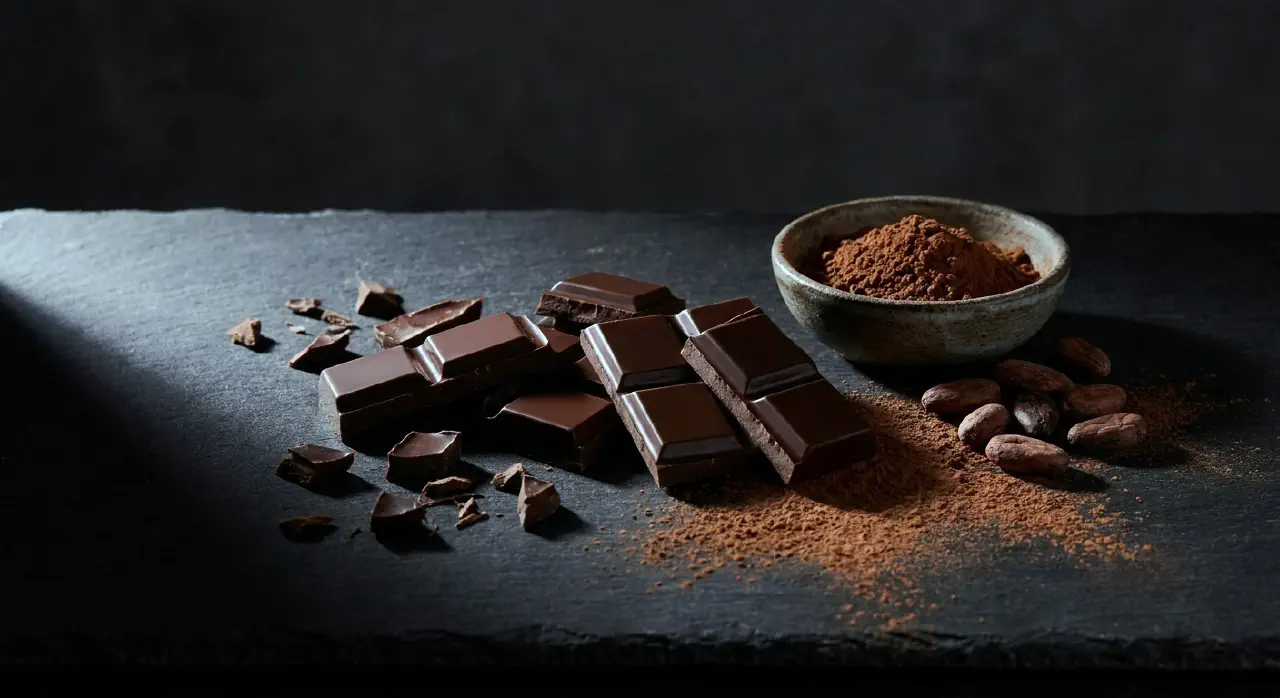
Chocolate is one of the most chemically complex foods - over 600 volatile aroma compounds, produced by an unusually elaborate chain of biological and thermal transformations. The cacao bean starts as a bland, astringent seed; three-phase fermentation converts it into a vessel of flavor precursors; gentle roasting develops those precursors through Maillard browning; and hours of conching aerates and mellows the result. At every stage, the wrong conditions destroy flavor that cannot be recovered.
The cacao bean
Theobroma cacao (“food of the gods”) is a broad-leaved evergreen growing within 20° of the equator. Its fibrous pods contain 20–40 seeds embedded in sweet-tart pulp. Fresh beans are ~65% water; dried fermented beans are ~54% cocoa butter (fat), 12% protein, 6% phenolics, 6% starch, with 1.2% theobromine and 0.2% caffeine as bitter alkaloids.
Three botanical groups supply the world crop: Criollos produce the mildest, most delicate beans (floral, tea-like) but are disease-prone and yield less than 5% of production. Forasteros are robust, high-yielding “bulk” beans providing most of the world’s cacao. Trinitarios are Criollo-Forastero hybrids with intermediate character.
Fermentation: the first flavor step
The least controlled and most critical stage. After harvest, workers break pods open and pile beans with their sugary pulp at ambient tropical temperature for 2–8 days. Three microbial phases proceed in succession:
Phase 1 - Yeast: Converts pulp sugars to alcohol, metabolizes some acids. Uses up trapped oxygen.
Phase 2 - Lactic acid bacteria: The same species found in fermented dairy and pickled vegetables succeed in the newly anaerobic environment.
Phase 3 - Acetic acid bacteria: When workers turn the mass (introducing air), vinegar-making bacteria succeed. They consume the yeast’s alcohol and produce acetic acid, which penetrates the beans, etches holes in cell walls, and spills storage proteins and sugars together.
The beans’ own digestive enzymes then break proteins into amino acids and sucrose into simple sugars - far more reactive flavor precursors than their parent molecules. Simultaneously, astringent phenolic compounds bind to proteins and oxygen, forming complexes that are much less astringent. The perforated beans also absorb fruity, floral, and winey notes from the fermenting pulp.
Result: Properly conducted fermentation transforms astringent but bland beans into vessels laden with desirable flavors and the chemical building blocks for hundreds more.
Roasting
Dried fermented beans are still unbalanced - dominated by vinegary acetic acid, with underdeveloped aroma. Roasting at 250–320°F/120–160°C for 30–60 minutes (whole beans) drives off volatile acids while Maillard browning between the abundance of free amino acids and sugars creates roasted, nutty, sweet, earthy, floral, and spicy notes (pyrazines, thiazoles, phenylalkanals). Importantly, cacao roasting is much gentler than coffee roasting - the reactive precursors are so abundant that intense heat destroys rather than creates complexity.
Grinding, refining, and conching
After roasting, cracked nibs (~55% cocoa butter) are ground between steel rollers into a thick dark fluid called cocoa liquor - cacao’s fat becomes the continuous phase with solid particles suspended in it. Refining brings particle size down to 0.02–0.03 mm, below the tongue’s detection threshold.
To make finished chocolate, manufacturers add sugar (dark chocolate), sugar and dried milk solids (milk chocolate), vanilla, and supplemental cocoa butter, then conch the mixture for 8–36 hours. Conching is extended agitation at 115–175°F/45–80°C that serves two purposes:
Texture: Breaks up particle aggregates, coats all solids evenly with cocoa butter, producing the smooth melt we expect.
Flavor mellowing: Aeration and moderate heat evaporate ~80% of volatile compounds - selectively removing harsh acids and aldehydes while augmenting desirable roasted, caramel, and malty notes (pyrazines, furaneol, maltol). Acidity steadily declines.
Toward the end of conching, additional cocoa butter and lecithin (an emulsifier that can replace 10 parts butter per 1 part lecithin) are added for fluidity.
Chocolate flavor
The richness comes from two factors: the bean’s intrinsic flavor potential (sugars, proteins, and enzymes creating reactive building blocks) and the complexity of the preparation (combining microbial chemical creativity with controlled heat).
Detectable notes span the full range: astringency and bitterness from phenolics and theobromine; fruity, winey, sherry notes from fermented pulp; almond, dairy, and floral notes from self-digested bean proteins; roasted, nutty, sweet, and spicy notes from Maillard browning; sweetness and warm spice from added sugar and vanilla; and caramel-butterscotch notes from added milk solids.
Cacao varieties and geography
West Africa (Ivory Coast, Ghana) produces over 50% of the world crop. Indonesia outproduces Brazil. Single-origin and single-estate chocolates parallel the terroir concept in wine - bean genetics, soil, climate, fermentation practice, and roasting all contribute to flavor differences. Swiss and German traditions grind smoother than English and American.
Cocoa powder and cocoa butter
Pressing cocoa liquor through a fine filter separates cocoa powder (the solids, ~10–12% residual fat) from cocoa butter (pure fat). Natural cocoa powder is slightly acidic (pH ~6); Dutch-process cocoa is treated with alkali for darker color, milder flavor, and higher pH (~7–8). Cocoa powder delivers rich chocolate flavor without the fat load of whole chocolate.
Cocoa butter, initially a byproduct, turned out to be the key to modern solid chocolate - its unique crystalline properties make tempering possible. See chocolate-cooking for the polymorphism and tempering science.
See also
- chocolate-cooking - tempering, ganache, bloom, melting, baking applications
- maillard-reaction - the browning reactions central to roasting and conching
- fermentation-overview - cacao’s three-phase fermentation parallels other microbial transformations
- sugar-science - sugar-amino acid reactions in chocolate; sweetness balance
- candy-making - chocolate as coating and ingredient in confectionery
- coffee - parallel roasting chemistry, though cacao is gentler
- temperature-switches - phase transitions driven by temperature