Custards
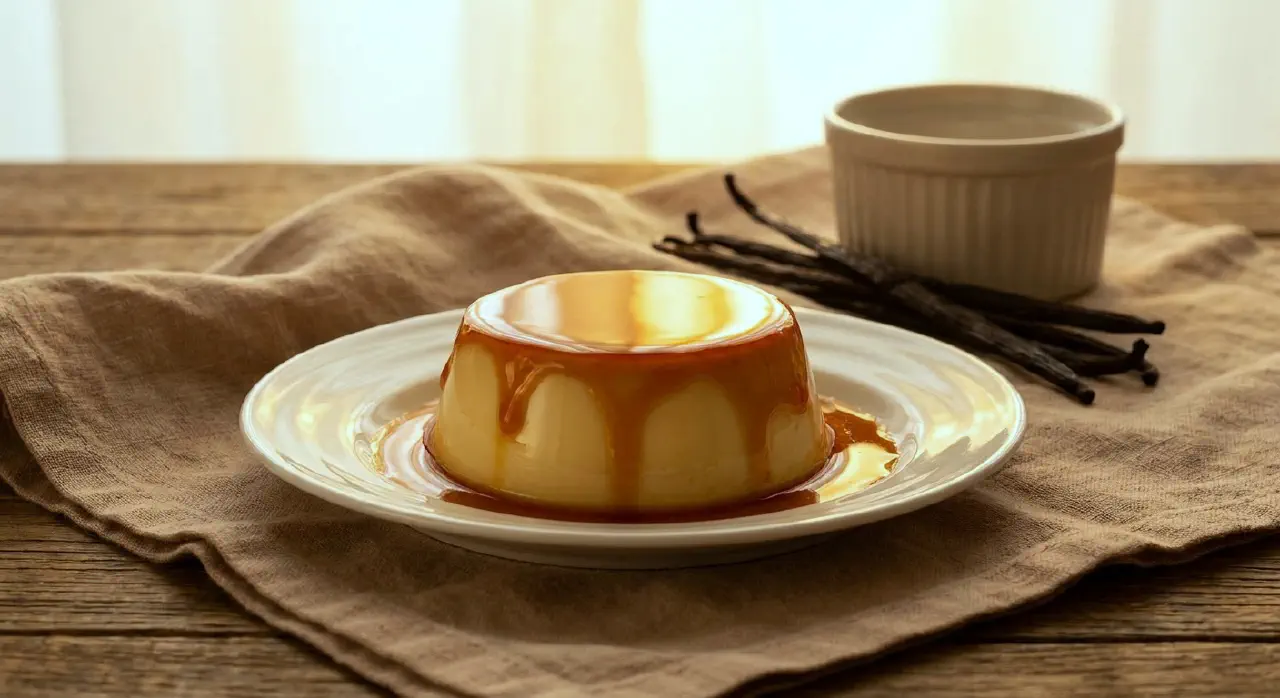
A custard is egg proteins diluted in milk or cream, cooked until the proteins form a delicate network that traps the liquid. The fundamental ratio - roughly 1 egg per 1 cup liquid plus 2 tablespoons sugar - produces a gel so fragile that a few degrees of overcooking can destroy it. Mastering custards means mastering temperature control.
The two families
All custards divide into two categories based on how they’re cooked:
Baked custards (crème caramel, crème brûlée, flan, quiche) cook in the oven, usually in a water bath. The egg proteins set into a self-supporting gel that holds its shape when unmolded or sliced. These use whole eggs or a mix of whole eggs and yolks.
Stirred creams (crème anglaise, pastry cream, fruit curds) cook on the stovetop with constant stirring. The cook stops heating just as the proteins thicken the liquid, producing a pourable or spoonable consistency rather than a set gel. These typically use yolks only, for richer flavor and smoother texture.
Why dilution changes everything
The baseline coagulation temperatures for eggs - ~160°F/70°C for yolk, ~180°F/80°C for ovalbumin - shift dramatically when the egg is diluted. In a standard custard mix (1 egg + 1 cup milk + 1 tablespoon sugar), the proteins must be hotter and moving faster to find each other across the vast volume of liquid. Thickening doesn’t begin until ~175–180°F/78–80°C instead of ~150°F/65°C.
This dilution also makes the gel far more delicate - the protein network is stretched thin across a huge volume of water. The margin between “barely set” and “curdled” may be only 5–10°F.
Sugar compounds the effect: each tablespoon surrounds egg proteins with thousands of sucrose molecules, raising the coagulation temperature further. Milk and sugar effects are additive.
Baked custards
The water bath
A water bath moderates oven heat by capping the custard’s environment at or below 212°F/100°C (the boiling point of water). But the actual temperature depends on pan material:
| Pan material | Bath temperature |
|---|---|
| Cast iron | ~195°F / 87°C |
| Glass | ~185°F / 83°C |
| Stainless steel | ~180°F / 80°C |
| Any material, foil-covered | 212°F / 100°C (full boil) |
The difference is evaporative cooling: an open water bath loses heat from its surface, keeping the temperature well below boiling. Covering with foil eliminates this cooling effect and defeats the purpose of the bath. Use a wire rack under the custard cups so water circulates freely - a towel on the bottom traps hot water and creates uneven heating.
Doneness
Remove baked custard when the center still jiggles sluggishly - it should move like gelatin, not slosh like liquid. Internal temperature at this point is ~175°F/79°C. Residual heat will carry the center to the proper set. Above ~180°F/82°C, the custard curdles.
Crème brûlée
Rich custard topped with a shattered caramel crust. The custard is baked, chilled thoroughly, then topped with sugar and caramelized with a torch. Chilling first is essential - it prevents the torch from overcooking the custard underneath. First known recipe: François Massialot, ca. 1692.
Crème caramel
Custard baked over a layer of liquid caramel. During baking, moisture from the custard softens the caramel into a sauce. Unmold while still warm (the caramel stiffens when cold). If refrigerated in the mold, a brief return to a warm water bath will soften the caramel enough to release.
Cheesecake
Technically a custard - eggs bind the filling. The filling (ricotta, cream cheese, sour cream, or combinations) is so rich that egg protein forms a secondary rather than primary structure. Uses ~1 egg per cup of filling and ~4 tablespoons sugar per cup (double the normal ratio, to balance dairy tartness).
The signature problem - cracking - happens because the batter expands during baking (from incorporated air and steam) then contracts during cooling. Prevention: beat gently to minimize air, bake slowly in a low oven, and cool gradually with the oven door ajar.
Quiche
Savory custard in a pastry shell, baked without a water bath (needs to be firm enough to slice into wedges). Uses ~2 whole eggs per cup of liquid - a higher ratio than sweet custards for structural strength. Salt replaces sugar.
Stirred creams
Crème anglaise
The foundational pourable custard sauce. Yolks, milk or cream, and sugar cooked on the stovetop with constant stirring to ~180°F/80°C - the point where it coats the back of a spoon. A double boiler is safest (slower but nearly impossible to curdle). Must be cooled with occasional stirring to prevent a solid gel from forming. Add fruit purées only after cooling - acidity and fiber cause curdling during cooking.
Pastry cream (crème pâtissière)
The thick, sliceable cream used to fill éclairs, tarts, and cakes. What distinguishes it from crème anglaise is the addition of starch (1–2 tablespoons flour or ~1 tablespoon cornstarch per cup of liquid), which allows it to set firmly.
The amylase problem: Egg yolks contain a heat-resistant starch-digesting enzyme (amylase) that survives normal custard cooking temperatures. If the pastry cream is not brought to a full boil, the amylase will digest the starch thickener over the next several hours, turning a firm cream into soup. This is the one custard where you must push through the curdling danger zone to a full boil and hold it for ~1 minute.
After boiling, minimize stirring during cooling - frequent agitation breaks the starch network and thins the cream. Once cool, pastry cream can be enriched with cream, butter, whipped cream, or egg white foam.
Fruit curds
Milk replaced by fruit juice - lemon curd is the most common. The acidity of the juice means starch thickeners can’t be used (acid inhibits starch gelatinization), so the texture comes entirely from egg protein and butter. Proportions are rich: ~4 eggs (or 8 yolks) + 1 cup sugar + ½ cup butter + ½ cup juice. Possibly descended from 17th-century French scrambled eggs with verjus or lemon juice.
Sabayon and zabaglione
Egg yolk foams thickened by gentle heat - covered in detail under egg-foams. These straddle the line between custard and foam: yolks whisked with sugar and liquid (usually wine) over a water bath to ~160°F/71°C. The heat partially coagulates the proteins while whisking incorporates air, producing a warm, mousse-like texture.
Preventing the skin
Any custard or cream exposed to air will form a tough surface skin as proteins concentrate through evaporation. Three options: dot the warm surface with butter (which melts and spreads into a protective fat layer), sprinkle with sugar (which dissolves into a concentrated syrup), or press waxed paper or buttered parchment directly onto the surface.
See also
- eggs - the protein science underlying all custards
- protein-denaturation - coagulation mechanics and temperature thresholds
- egg-foams - sabayons, soufflés, and the foam side of egg cookery
- cream - the enriching liquid in most custard bases
- starch-gelatinization - why starch-thickened custards must be boiled
- caramelization - the sugar chemistry in crème brûlée and crème caramel
- sauce-making - egg protein as one of six thickening strategies
- emulsion-sauces - hollandaise and béarnaise as hot egg emulsion sauces