Candy Making
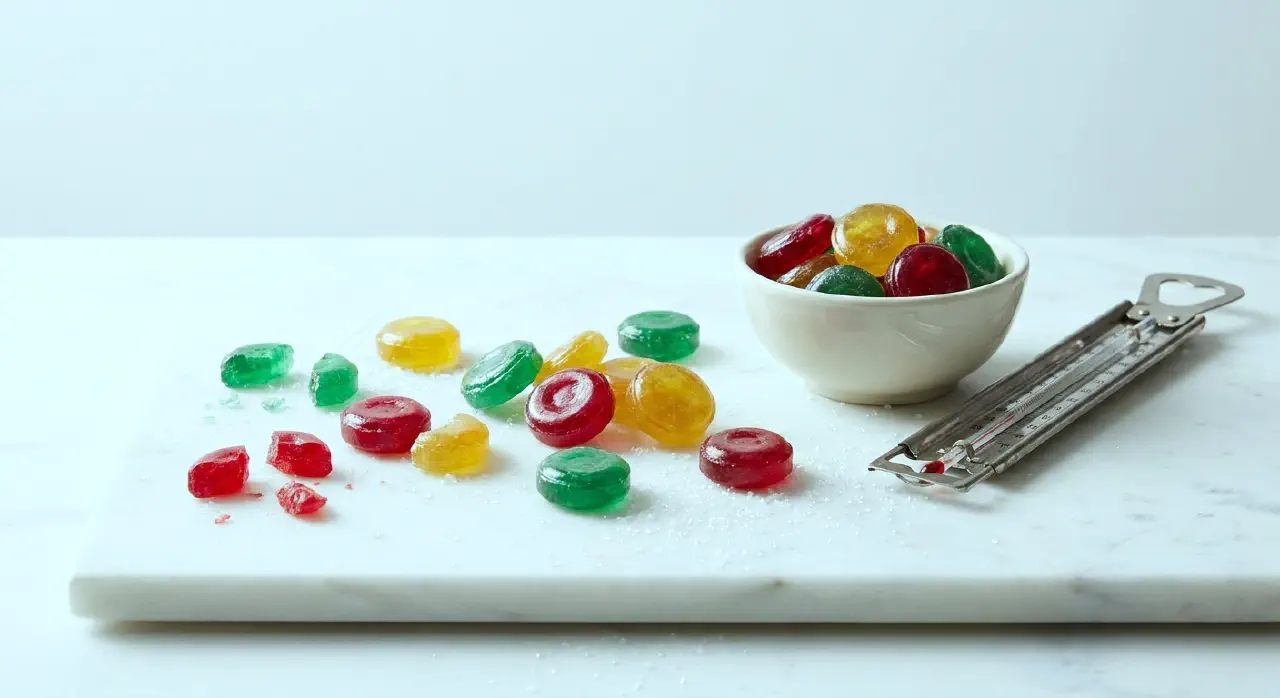
All sugar candies - brittle or creamy or chewy - are essentially mixtures of sugar and water. The astonishing range of textures comes from managing two variables: how concentrated the syrup gets (set by cooking temperature) and what the sugar molecules do as the syrup cools (crystallize into ordered solids, freeze into disordered glass, or get trapped in a matrix of protein, fat, or gel). Mastering confectionery means mastering crystallization science.
Temperature stages: setting concentration
Dissolved sugar elevates a solution’s boiling point - more sugar means a higher boiling point. This colligative property gives candy makers a built-in thermometer: the boiling temperature of a syrup precisely indicates its sugar concentration.
| Stage | Temperature | Sugar % | Texture when cool |
|---|---|---|---|
| Thread | 230°F / 110°C | ~80% | Thin threads |
| Soft ball | 235°F / 113°C | ~85% | Fudge, fondant |
| Firm ball | 245°F / 118°C | ~87% | Caramels |
| Hard ball | 270°F / 132°C | ~90% | Taffy, nougat |
| Soft crack | 290°F / 143°C | ~95% | Butterscotch |
| Hard crack | 300°F / 149°C | ~99% | Brittles, hard candy |
The classic cold-water test - dropping hot syrup into cold water and judging its behavior - has been used for 400 years as a tactile alternative to the thermometer.
Crystal control: the texture divide
Crystalline candies (fondant, fudge)
When a concentrated syrup cools, sugar molecules can organize into crystals. The goal for fondant and fudge is many tiny crystals that dissolve to creaminess on the tongue. Two rules govern crystal size:
Cool before stirring. Hot syrups produce coarse crystals - fast-moving molecules reach crystal surfaces quickly, and the few crystal seeds that form grow large. Cooling syrup from 235°F down to ~110°F/43°C before initiating crystallization produces many more seeds and smaller average crystal size.
Stir continuously. Agitation pushes molecules together, favoring seed formation. More seeds competing for free sugar molecules means smaller crystals. The “wear your arm out” dictum for fudge is real physics. If stirring stops, existing crystals grow larger - the candy becomes coarse and grainy.
Fondant is the pure expression: sucrose syrup with corn syrup (as an interfering agent), cooled and beaten to fine-crystal creaminess. It’s the base for candy “creams,” filled chocolates, and cake icing. Fudge is fondant with added milk, fat, and sometimes chocolate. Penuche uses brown sugar.
Noncrystalline candies (sugar glass, caramels)
When syrup is cooked to very high concentration (99%+ sugar, only 1–2% moisture) and cooled rapidly, molecules stop moving before they can organize into crystals. They freeze in place as a disordered “glass” - transparent, brittle, and hard. This is the physics of hard candy, lollipops, and butterscotch. Sugar glass is transparent for the same reason window glass is: individual molecules are too small and randomly arranged to deflect light.
Caramels, toffees, and taffies are noncrystalline candies containing milk fat and milk solids. Their chewiness comes from lower cooking temperatures (higher moisture), large corn syrup proportions, and casein proteins that thicken the candy. The hierarchy is: caramels (softest, lowest cooking temp, most moisture) → toffees (firmer, cooked ~50°F hotter, less butter) → taffies (firmest, sometimes no milk solids, often pulled for aeration). Characteristic flavor comes from both caramelization and Maillard reactions between sugars and milk proteins. Baking soda is often added - it favors browning (alkaline conditions) and its CO₂ creates a lighter, less dense texture.
Brittles are hard candies with butter, milk solids, and nut pieces - opaque and brown from extensive Maillard reactions.
Interfering agents
Controlling pure sucrose crystallization is difficult. Confectioners add ingredients that interfere with crystal formation:
Invert sugar (glucose + fructose from breaking sucrose with acid): These molecules temporarily bond to crystal surfaces, blocking sucrose access. honey is a natural invert sugar source. Cream of tartar added to boiling syrup converts some sucrose to invert sugar in situ.
Corn syrup: The master interfering agent. Its long glucose chains tangle together, physically impeding sugar and water molecule motion. Glucose and maltose molecules also interfere chemically like invert sugar. Corn syrup additionally provides body, chewiness, and reduced sweetness.
Milk proteins and fat: Casein thickens and adds chewy body; whey proteins contribute to browning; butterfat adds smoothness and reduces teeth-sticking. Milk proteins curdle in acid conditions - candies with milk solids are sometimes neutralized with baking soda.
Aerated candies
Light, chewy textures come from combining sugar syrup with a stable foam:
Marshmallows: Originally made from marsh mallow root juice; modern versions combine gelatin (2–3% of mixture) with sugar syrup concentrated to caramel stage, then whip vigorously. Gelatin molecules collect in bubble walls, producing an elastic texture. Egg-white versions are lighter and softer.
Nougat: A cross between meringue and candy - hot concentrated syrup streamed into beaten egg whites, often with honey and nuts. Soft or hard depending on syrup concentration and proportions.
Paste and gel candies
Marzipan: Ground almonds, sugar, and sometimes egg white - a smooth, moldable paste. The name may derive from Martaban (Myanmar), a medieval spice-trading port.
Turkish delight (lokum): Sugar syrup thickened with ~4% starch into a translucent, firm gel, traditionally flavored with rose essence. One of the oldest chewy candies, made in the Middle East for centuries.
Gummy candies: Sugar syrup set with gelatin (tough, elastic chew), pectin (tender gel), agar (firm, less elastic - used in Asian confections at concentrations as low as 0.1%), or combinations.
Licorice: ~30% wheat flour, ~60% molasses, ~5% licorice root extract - dense, opaque, strong-flavored. Scandinavian tradition pairs it with ammonia (salmiak).
Sugar work
The most spectacular confectionery exploits sugar’s resemblance to mineral glass. Molten sucrose mixed with large proportions of glucose and fructose (preventing crystallization) is heated to 315–330°F until practically no water remains, cooled to ~130°F (pliable, doughy), then sculpted, blown like glass, or pulled into satin-like ropes of partly crystalline threads separated by air columns. Sugar work dates back at least 500 years - pre-1600 China produced “nests of silken threads” from malt syrup for the Imperial household.
Panned candies
The modern version of medieval dragées: flavorful centers (nuts, spices, jelly) rolled in a pan and repeatedly coated. Hard panning sprays concentrated sucrose syrup that evaporates to interlocking crystal layers 0.01–0.02 mm thick. Soft panning (jellybean method) uses glucose syrup and powdered sugar - thicker, less crystalline layers.
See also
- sugar-science - the chemistry of crystallization, caramelization, and sugar types
- caramelization - thermal decomposition of sugars into flavor and color
- maillard-reaction - sugar-protein browning in caramels, toffees, brittles
- chocolate-cooking - chocolate coating, tempering, truffles
- honey - natural interfering agent and traditional candy ingredient
- syrups - corn syrup as the master crystallization inhibitor
- egg-foams - meringue as the base for nougat and aerated candies
- gelatin-gels - gelatin in marshmallows and gummy candies