Sugar Science
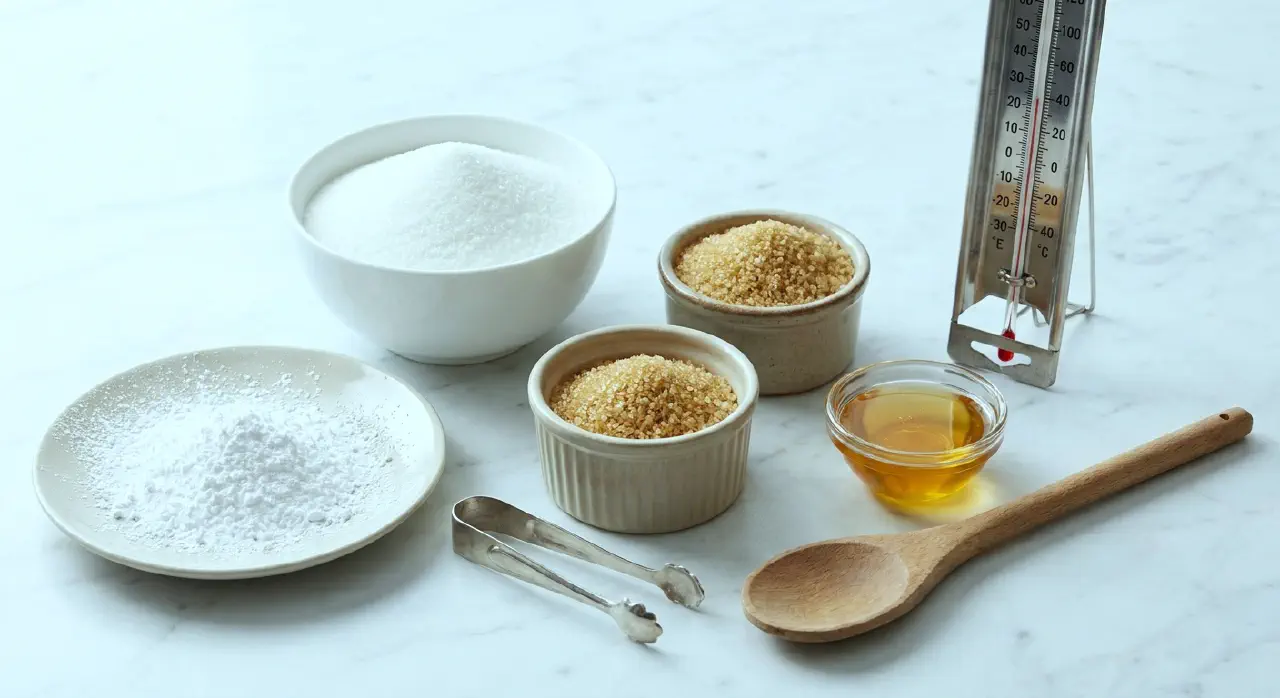
Sugars are small carbohydrate molecules - chains and rings of carbon, hydrogen, and oxygen - that serve as energy currency in both plants and animals. In the kitchen, their value goes far beyond sweetness: sugars bind moisture, depress freezing points, feed fermentation, brown into hundreds of flavor compounds through caramelization and the maillard-reaction, and crystallize into the rigid structures of confectionery. Understanding which sugar does what - and why - is the key to controlling texture, color, and flavor across baking, preserving, and candy work.
The three kitchen sugars
Sucrose (table sugar)
The workhorse. A composite molecule - one glucose bonded to one fructose - extracted from sugarcane or sugar beet. Sucrose occupies the sweet spot (literally) of culinary properties: second sweetest after fructose, second most soluble, produces the greatest viscosity in solution, and alone among sugars tastes pleasant at the very high concentrations found in candies and preserves. Melts at ~320°F/160°C; caramelizes at ~340°F/170°C.
Glucose (dextrose)
The universal energy molecule. Every cell burns glucose directly. It is the building block of starch and the sugar that most concerns diabetics. Less sweet than sucrose (sweetness index ~70), less soluble, and produces thinner solutions. Caramelizes at ~300°F/150°C. The primary sugar in corn syrup.
Fructose (levulose)
The outlier. Chemically identical to glucose in formula but different in molecular shape - and those shapes shift in solution, producing dramatically different behavior. Fructose is the sweetest common sugar (index ~120), the most soluble (4 parts dissolve in 1 part room-temp water), the most hygroscopic, and caramelizes at the lowest temperature (~220°F/105°C). Most remarkably, its sweetness is temperature-dependent: at 140°F/60°C, apparent sweetness drops by nearly half as the molecule shifts to a less receptor-active shape. This means fructose delivers more sweetness per calorie in cold drinks but equals sucrose in hot coffee.
Sweetness perception
Sweetness is not a simple on/off signal. Different sugars register differently on the tongue:
Sucrose takes time to detect but lingers. Fructose registers quickly and strongly but fades fast - its rapid onset enhances perceived fruitiness, tartness, and spiciness by preventing residual sweetness from masking other flavors. Corn syrup is slow to taste sweet, peaks at about half sucrose’s intensity, and lingers longest. These temporal profiles explain why candy makers blend sugars: each contributes a different dimension to the sweetness curve.
Sweetness also masks sourness and bitterness and enhances the perception of food aromas - the brain treats sweetness as a signal that food is a good energy source, making us more attentive to its other qualities.
| Sugar | Sweetness index | Caramelization temp |
|---|---|---|
| Fructose | 120 | ~220°F / 105°C |
| Sucrose | 100 | ~340°F / 170°C |
| Glucose | 70 | ~300°F / 150°C |
| Maltose | 45 | - |
| Lactose | 40 | - |
Inversion
Heating sucrose with acid (cream of tartar, lemon juice) or treating it with the enzyme invertase breaks the glucose-fructose bond, producing invert sugar - a mixture of ~75% glucose and fructose with ~25% residual sucrose. Invert sugar exists only as syrup because the mixed sugars interfere with each other’s crystallization. This property makes inversion central to candy-making: invert sugar prevents the grainy texture of uncontrolled sucrose crystallization. honey is nature’s invert sugar - bees’ enzymes convert nectar’s sucrose almost entirely to glucose and fructose.
Crystallization
Unlike proteins (easily denatured) or fats (prone to rancidity), pure sugar molecules are remarkably robust - they survive boiling and high heat intact. When sufficiently concentrated in water, they readily bond to each other and collect into solid crystalline masses. This crystallization is how pure sugar is refined from plant juices and how most candies are made.
Two factors control crystal character: temperature at crystallization onset (hot syrups = fewer, larger crystals; cool syrups = many tiny crystals) and agitation (stirring pushes molecules together, seeding more crystals, producing finer texture). These two variables explain the difference between grainy rock candy and silky fondant - see candy-making for the full crystallization framework.
Caramelization revisited
caramelization is sugar’s thermal decomposition - molecules heated past their tolerance break apart, then recombine into hundreds of new compounds. From a single colorless, odorless, sweet molecule, the cook generates sour fragments, bitter fragments, intensely aromatic fragments (buttery diacetyl, fruity esters, rum-like lactones), and large brown aggregates with no flavor but deep color.
Sucrose actually breaks into glucose and fructose before fragmenting further. Glucose and fructose are “reducing sugars” - their reactive atoms donate electrons to other molecules - which is why they caramelize at lower temperatures than the less-reactive sucrose. When proteins or amino acids are present (milk, cream, butter), Maillard browning occurs alongside true caramelization, producing a richer, more complex aroma than either reaction alone.
Sugar alcohols and substitutes
Sugar alcohols (polyols) - sorbitol, xylitol, mannitol - are carbohydrates that provide bulk similar to sugar but with slower glucose absorption, fewer calories, and no contribution to tooth decay (mouth bacteria can’t metabolize them). Xylitol matches sucrose’s sweetness; sorbitol reaches ~60%. All produce a cooling sensation on the tongue and can cause digestive effects in large amounts.
High-intensity sweeteners (saccharin, aspartame, sucralose, stevia, monk fruit) are hundreds of times sweeter than sucrose and used in tiny quantities. They provide sweetness without calories but lack sugar’s bulk, moisture-binding, and browning abilities - which is why sugar-free baking requires combining a high-intensity sweetener with a polyol or other bulking agent.
See also
- caramelization - the thermal decomposition of sugars into flavor and color
- maillard-reaction - sugar + protein browning, complementary to caramelization
- candy-making - crystallization control as the foundation of confectionery
- honey - natural invert sugar, the original sweetener
- syrups - maple, corn, molasses, malt, and other sugar syrups
- chocolate - cacao fermentation and roasting depend on sugar-amino acid reactions
- ice-cream - sugar depresses freezing point and controls ice crystal size
- starch-gelatinization - starch as glucose polymer; retrogradation
- carbohydrate-overview - sugars in the carbohydrate hierarchy; oligosaccharides, polysaccharides
- temperature-switches - phase transitions driven by temperature