Condiments
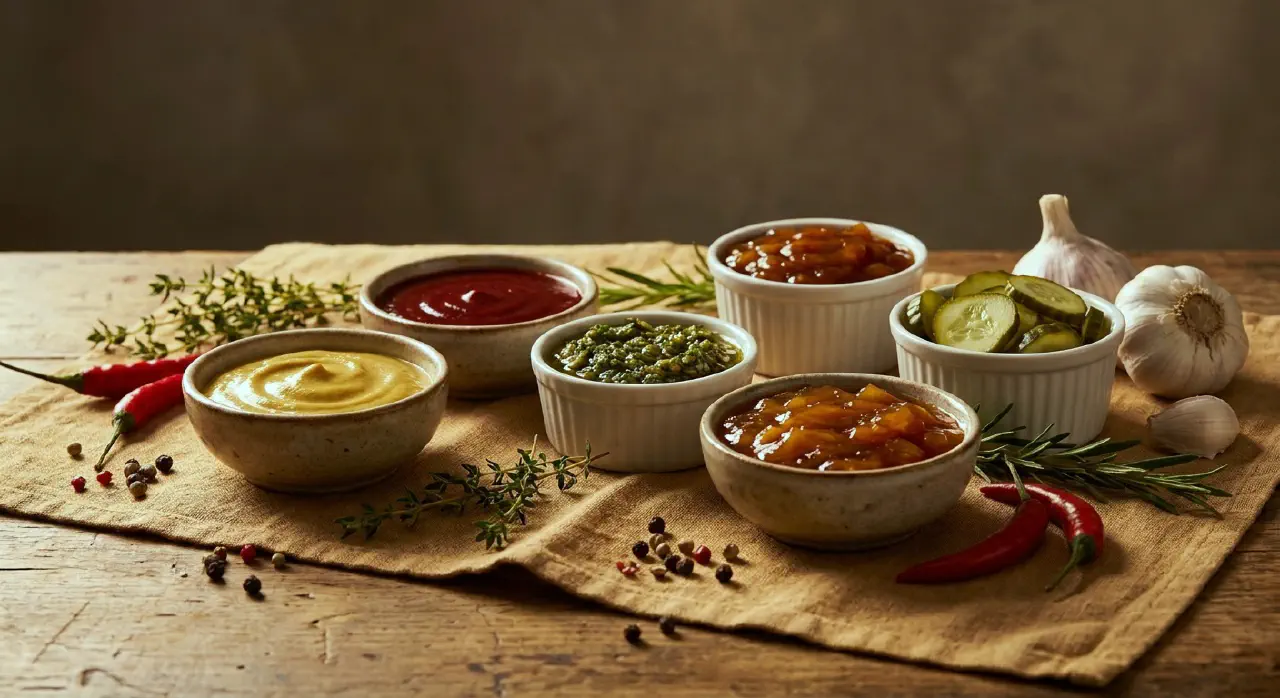
Condiments are the sauces that come to the table rather than the stove - flavor concentrates meant to contrast, brighten, or deepen the food they accompany. They divide broadly into fresh preparations (salsas, pesto, vinaigrettes) and fermented or preserved preparations (mustard, ketchup, soy sauce, fish sauce, vinegar, chutneys). The fermented condiments represent some of the oldest food technologies: salt and time converting perishable ingredients into shelf-stable, intensely flavored liquids.
Fresh sauces
Salsas
Salsa (Spanish for “sauce”) in its simplest form is raw diced tomatoes, onion, cilantro, fresh chiles, and lime juice - bright, pungent, tart. The flavor depends on balancing acidity (lime), pungency (chiles), and aromatics (cilantro, which is polarizing - some palates register it as soapy). Let the mixture sit 15–30 minutes for flavors to meld before adjusting the balance. Fruit salsas (pineapple, mango) shift the balance toward sweetness.
Pesto
Pesto Genovese - basil, garlic, pine nuts, olive oil, Parmesan - descends from ancient Roman preparations of pounded herbs, cheese, and oil. The preparation method matters for texture and flavor:
Mortar and pestle: Grinding and pounding produces a relatively coarse texture with the freshest basil flavor (minimal cell rupture means less oxidation). This is the traditional method.
Blender: More intense shearing action, medium texture, slightly more evolved flavor from greater cell breakage.
Food processor: Fastest, slicing rather than crushing, variable results depending on speed and duration.
Oxidation is pesto’s enemy - broken basil cells darken rapidly. Serve immediately, or preserve by chilling, blanching basil before processing (deactivates oxidizing enzymes), adding lemon juice (acid inhibits oxidation), or freezing in portions.
Fermented condiments
Vinegar
Acetic acid bacteria oxidize ethanol to acetic acid - vinegar is the controlled spoilage of alcohol. The source determines character: wine vinegar carries wine aromatics, rice vinegar is mild and slightly sweet, malt vinegar is grainy and robust. Typical strength is 3–7% acetic acid. Beyond its role as a condiment, vinegar is a fundamental preserving agent (pickling) and the acid component in vinaigrettes.
Mustard
Ground mustard seeds mixed with liquid (vinegar, wine, water) release pungent sulfur compounds - the same isothiocyanate chemistry found in horseradish, wasabi, and cruciferous vegetables. Regional traditions produce very different results: mild American yellow mustard, sharper French Dijon, textured whole-grain mustards. Mustard also functions as an emulsifier - a dab stabilizes vinaigrettes because mustard seed compounds act as surfactants at the oil-water interface (see emulsions).
Soy sauce
Soybeans and wheat fermented with salt and molds over months - one of the oldest and most complex fermented foods. Fermentation breaks proteins into free amino acids (particularly glutamate), generating intense umami. Soy sauce is simultaneously a seasoning, a cooking liquid, a marinade base, and a dipping sauce. Its salt content (typically 14–18%) makes it shelf-stable at room temperature.
Fish sauce
Small fish heavily salted and fermented - enzymes break down proteins into a concentrated umami liquid with a powerful, polarizing aroma. Ancient Roman garum was used in virtually every sauce; modern fish sauce (Vietnamese nuoc mam, Thai nam pla) plays the same foundational role in Southeast Asian cooking. Used in small quantities, fish sauce adds savory depth without tasting of fish.
Ketchup
Modern tomato ketchup descends from Asian fish sauces - the word “ketchup” likely derives from a Chinese or Malay term for fermented fish condiment. British cooks adapted the concept with local ingredients (mushrooms, anchovies, walnuts), and the tomato version emerged in 19th-century America. Today’s ketchup balances sweetness (sugar dominates), tartness (vinegar), and umami (tomato glutamate), seasoned with allspice, cloves, and cinnamon.
Chutneys
Indian-origin preserves combining fruits, vegetables, spices, and often sugar - cooked or uncooked. The best chutneys balance sweet, sour, spicy, and aromatic elements. Mango chutney (sweet, spiced), tamarind chutney (sour, complex), and coconut chutney (creamy, subtle) represent the range.
Preservation science
Three agents preserve condiments while simultaneously building flavor:
Salt creates an osmotic environment hostile to spoilage bacteria while allowing salt-tolerant, flavor-producing microbes to thrive. Salt also enhances the perception of other flavors and suppresses bitterness.
Acid (from vinegar or fermentation) inhibits spoilage organisms and provides the bright, tart quality that makes condiments refreshing against rich food.
Sugar inhibits microbial growth through the same osmotic mechanism as salt, and contributes sweetness that balances tartness and salinity.
Two philosophies
English condiment tradition, shaped by East India Company imports, favors bold contrast - Worcestershire sauce, strong mustards, sharp pickles, all designed to stand out against the main dish. The French tradition favors subtle enhancement - sauces that extend and concentrate the flavor of the primary ingredient rather than competing with it. Most modern kitchens mix both approaches freely.
See also
- sauce-making - the broader thickening and flavor taxonomy
- emulsion-sauces - vinaigrettes, mayonnaise, and other emulsified cold sauces
- fermentation-overview - the microbiology behind vinegar, soy sauce, fish sauce
- emulsions - mustard as an emulsifier in vinaigrettes
- flavor-chemistry - pungency science (mustard, horseradish, chiles)
- vinegar - acetic fermentation, production methods, balsamic, sherry vinegar