Culinary Herbs
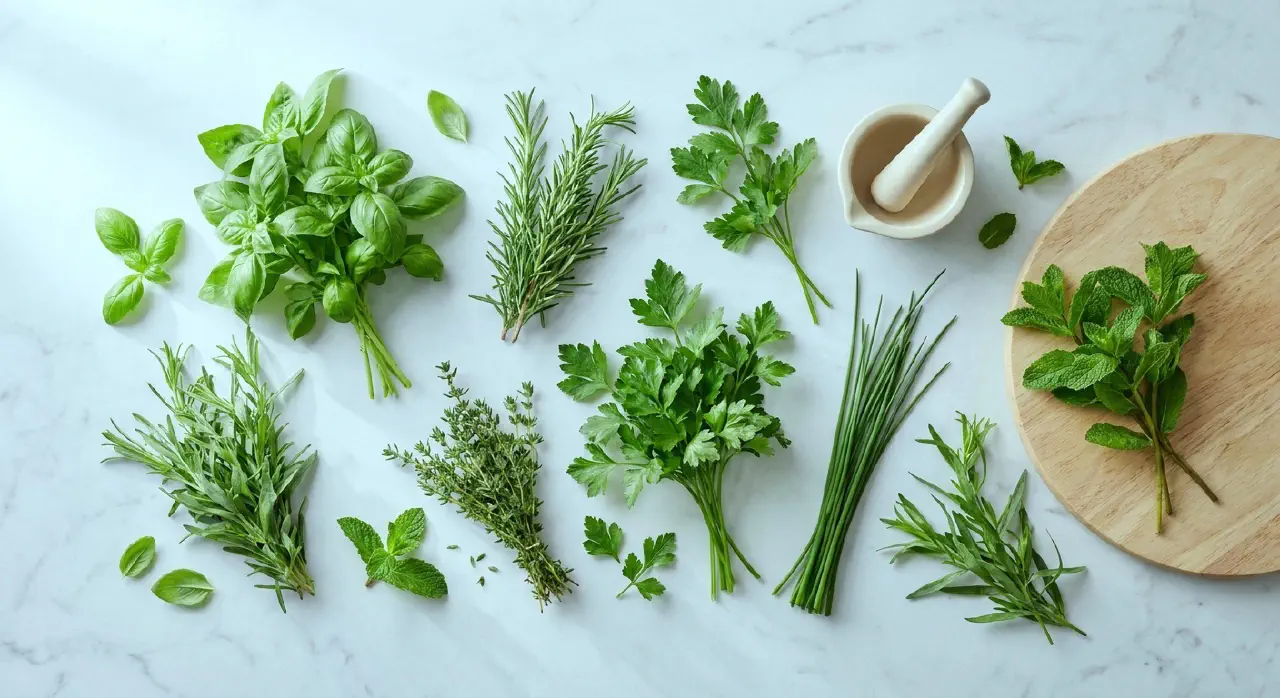
Herbs are the leafy, aromatic parts of plants used in small quantities to flavor food. Nearly all are chemical defense systems - volatile compounds stored in specialized glands or oil canals that deter insects and microbes. Three plant families dominate the kitchen herb world: the mint family (Mediterranean shrubs with surface oil glands), the carrot family (gentler plants with oil canals inside leaves), and the laurel family (ancient tropical trees). Understanding the family relationships explains flavor affinities and substitution logic.
The mint family (Lamiaceae)
The richest source of kitchen herbs - ~180 genera of Mediterranean shrubs with vigorous chemical defense in tiny glands on leaf surfaces (up to 10% of leaf weight in some species). Members readily hybridize and vary chemically, which is why “oregano” can taste completely different depending on source.
Basil (Ocimum basilicum): Tropical African genus domesticated in India. Sweet basil is the main European type, but flavor varies enormously - lemon, lime, cinnamon, anise, camphor varieties exist. Pesto genovese basil has a distinctive clove-like eugenol character (no tarragon note). Thai basil is anise-camphor dominant; holy basil is eugenol-dominated. Young leaves contain 5× more aromatics than old. Chilling-sensitive - store at room temperature with stems in water, not in the refrigerator.
Oregano (Origanum, ~40 species): “Joy of mountains” - Mediterranean rocky habitats. The penetrating quality comes from phenolic carvacrol; Greek oreganos are richest in it. Milder Italian/Turkish/Spanish types have more thymol and fresh terpenes. Mexican oregano is a different plant entirely (Lippia, verbena family) with 3–4× the essential oil of true oregano.
Thyme (Thymus, 60–70 species): Distinguished by phenolic thymol - penetrating but kinder than carvacrol, making thyme more versatile than oregano. French cooking favors it for meat and vegetable dishes. Varieties exist with lemon, mint, caraway, and nutmeg character.
Rosemary (Rosmarinus officinalis): Distinctive woody shrub with needle-like leaves. Composite scent of woody, pine, floral, eucalyptus, and clove notes. Flavor well-preserved by drying - one of the few herbs that dries successfully.
Sage (Salvia, ~1,000 species): Common/Dalmatian sage has penetrating warmth from thujone (toxic to the nervous system - use only as occasional flavoring, never in concentrated daily doses). Clary sage is completely different: tea-like, floral, sweet. Prominent in northern Italian cooking, North American poultry stuffing, and pork sausage. Affinity for fat. “Rubbed” sage (minimally ground) retains aroma longer than finely ground.
Mints (Mentha, ~25 species, 600+ varieties): Spearmint has rich, complex L-carvone character with roasted-food pyridines - used in large quantities across the Eastern Mediterranean, India, and Southeast Asia. Peppermint is simpler and clearer, defined by menthol, which uniquely binds temperature-sensing nerves to signal 7–13°F cooler than actual. Menthol is reactive and degenerates when heated - use raw only. Hot, dry growing conditions convert menthol to non-cooling pulegone.
Other mint-family herbs: Marjoram (milder oregano sister - fresh, green, floral), savory (oregano + thyme blend), lavender (tenacious floral-woody perfume, herbes de Provence), lemon balm (citrusy terpenes), perilla/shiso (fatty-herbaceous-spicy perillaldehyde, Japanese cuisine).
The carrot family (Apiaceae)
Fewer herbs than the mint family but remarkable - some provide aroma as both herb (leaves) and spice (seeds), some are eaten as vegetables. Gentler terpene flavors, aromatic compounds stored in oil canals within leaves under the veins. The shared warm terpene myristicin appears in dill, parsley, fennel, and carrots.
Parsley (Petroselinum crispum): One of the most important European herbs. Distinctive menthatriene note plus fresh/green/woody background that complements many foods generically. Chopping causes the distinctive note to fade while green and faintly fruity character develops. Flat-leaf varieties have stronger parsley flavor when young.
Cilantro/Coriander leaf (Coriandrum sativum): The most widely consumed fresh herb globally. Main aroma is fatty aldehyde decenal (also in orange peel “waxy” note) - very reactive, loses aroma when heated. Use as garnish or uncooked. Often called “soapy” in Mediterranean/European cultures. Thai coriander root (no decenal, woody/green like parsley) goes into spice pastes. The dried seed is an entirely different flavor - see aromatic-seeds.
Dill (Anethum graveolens): Distinctive “dill ether” blended with green/fresh notes. Western cooking pairs it with fish; Greek and Asian cuisines use it in large quantities like a vegetable with rice.
Fennel (Foeniculum vulgare): Three forms - wild (sharp, for meat/fish), cultivated sweet (high in anethole, characteristic anise aroma), and Florence (bulb vegetable). Sprouts have little anethole, unlike the mature plant.
Other carrot-family herbs: Chervil (delicate estragole, component of fines herbes - best raw), angelica (sweet lactone, candied stems, gins), celery (phthalide character, mirepoix base), lovage (celery + oregano + floral), mitsuba/Japanese parsley (woody-resinous terpenes).
The laurel family (Lauraceae)
Ancient tropical trees. Bay laurel (Laurus nobilis): Mediterranean evergreen with well-rounded woody, floral, eucalyptus, clove notes in spherical glands. Dried in shade; the standard savory herb for long-cooked dishes. California bay (Umbellularia californica) is a different tree with much stronger eucalyptus-dominant character. Sassafras/filé (Sassafras albidum): leaves ground into filé powder for thickening Louisiana gumbo.
Other notable herbs
Tarragon (Artemisia dracunculus, lettuce family): French tarragon defined by phenolic estragole (chemical relative of anethole), giving anise-like character. Component of fines herbes; béarnaise sauce’s primary flavoring. Russian tarragon is harsh and uninteresting.
Lemongrass (Cymbopogon citratus, grass family): Thick shoots with lemony citral + flowery geraniol/linalool. Thai standard in pounded spice pastes; lower stalk tender and edible.
Pandan/screwpine (Pandanus species): Indonesian origin. Primary volatile is 2-acetyl-1-pyrroline - the same molecule responsible for the nutty aroma of basmati/jasmine rice and popcorn.
Capers (Capparis spinosa): Distantly related to the cabbage-family; raw buds have radish/onion pungent sulfur notes. Dry-salting triggers a remarkable transformation: radish/onion displaced by violet and raspberry aroma (ionone, raspberry ketone).
Juniper berries: Tiny cone-like structures of Juniperus species. Mature berries have pine, green-fresh, citrus terpenes. Aroma largely gone after 2 years storage. Gin’s distinguishing and name-giving flavor (Dutch genever).
Makrut/kaffir lime: See citrus. Leaves intensely fresh and lingering (citronellal), distinct from the sweeter citral in lemongrass.
See also
- flavor-chemistry - terpenes vs phenolics, essential oil chemistry, volatility
- aromatic-seeds - the seed/spice forms of many herbs listed here (coriander, dill, fennel, celery)
- spice-handling - storage, drying, extraction methods for fresh and dried herbs
- cabbage-family - isothiocyanate pungency shared with capers, nasturtium
- alliums - sulfur-compound pungency in a different plant family
- citrus - lemongrass/makrut lime as citrus-flavored non-citrus herbs