Alliums
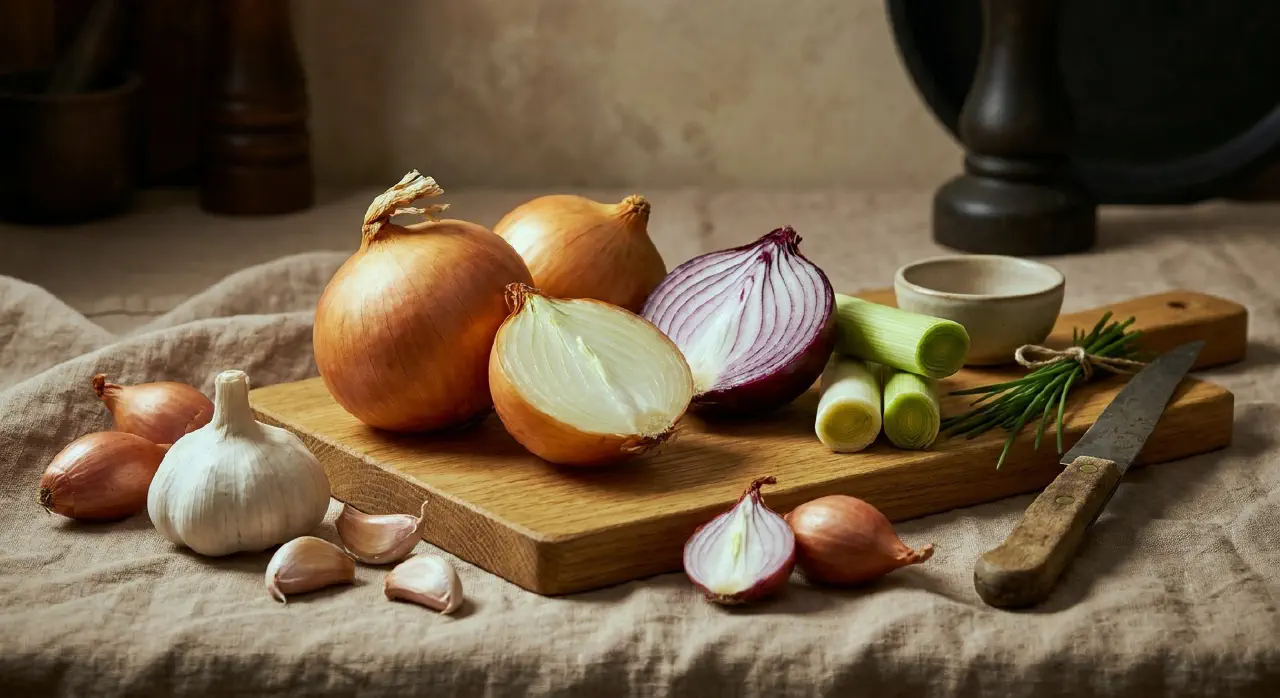
About 500 species in the genus Allium (lily family), native to northern temperate regions, with ~20 important food species and a 3,000+ year culinary history. The allium family is the aromatic backbone of most savory cooking worldwide, defined by sulfur chemistry that makes them pungent raw and sweet when cooked. All alliums store energy as fructose chains (not starch), which is why long slow cooking breaks them down to produce marked sweetness.
The sulfur defense system
Allium cells store four different kinds of sulfur ammunition in cell fluids, with the trigger enzyme (alliinase) held separately in storage vacuoles. Cell damage - cutting, crushing, chewing - releases the enzyme, which breaks the ammunition molecules into irritating, strong-smelling sulfurous compounds. The specific mixture depends on the ammunition type (different for each species), the extent of tissue damage, oxygen availability, and reaction duration.
In onions: The lachrymatory factor (syn-propanethial-S-oxide) - a volatile “molecular bomb” that escapes into the air, lands on eyes and nose, and breaks down to hydrogen sulfide, sulfur dioxide, and sulfuric acid. Produced significantly only in onion, shallot, leek, chive, and rakkyo.
In garlic: Allicin and its derivatives. Garlic produces 100 times the concentration of initial reaction products compared to other alliums - explaining its disproportionate punch.
Preparation matters: Chopping, pounding (mortar), and food processor all give distinctive results because each produces different patterns of cell damage. Rinsing chopped raw alliums removes sulfur compounds from damaged surfaces - important because these compounds harsen with time and air exposure.
Heat transforms allium flavor
Cooking is the great allium moderator. Heating breaks reactive sulfur compounds into milder, sweeter molecules. Crucially, prolonged cooking makes alliums better - the opposite of the cabbage-family, where extended heat generates increasingly harsh trisulfides. This is the single most important cooking distinction between the two great sulfur vegetable families.
Cooking medium matters
Butter: Mild garlic compounds persist in the less reactive environment.
Vegetable oils (unsaturated): Garlic compounds change to rubbery, pungent notes - the more reactive unsaturated fats alter the sulfur chemistry.
Baking, drying, microwaving: Generate trisulfides with characteristic overcooked-cabbage notes - less desirable methods for alliums.
Blanching whole garlic: Inactivates the flavor-generating enzyme before it can act fully. Result: only slightly pungent, with sweet and nutty notes prominent.
Browning and sweetness
The fructose chains that alliums store (instead of starch) make them readily brown when fried, contributing a caramel note to cooked flavor. Long, gentle cooking pushes this transformation furthest: sulfur compounds mellow completely, sugars caramelize, Maillard reactions contribute, and the result is deeply sweet and complex with almost no sharpness.
Garlic breath
Two components. Oral: Chemical relatives of skunk spray (methanethiol) persist in the mouth. Raw fruits and vegetables help - their browning enzymes transform the thiols into odorless molecules. Digestive: Methyl allyl sulfide generated as garlic passes through the system, peaking in breath 6–18 hours after eating. This systemic component is probably beyond reach of any remedy.
The species
Onions
Central Asian native in hundreds of varieties. Latin name from “oneness/unity” - a Roman farmer variety that grew singly.
Spring/short-day onions: Planted as seedlings in late fall, harvested before maturity. Relatively mild, moist, perishable - best refrigerated. “Sweet” onions are actually mild onions grown in sulfur-poor soils, with half or less the usual sulfur compounds.
Storage onions: Grown through summer, harvested mature in fall. Rich in sulfur compounds, drier, stored for months in cool conditions.
Colors: White (moister, less durable), yellow (phenolic flavonoid compounds), red (anthocyanins in surface layers only - cooking dilutes and dulls the color).
Shallots
A distinctive clustering variety of onion. Smaller, finer-textured bulbs, somewhat milder and sweeter, often purple. Especially valued in France and Southeast Asia.
Garlic
Central Asian native producing a tight head of cloves - each a single swollen storage leaf surrounding a young shoot. Much less water than onion (under 60% vs. 90%) and much higher fructose content, which is why garlic dries out and browns much faster when frying or roasting.
Flavor variety: Many varieties with different sulfur compound proportions, meaning different flavors and pungencies. Cold growing conditions produce more intense flavor. Garlic is moistest soon after harvest (late summer to fall) and concentrates during storage.
Refrigeration shifts flavor: Cold storage decreases distinctive garlicky character and increases generic onion flavors.
Storage safety: Garlic stored under oil creates anaerobic conditions that encourage Clostridium botulinum. Prevention: soak in acidic vinegar or lemon juice for several hours before oiling, and store in the refrigerator.
Discoloration: Acid-pickled garlic occasionally turns bluish-green from a reaction involving sulfurous flavor precursors. Blanching before pickling minimizes this.
Leeks
Unlike onions and garlic, leeks don’t form useful storage bulbs - they’re grown for their scallion-like mass of fresh leaves. Very cold-tolerant; harvested throughout winter. The prized white portion is increased by hilling soil around the growing plant, which also fills leaf spaces with grit (requiring careful washing).
Inner leaves and roots have the strongest flavor. Upper green portions are tougher with a more cabbage-like character. Rich in long-chain carbohydrates that give cooked leeks a slippery texture and gel when chilled - excellent for lending body to soups and stews.
Elephant garlic: Despite the name, actually a bulbing leek variety producing garlic-like clusters up to 1 pound.
Minimizing tears
Pre-chill onions 30–60 minutes in ice water. Cold slows the enzyme to a crawl and gives the volatile lachrymatory factor less energy to launch into the air. The chilling also hydrates the papery skin and toughens it, making peeling easier.
See also
- cabbage-family - the other great sulfur family, with opposite cooking behavior
- maillard-reaction - contributes to browning and flavor of caramelized onions
- fermentation-overview - pickled and fermented alliums
- plant-flavor - alliums as one of the sulfur-aroma families
- stem-vegetables - celery as the other aromatic base partner in mirepoix
- tomatoes - the classic sauce combination of alliums plus nightshade fruits
- aromatic-seeds - asafoetida parallels allium sulfur compounds (Jain cuisine substitute)
- spice-handling - garlic-in-oil botulism risk, herb/spice safety