Distilled Spirits
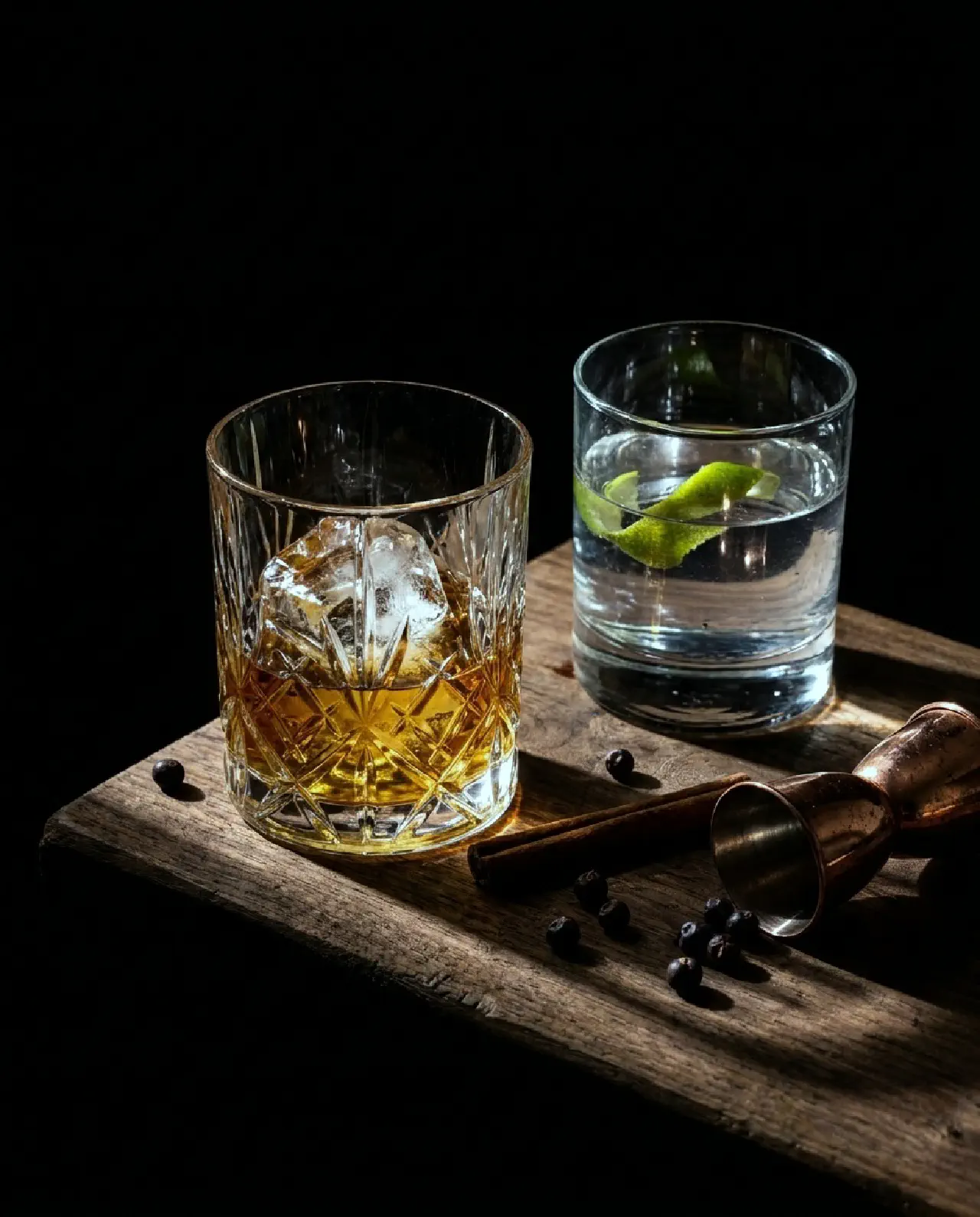
Distilled spirits are the concentrated essence of wine and beer - products of the simple principle that alcohol (boiling point 173°F/78°C) vaporizes before water (212°F/100°C). Heating a fermented liquid sends alcohol-rich, aroma-laden vapor off preferentially; cooling and condensing that vapor produces a liquid far more potent than the original. The result is not just stronger drink but some of the most intensely flavorful foods humans produce.
History
Mesopotamians were concentrating essential plant oils by distillation over 5,000 years ago. Chinese alchemists may have distilled concentrated alcohol ~2,000 years ago, with commercial production by the 13th century. In Europe, significant quantities appeared in Salerno, Italy (~1100) at its medical school. The Catalan scholar Arnaud of Villanova (~1300) dubbed it aqua vitae - “water of life” - a term that survives in Scandinavian aquavit, French eau de vie, and the Gaelic uisge beatha that became “whisky.”
Spirits transitioned from medicine to recreational drink by the 15th century. Armagnac winemakers began distilling wine for shipping resistance; gin emerged from Holland as a juniper-flavored rye spirit; Cognac gained renown by ~1620; rum appeared from West Indian molasses by ~1630. The column still (late 18th–early 19th century) enabled continuous, high-purity distillation and made spirits broadly affordable - which also brought addiction problems, particularly gin in industrial England.
The distilling process
Volatility fractionation
Yeast fermentation produces thousands of volatile compounds. The distiller’s art is separating the desirable from the harmful by subdividing vapor according to volatility:
Heads (foreshots) - the most volatile fraction, arriving first: toxic methanol, acetone. Discarded.
Main run - intermediate volatility: alcohol-rich, carrying desirable aromas. This is the spirit.
Tails (feints) - less volatile: esters, terpenes, volatile phenolics, and “higher” alcohols (fusel oils - long fat-like chains that give oily body but harsh flavor if excessive). A small dose gives character; too much makes the spirit unpleasant.
The relationship between distillation strength and flavor is inverse: vodka at 90%+ alcohol is nearly flavorless; brandies and whiskies at 60–80% retain far more aromatic character; moonshine at 20–30% is harsh and hazardous.
Pot still (time-based selection)
The original method, still used for the finest spirits. A simple pot is heated through a batch process taking 12+ hours. The most volatile heads come off first, then the alcohol-rich main run, then the heavier tails. The distiller diverts early and late vapors, collecting the main run separately. Typically repeated: the first pass yields 20–30% alcohol, the second 50–70%. This gives the distiller fine control over composition.
Column still (position-based selection)
A French and English Industrial Revolution invention. An elongated chamber is fed fermented liquid from the top and heated with steam from the bottom. The hottest bottom vaporizes everything; as vapor rises through progressively cooler zones, compounds condense at heights corresponding to their boiling points - methanol stays vaporized near the top, fusel oils condense on lower plates, and alcohol condenses at an intermediate point. Two or more columns in series produce 90–95% neutral distillate. Continuous operation, but less opportunity for the distiller to shape composition than pot distillation.
Concentration by freezing
An alternative to heat distillation: because water freezes at 32°F/0°C while alcohol freezes at –173°F/–114°C, freezing a fermented liquid produces ice crystals that can be removed, leaving alcohol-enriched fluid behind. North American settlers made applejack this way; Central Asian nomads applied the method to fermented mare’s milk. Freeze concentration retains sugars, savory amino acids, and other nonvolatile substances that distillation leaves behind - producing a fundamentally different character.
Maturation and aging
Fresh distillate is colorless and harsh. All spirits require at least weeks to months of maturation as components react with each other and become less irritating.
White spirits (vodka, fruit eaux de vie) are not barrel-aged - they’re adjusted to proper alcohol content with water and bottled. Brown spirits age in wood barrels for months to decades, deriving their tawny color and flavor complexity from wood extraction, absorption, and oxidation. The barrel allows slow evaporation - the “angels’ share” - losing several percent of volume yearly, approaching 50% after 15 years.
Before bottling, spirits are typically blended for consistency, diluted to ~40% alcohol, and may receive caramel coloring, sugar, wood extract (boisé), or wine/sherry additions. Chill-filtering (chilling below freezing and filtering) removes cloudy fusel oils and fatty acids, preventing cloudiness when diluted - but also removes some flavor and body. Spirits above 46% alcohol don’t cloud, so cask-strength bottlings are often left unfiltered.
Families of spirits
Brandy - Distilled from grape wine. Cognac is double-distilled to ~70% from neutral white grapes; Armagnac is single-distilled to ~55%. Both age in French oak (minimum 6 months; some Cognacs 60+ years). Long aging develops rancio character from fatty acid transformation into methyl ketones - a blue-cheese-like aroma. Eaux de vie capture concentrated fruit essence (Calvados from apples, Kirsch from cherries, Poire Williams from pears); most are unaged and colorless, representing 10–30 lb of fruit per bottle.
Whiskey - Distilled from fermented grains. Scotch malt whisky uses malted barley with flavors varying by region, water, and peat. Irish whiskey is often triple-distilled for smoothness. American bourbon must be 51%+ corn aged in new charred oak - the charred surface acts as activated charcoal, accelerating maturation and imparting distinctive vanilla and oak lactone flavors. Rye whiskey has a sharp, spicy character.
Rum - Distilled from molasses or sugar cane juice, in styles from light to dark to aged.
Vodka - Distilled to 90%+ alcohol for maximum neutrality, from grain, potato, or other carbohydrate sources. Often charcoal-filtered.
Gin - A neutral base spirit flavored with juniper and botanicals. London Dry is herbal and dry; genever (Dutch origin) is barrel-aged, darker, and more complex.
Tequila - Distilled from fermented blue agave in Mexico. Blanco is unaged; reposado rests 2+ months; añejo ages 1+ year.
See also
- alcohol-science - ethanol properties, fermentation chemistry, cooking with alcohol
- wine - the fermented grape base for brandy
- beer-brewing - the fermented grain base for whiskey
- barrel-aging - oak science, toasting, charring, flavor extraction
- vinegar - alcohol’s sequel via acetic acid bacteria
- sake - mold-based rice alcohol, an alternative fermentation tradition