Honey
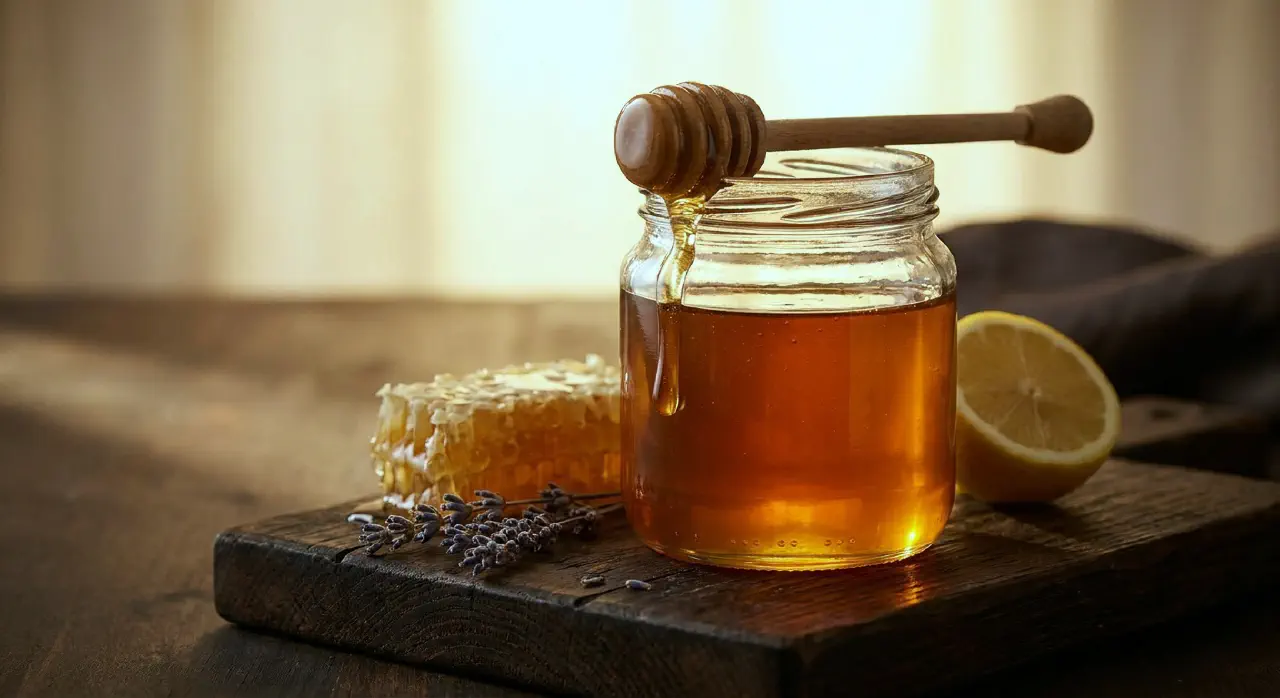
Honey is the natural model for all human sugar production - concentrated plant sugar solution, enzymatically transformed and preserved. Where humans crush, boil, and refine, bees collect dilute flower nectar and evaporate it in wax cells while their enzymes convert sucrose into the more soluble glucose-fructose mixture called invert sugar. The result is a supersaturated syrup (~80% sugar, ~17% water) that resists microbial spoilage, contains hundreds of flavor compounds, and has been humanity’s primary sweetener for most of recorded history.
How bees make honey
The honeybee (Apis mellifera) collects nectar - a dilute sugar solution produced by flowers to attract pollinators. A forager bee carries nectar in a honey sac where glandular enzymes begin converting sucrose into glucose and fructose. Back at the hive, house bees pump the nectar in and out of themselves for 15–20 minutes, forming thin films under their proboscises to accelerate evaporation. The concentrated nectar is then deposited in honeycomb cells (hexagonal wax cylinders ~5 mm across), where workers fan their wings to maintain continuous airflow. Over ~3 weeks of “ripening,” water content drops below 20%, and the bees cap each cell with a wax seal.
A second enzyme oxidizes some glucose to gluconic acid (lowering pH to ~3.9, hostile to microbes) and hydrogen peroxide (an antiseptic). The total labor is staggering: enough nectar for one pound of surplus honey requires flight distance equivalent to three orbits of the Earth.
Composition
| Component | Typical % |
|---|---|
| Fructose | 38 |
| Glucose | 31 |
| Water | 17 |
| Other disaccharides | 7 |
| Sucrose | 1.5 |
| Higher sugars | 1.5 |
| Acids | 0.6 |
| Minerals | 0.2 |
The fructose-glucose ratio matters: honeys with more glucose (clover, canola) crystallize faster; high-fructose honeys (acacia, tupelo) remain liquid longer. “Cream honey” is deliberately crystallized to 15% fine glucose crystals dispersed in 85% liquid - smooth and spreadable.
Monofloral honeys
Most honey is a blend of nectars, but ~300 monofloral honeys are produced worldwide, each with distinctive character. All share a base of caramel, vanilla, fruity, floral, and buttery notes, but individual flower sources add signature aromatics: buckwheat honey is malty (methylbutanal), chestnut carries a corn-tortilla note (aminoacetophenone), citrus and lavender have a grapy, herbal character (methyl anthranilate), and linden offers a minty-herbal complexity.
Darker honeys (buckwheat, chestnut) have higher protein content in the original nectar, which reacts with sugars to produce darker pigments and more toasted aromas. A few honeys are toxic: rhododendron nectar from eastern Turkey contains grayanotoxins that interfere with heart and lung function - notorious since antiquity.
Honey in cooking
Moisture retention: Honey is more hygroscopic than table sugar - it absorbs and retains water. Baked goods made with honey stay moist longer, losing water to air more slowly and absorbing it on humid days.
Browning acceleration: Honey’s glucose and fructose are reducing sugars that participate readily in Maillard reactions, producing deeper color and richer crust flavors than sucrose at the same temperature. This makes honey valuable in glazes, marinades, and crust work.
Leavening: Honey’s acidity (pH ~3.9) reacts with baking soda to produce CO₂, contributing to leavening in quick breads.
Antioxidant protection: Phenolic compounds in honey slow the development of stale flavors in baked goods and warmed-over flavors in meats.
Substitution: 1 measure honey replaces ~1.25–1.5 measures sugar in sweetening power; reduce other liquid to compensate for honey’s water content.
Crystallization and storage
All honey eventually crystallizes - glucose molecules come out of the supersaturated solution and form solid crystals. Gentle warming above ~80°F/26°C reliquefies crystallized honey. Honey is shelf-stable but not immortal: its high sugar concentration and amino acids drive slow browning reactions that flatten flavor over months at room temperature. For infrequent use, store below 50°F/15°C.
Infant botulism warning: Honey often carries dormant spores of Clostridium botulinum that can germinate in an infant’s immature digestive system. Honey should not be given to children under one year old.
See also
- sugar-science - honey as natural invert sugar; fructose and glucose chemistry
- syrups - maple, corn, molasses, and other liquid sweeteners
- caramelization - honey’s reducing sugars caramelize at lower temperatures than sucrose
- maillard-reaction - honey accelerates browning in baking and glazes
- fermentation-overview - mead (honey wine); honey’s enzymatic transformation parallels fermentation
- candy-making - honey as an interfering agent preventing sucrose crystallization