Ice Cream
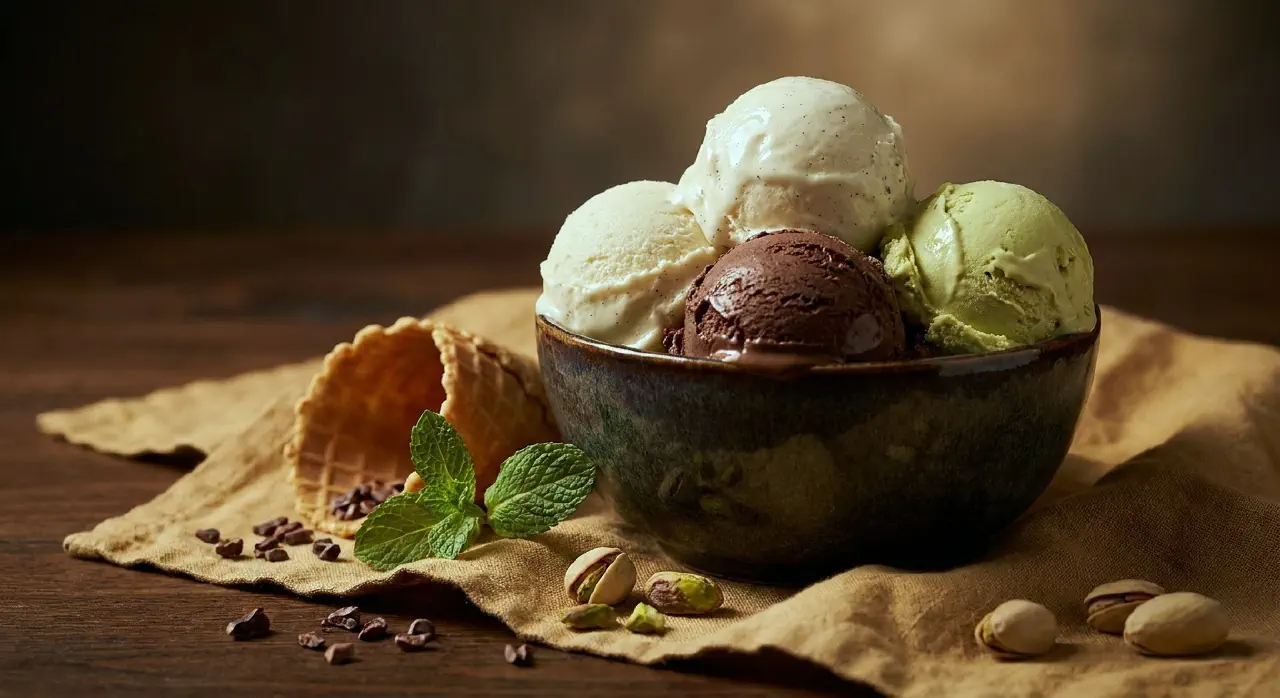
Ice cream is a three-phase system - water, fat, and air - held in dynamic equilibrium by freezing, emulsification, and mechanical aeration. Understanding these three phases and how they interact explains everything about ice cream’s texture, from the silky density of gelato to the airy lightness of soft-serve.
The three phases
- Water phase (continuous): A sugar solution containing dissolved lactose, milk proteins, and minerals. The sugar lowers the freezing point, which is why ice cream is scoopable rather than solid.
- Fat phase (dispersed): Cream fat globules coated in MFGM proteins and phospholipids, the same emulsion structure as milk - just frozen.
- Air phase (dispersed): Bubbles incorporated during churning, stabilized by fat globule membranes and denatured proteins. Air is what makes ice cream light; without it, frozen cream is rock-hard.
Freezing point depression
Pure water freezes at 32°F/0°C. Ice cream mixture, with 12–18% dissolved solids (sugar, lactose, minerals), freezes around 26–28°F/−3 to −2°C. Each 1% dissolved solids lowers the freezing point by roughly 0.1°F. This is the fundamental reason ice cream has texture instead of being a block of ice - at serving temperature, a significant fraction of the water remains liquid, keeping the mixture soft.
More sugar = lower freezing point = softer scoop. This is also why alcohol-heavy ice creams (rum raisin) are notoriously soft - ethanol is a powerful freezing point depressant.
Crystal size: the texture determinant
Small crystals (rapid freezing with constant agitation, ~20 minutes in an ice cream machine): smooth, creamy mouthfeel. The churning paddle continuously breaks forming crystals into tiny pieces.
Large crystals (slow freezing without agitation, as in a still-frozen dessert): grainy, icy texture. The crystals have time to grow undisturbed.
Recrystallization in storage: Even properly made ice cream develops larger crystals over weeks as small crystals merge. Proper storage at −8°F/−22°C or colder minimizes this. Refrigerator temperature (around 0°F/−18°C) allows noticeable crystal growth within weeks.
Stabilizers (gelatin, guar gum, locust bean gum) bind water and slow crystal growth - this is why commercial ice cream stays smoother longer than homemade.
Overrun: the air variable
Overrun is the percentage volume increase from air incorporation. One cup of mix churned to two cups = 100% overrun.
- 20–30% overrun: Dense, rich. High-end artisan ice cream.
- 50% overrun: Creamy, scoopable. Professional standard.
- 75–100% overrun: Light, airy. Typical commercial ice cream.
- 150%+ overrun: Mostly air. Cheap commercial ice cream with poor mouthfeel.
Overrun determines both perception and economics. Low-overrun ice cream feels dense and cold on the tongue; high-overrun feels light and melts quickly. Manufacturers can double their output by doubling the air.
Custard base
The classic ice cream base (custard-style) uses egg yolks for fat, emulsification, and protein structure. Yolks are heated with cream and milk to 170–180°F/77–82°C to pasteurize and denature proteins, which then coat fat globules and stabilize air bubbles during churning. The result: smoother texture, richer flavor, more stable structure than a cream-only base.
See also
- cream - the primary fat source and emulsion base
- eggs - custard-based ice cream relies on yolk proteins and lecithin
- starch-gelatinization - starch-stabilized ice cream bases
- milk - freezing point depression from lactose and milk solids
- sugar-science - sugar depresses freezing point and controls ice crystal size; fructose vs sucrose behavior