Eggs
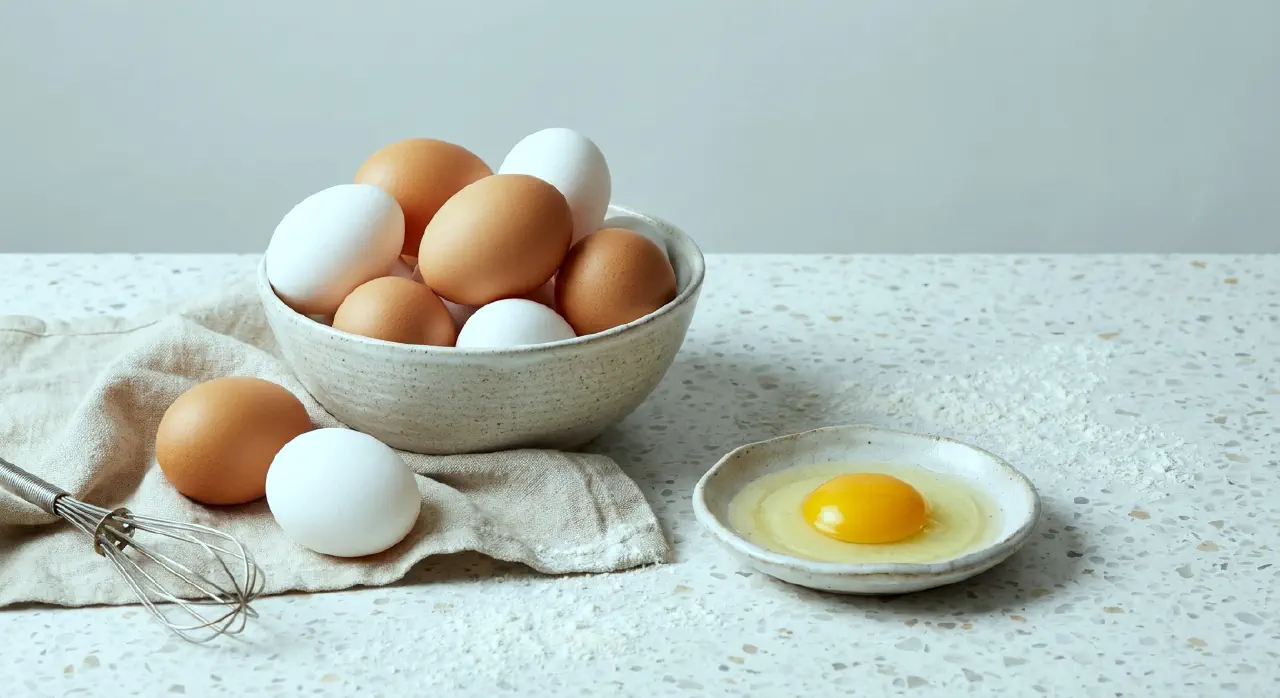
Eggs are the most versatile ingredient in cooking - they thicken, emulsify, leaven, bind, coat, and enrich. This versatility comes from their proteins, which respond to heat, acid, air, and mechanical force in predictable ways that no other single ingredient can match. Understanding egg science means understanding the biology first: every cooking property the egg possesses is a side effect of its original job - supporting 21 days of embryonic development inside a sealed calcium shell.
Biology and structure
A hen invests roughly 25% of her daily energy into each egg (ducks invest ~50%). Each egg takes about 25 hours to form: 10 weeks for the yolk to mature, then 25 hours for the white to be deposited and the shell to mineralize.
The yolk
The yolk accounts for just over one-third of the shelled egg by weight but three-quarters of its calories. It carries most of the egg’s iron, thiamin, vitamin A, and all of its fat-soluble vitamins (A, D, E, K).
Structurally, the yolk is a hierarchy of spheres within spheres. The outermost are ~0.1 mm primary spheres, tightly packed and distorted into flat-sided shapes. Inside each primary sphere are ~0.001 mm secondary spheres suspended in water - large enough to deflect light, which is why yolk appears opaque. Inside those are the smallest units: lipoprotein aggregates (~40× smaller still), each a fat core surrounded by a shell of protein, cholesterol, and phospholipid (mainly lecithin). These are mostly low-density lipoproteins (LDLs) - the same particles tracked in blood cholesterol tests - and they are what give yolk its extraordinary emulsifying and enriching capacity.
This architecture has practical consequences. When yolk is cooked intact, the primary spheres harden into distinct particles, producing crumbly texture. When yolk is broken and mixed before cooking, the spheres move freely and the result is less granular. Adding salt breaks apart the secondary spheres, making yolk simultaneously clearer (components too small to deflect light) and thicker (protective shells around fat-protein packages are disrupted).
Yolk color comes from xanthophyll pigments obtained entirely from the hen’s diet (primarily alfalfa and corn). The hen cannot manufacture yellow pigments. Color has no correlation with taste or nutritional value - a deep orange yolk may simply indicate marigold petal additives in commercial feed.
The white (albumen)
The white is ~90% water and ~10% protein, plus ~250 mg glucose (enough for early embryonic growth but not enough to taste sweet - though in long-cooked eggs, this glucose participates in the Maillard reaction, turning the white tan). Raw white gets its faint yellow-green cast from riboflavin.
The albumen proteins form a biochemical defense system evolved over millions of years:
| Protein | % of albumen | Function |
|---|---|---|
| Ovalbumin | 54% | Nourishment; blocks digestive enzymes |
| Ovotransferrin | 12% | Binds iron (starves bacteria) |
| Ovomucoid | 11% | Blocks digestive enzymes |
| Globulins | 8% | Seal membrane defects |
| Lysozyme | 3.5% | Digests bacterial cell walls |
| Ovomucin | 1.5% | Thickens albumen; inhibits viruses |
| Avidin | 0.06% | Binds biotin (vitamin B7) |
At least 4 proteins block digestive enzymes, 3 sequester vitamins, 1 binds iron, 1 digests bacterial cell walls directly. For the cook, what matters is that each protein has a different heat sensitivity - and this is why eggs coagulate in stages rather than all at once.
Shell and membranes
The shell is calcium carbonate plus a protein matrix, formed over ~14 hours. It contains roughly 10,000 pores (concentrated at the blunt end) for embryonic gas exchange. The cuticle - a thin proteinaceous coating - initially plugs these pores, then gradually fractures during storage, which is why older eggs lose moisture faster. Shell color is genetic (breed-determined) and has zero relationship to interior quality. The chalazae - twisted dense cords of albumen - anchor the yolk centrally, keeping maximum cushioning between embryo and shell.
Coagulation: how heat sets eggs
When heated, egg proteins unfold (protein-denaturation) and bond into a three-dimensional network that traps water, converting the liquid egg into a moist solid. The critical insight is that different proteins coagulate at different temperatures:
| Protein | Coagulation temp | What happens |
|---|---|---|
| Ovotransferrin (12% of white) | 140–150°F / 60–65°C | White begins to set |
| Yolk proteins | 150–158°F / 65–70°C | Yolk thickens and sets |
| Whole mixed egg | ~165°F / 73°C | Combined egg sets |
| Ovalbumin (54% of white) | ~180°F / 80°C | White becomes dramatically firmer |
This temperature staging is the entire basis of egg cookery. A soft-boiled egg works because the white’s most sensitive protein has coagulated while the yolk hasn’t reached its threshold. See basic-egg-dishes for practical applications.
Overcooking is the enemy: proteins bond too tightly, squeeze out water, and the egg becomes rubbery (plain eggs) or curdles (custard mixtures separate into lumps and liquid). The target is always barely coagulated.
How ingredients shift egg behavior
One of the most useful principles in egg cookery - the key to custards and egg-foams:
Dilution (milk, cream, water): Raises coagulation temperature. Proteins must be hotter and moving faster to find each other across greater distances. A custard (1 cup milk + 1 egg) thickens at ~175–180°F/78–80°C instead of ~160°F/70°C for an egg alone.
Sugar: Acts as a molecular diluent - sucrose molecules surround proteins, raising the coagulation temperature just like water does. The effects of milk and sugar are additive.
Acid (lemon juice, vinegar, cream of tartar): Lowers coagulation temperature but produces a more tender result. The paradox: proteins that coagulate sooner (while still compact) can’t intertwine as tightly, so the network is looser. Acid also suppresses the sulfur chemistry that produces the tightest bonds. Moroccan cooks have beaten eggs with lemon juice before long cooking for centuries - they understood this intuitively.
Salt: Same mechanism as acid - neutralizes protein charges, causing earlier but gentler coagulation. The old myth that salt toughens eggs is exactly backwards.
Eggs as emulsifiers
Egg yolk’s lipoprotein structure makes it the most powerful natural emulsifier available to the cook. The lecithin and other phospholipids are amphipathic - one end loves water, the other loves fat - and the LDL aggregates are already pre-organized for emulsion duty:
Mayonnaise: Cold emulsion. One yolk can emulsify ~150 ml oil. The lecithin coats oil droplets and prevents coalescence.
Hollandaise/béarnaise: Hot emulsion. Yolks whisked over gentle heat (120–140°F/50–60°C) to begin unfolding proteins, then butter incorporated. Overheating above the coagulation threshold breaks the emulsion irreversibly.
Liaison: A quick enrichment technique - yolk whisked with cream, then tempered into a hot sauce just before serving. Thickens delicately without prolonged cooking.
Eggs as foams
Egg white proteins are uniquely effective at stabilizing air bubbles. When whisked, the mechanical stress and the air-water interface both unfold proteins, which then gather at the bubble surface - water-loving portions in the liquid, water-avoiding portions projecting into the air. The unfolded proteins bond to each other, forming a continuous solid network that reinforces bubble walls. See egg-foams for full coverage of meringues, soufflés, and sabayons.
Key foam facts: Globulins and ovotransferrin do the initial stabilization work (they’re most sensitive to physical stress). Ovalbumin - the majority protein - contributes little to raw foam but becomes critical when the foam is cooked, more than doubling the solid protein reinforcement as it coagulates at ~180°F/80°C. This is why baked meringue sets into a permanent solid.
Fat is the enemy of egg foams - even a trace of yolk, oil, or detergent in the whites can prevent proper foaming, because these molecules compete with proteins for space at the bubble surface without providing structural reinforcement.
Copper bowls work by forming extremely tight bonds with reactive sulfur groups on proteins, preventing the disulfide bonds that cause overwhipped foam to go grainy. Cream of tartar (acid) achieves the same effect by suppressing sulfur-hydrogen shedding - 1/8 teaspoon per egg white is sufficient.
Freshness and quality
As an egg ages, CO₂ escapes through shell pores, raising the pH of the white from ~7.6 (fresh) to ~9.4 (old). This thins the albumen (ovomucin breaks down in alkaline conditions) and weakens the yolk membrane. The air cell at the blunt end grows as moisture evaporates - larger air cell means older egg.
The green ring around an overcooked hard-boiled yolk is iron sulfide: iron from the yolk reacting with hydrogen sulfide released from overheated white proteins. Harmless, but a reliable indicator of overcooking. Older eggs produce more of it because their more alkaline whites release hydrogen sulfide more readily.
Flavor
Egg flavor is mostly sulfur chemistry. Heating the white produces hydrogen sulfide (the rotten-egg smell in trace amounts), which is why overcooked eggs smell worse than properly cooked ones. Yolk flavor is richer and more complex, with fatty acid breakdown products contributing buttery and savory notes. The hen’s diet can influence egg flavor - fish meal in feed produces fishy-tasting eggs; access to varied forage (insects, plants) produces more complex flavor.
See also
- protein-denaturation - the fundamental science behind egg cooking
- custards - baked and stirred custards, pastry cream, fruit curds
- egg-foams - meringues, soufflés, and sabayons
- basic-egg-dishes - boiled, poached, fried, scrambled
- emulsions - how egg yolk stabilizes oil-water mixtures
- maillard-reaction - what happens when egg proteins meet sugars at high temperatures
- salt - the counterintuitive tenderizing effect on eggs