Legumes
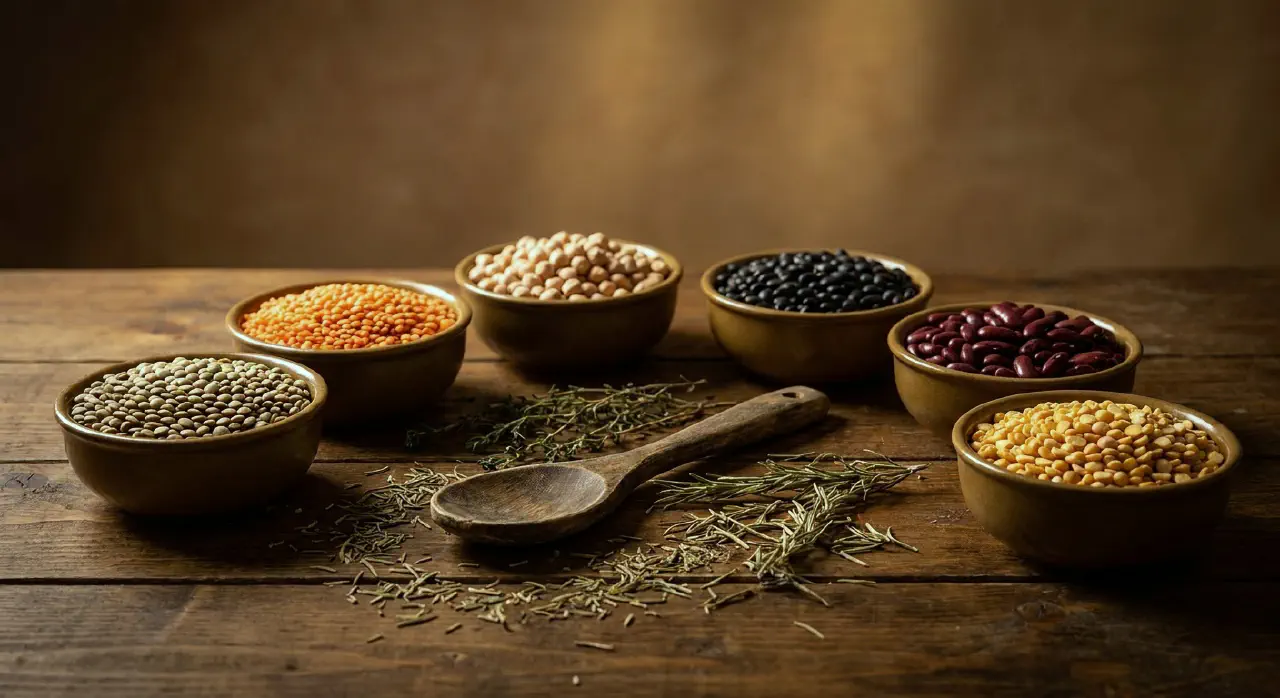
The second most important plant family in the human diet (after grasses), legumes owe their protein power to a symbiosis: soil bacteria (Rhizobium) colonize the roots and convert atmospheric nitrogen into plant-usable form, allowing legumes to accumulate 2–3× the protein of wheat or rice. Four legumes were so prominent in ancient Rome that they gave names to distinguished families - Fabius (fava), Lentulus (lentil), Piso (pea), and the most celebrated, Cicero (chickpea).
Structure
Legume seeds consist of two large cotyledons (storage leaves) packed with protein and starch, surrounded by a fibrous seed coat (testa). The seed coat controls water entry - initially only through the hilum (the small scar where the seed attached to the pod), then gradually across the entire surface once the coat is hydrated. This slow water entry is the fundamental reason dried legumes take so long to cook.
Protein and starch: Most beans and peas are primarily protein (20–25%) and starch (55–65%). Major exceptions: soybeans (~37% protein, 18% oil, minimal starch) and peanuts (~26% protein, 50% oil) - both are oil crops, not starchy staples.
Defensive compounds: Raw legumes contain lectins, protease inhibitors, and (in tropical lima beans) cyanide-generating compounds. Animals fed raw beans lose weight. All are disabled by thorough cooking.
Color and pigments
Seed coat color comes mainly from anthocyanin pigments. Solid reds and blacks generally survive cooking; mottled patterns wash out (water-soluble pigments migrate to unpigmented areas and into cooking liquid). Color is best preserved by minimizing cooking water - start beans barely covered, add water only as needed. Pale beans sometimes develop a delicate pink blush in the embryonic stem during cooking, from the same reaction that turns quinces and pears ruby-red in slow cooking.
The flatulence problem
Everyone produces about a quart of intestinal gas daily from gut bacteria. Legumes significantly amplify this, for two reasons: oligosaccharides (3–5 linked sugar molecules in unusual bonding) that human enzymes can’t digest, and cell-wall cements that generate identical CO₂ and hydrogen. Beans contain roughly twice as much of the latter as the former - making cell walls, not just oligosaccharides, the primary culprit.
Reduction strategies: Boil beans briefly in excess water, let stand 1 hour, discard the soaking water, and start cooking with fresh water - this leaches most water-soluble oligosaccharides. The cost: also lost are vitamins, minerals, sugars, seed coat pigments, and flavor. Prolonged cooking breaks down oligosaccharides and some cell-wall cements into digestible sugars. Sprouting and fermentation (miso, tempeh, soy sauce) are most effective - oligosaccharides are consumed by the seed or by microbes.
Cooking science
Soaking: Reduces cooking time by 25%+. Without presoaking, heat penetrates the dry outer portions while the center is still absorbing water - the outside overcooks and becomes fragile before the center softens. Presoaking in salted water (1% solution, 10g/l) is particularly effective: sodium displaces magnesium from cell-wall pectins, making them dissolve more easily, significantly speeding cooking.
Temperature: Boiling is faster but turbulent water damages seed coats; beans may disintegrate. 180–200°F (80–93°C) - a gentle simmer - produces more intact results.
What slows softening: Three substances keep beans firm longer: acids (stabilize cell-wall hemicelluloses - tomatoes or vinegar added early create long-simmered beans that hold their shape), sugar (reinforces cell walls and slows starch granule swelling), and calcium (cross-links pectins - hard water notably slows cooking). Baked beans exploit all three: molasses is acidic, sweet, and calcium-rich, giving beans that can survive hours of reheating.
Baking soda (0.5%, 1 tsp/qt): Reduces cooking time ~75% via alkalinity facilitating hemicellulose dissolution. Downsides: unpleasantly slippery mouthfeel and soapy taste. Pressure cooking at 250°F (120°C) cuts time by more than half; salt-presoaked beans may be done in 10 minutes.
Hard-to-cook beans: Beans stored long at warm temperature with high humidity develop resistance to softening - woody lignin forms, phenolics convert to tannins that cross-link proteins, and storage proteins denature to coat starch granules with a water-resistant layer. These changes cannot be reversed. No way to identify before cooking.
Flavor
The characteristic “beany” flavor comes from lipoxygenase enzymes breaking unsaturated fatty acids into 5, 6, and 8-carbon aromatic fragments when bean cells are damaged in the presence of moisture and oxygen. Main notes: grassy hexanal, mushroomy octenol. This is the same enzyme family responsible for fresh-green aromas in vegetables and, when uncontrolled, off-flavors in soy products. Cooked bean aroma also carries a sweet note from lactones, furans, and maltol. Prolonged storage before sale causes loss of typical flavor and accumulation of stale notes.
Fresh legumes: Harvested moist, before full starch development, fresh shell beans (peas, edamame, cranberry beans, lima beans) are sweeter and cook in 10–30 minutes. Soybeans as edamame - harvested at ~80% maturity - are the clearest example of the palatability advantage.
Roasting
Most legumes require water for softening, but high-oil legumes (peanuts) and some lower-oil varieties (soybeans, chickpeas) can be dry-roasted to a nut-like texture. Lower-oil beans must be soaked first; initial moisture softens the cell walls before continued roasting evaporates water and creates crispness.
Legume composition (% dry weight)
| Legume | Protein | Carbohydrate | Oil |
|---|---|---|---|
| Common bean | 22 | 61 | 2 |
| Fava bean | 25 | 58 | 1 |
| Lima bean | 20 | 64 | 2 |
| Mung bean | 24 | 60 | 1 |
| Lentil | 25 | 60 | 1 |
| Chickpea | 21 | 61 | 5 |
| Pea | 24 | 60 | 1 |
| Soybean | 37 | 34 | 18 |
| Peanut | ~26 | ~16 | ~50 |
Soybeans and peanuts are the dramatic outliers - oil crops more than starchy staples. Most others cluster around 20–25% protein and 60% starch, roughly doubling the protein density of grains.
See also
- seed-biology - seed coat water control, soluble protein behavior, soaking principles
- soy-products - the full soybean transformation: tofu, miso, soy sauce, tempeh, natto
- nuts - high-oil seeds with similar oil body structure; rancidity parallels
- plant-color - anthocyanin pigments in bean seed coats
- fermentation-overview - fermented legume products; miso, tempeh, and the gas-reduction benefit
- spice-handling - Indian dal cooking parallels