Soy Products
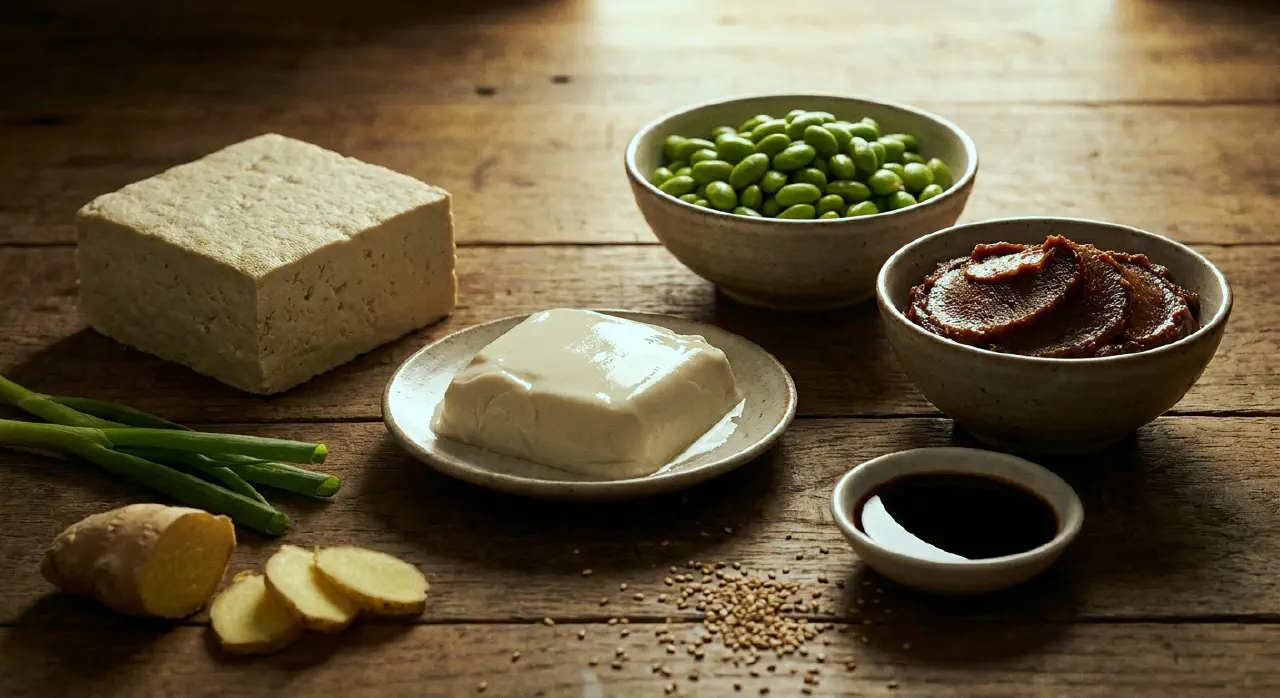
Soybeans present a palatability paradox: double the protein of other legumes, near-ideal amino acid balance, rich oil - yet raw or plainly boiled, they’re strongly “beany,” full of gas-producing oligosaccharides, antinutritional compounds, and a texture that’s firm rather than creamy (they contain negligible starch). Chinese cooks solved this with two fundamentally different approaches: extraction (separating desirable proteins and oil from everything else to make soymilk and tofu) and fermentation (using microbes to consume the undesirable compounds while generating savory complexity). The results - bean curd, soymilk, yuba, miso, soy sauce, tempeh, natto - are among the most versatile fermented foods in any tradition.
The beany flavor problem
The “beany” aroma comes from lipoxygenase enzymes breaking soybeans’ abundant polyunsaturated oil into 5, 6, and 8-carbon fragments when cells are damaged in the presence of oxygen - producing grassy, paint-like, and rancid-fat notes. Minimizing this requires inactivating the enzymes quickly: soaking to speed subsequent cooking, then plunging immediately into boiling water or pressure-cooking before grinding.
Fresh soybeans (edamame)
Harvested at ~80% maturity, before full starch and antinutritional compound development. Still sweet, crisp, and green. Lower gassy substance levels; less pronounced beany flavor. Boiled minutes in salted water. Nutritionally ~15% protein, ~10% oil.
Soymilk and yuba
Soymilk: Soaked, ground, cooked soybeans with solids strained off - a dispersion of soy proteins and microscopic oil droplets in water. Parallel to dairy milk in structure, not origin. Modern minimal-flavor method: soak at 150°F (65°C) for 1 hour (water absorption without significant cell damage), then grind at or above 180°F to inactivate lipoxygenase before cell damage can generate beany volatiles.
Yuba (dou fu pi): When soymilk is heated in an uncovered pot, heat-unfolded proteins concentrate at the surface, tangle together, lose moisture to the air, and form a thin protein sheet - identical to the skin that forms on heated dairy milk. The sheet entraps oil droplets, developing fibrous, chewy texture. Japanese restaurants serve it just-removed from the milk, meltingly tender; it’s also dried and layered for savory and sweet preparations across China and Japan.
Tofu (bean curd)
Invented China ~2,000 years ago. Cooked soymilk cooled to ~175°F (78°C), then coagulated with calcium sulfate (traditional Chinese, adding calcium nutrition) or nigari (magnesium and calcium salts from seawater - Japanese and coastal Chinese method). The coagulants bridge dissolved proteins and protein-coated oil droplets into a cloud-like curd. Remaining “whey” is removed; curds pressed 15–25 minutes while hot to form a cohesive mass: ~85% water, ~8% protein, ~4% oil.
Silken tofu: Coagulated in the package without breaking curds - full of moisture, extremely delicate. Firm tofu: Pressed more extensively to remove water - holds shape for stir-frying and slicing.
Frozen tofu: One of the few foods usefully improved by freezing. Ice crystals form pockets in the protein network; thawing leaves a spongy structure that readily absorbs flavored cooking liquids. Chewier, meatier texture - a deliberate technique, not an accident.
The two-stage fermentation system: koji + brine
Miso and soy sauce share an underlying fermentation architecture: Aspergillus mold generates enzymes; salt brine selects for lactic acid bacteria and yeasts while excluding pathogens.
Stage 1 (~2 days): Dormant Aspergillus spores mixed with cooked grains or soybeans, kept warm, moist, and aerated. Germinating hyphae (koji) produce amylases, proteases, and lipases - digestive enzymes that begin breaking starch to sugars, proteins to amino acids, and oils to fatty acids.
Stage 2: The koji is immersed in salt brine with additional cooked soybeans. Low oxygen kills the mold, but enzymes continue working. Salt-tolerant lactic acid bacteria and yeasts grow, contributing flavor - fruity esters (acid + alcohol), roasty pyrazines (sugar + amino acid browning), and complex aromatic molecules. Products react over months to years.
Miso
Dozens of varieties; broadly classified by grain base (rice, barley, or soybean), fermentation time, and salt content. Fresh, traditionally made miso: rich, savory complexity dominated by sweet and roasted notes, sometimes pineapple-like esters. Industrial production short-cuts fermentation from months to weeks, compensating with additives. Used as soup base, seasoning, marinade, and pickling medium.
Soy sauce
Evolved from fermented meat/fish brines (Chinese original) → fermented soybeans (~200 BCE) → soy paste → soy sauce as its own product by ~1000 CE. Flavor depends heavily on soybean:wheat ratio:
Chinese soy sauce / tamari: Primarily soybeans; no or little wheat. Darker, richer, higher amino acid concentration - especially glutamic acid (the savory backbone of umami).
Japanese shoyu: Equal soybeans and wheat; wheat starch contributes sweetness; higher alcohol content produces more fruity esters.
Shiro (white soy sauce): More wheat than soybeans - lighter color and flavor.
Tamari: Closest to Chinese original; little to no wheat; sometimes stabilized with added alcohol.
The final product: salty, tart, sweet, savory - hundreds of aroma molecules including roasty furanones, pyrazines, sweet maltol, and meaty sulfur compounds. A concentrated flavor amplifier. “Chemical” soy sauce (hydrolyzed vegetable protein acidified and neutralized) is a very different product, usually blended with small amounts of genuine fermented soy sauce for palatability.
Tempeh
Indonesian invention - unlike miso and soy sauce (preserved condiments), tempeh is fresh, unsalted, and perishable. Cooked whole soybeans formed into thin layers, inoculated with Rhizopus mold, and fermented 24 hours at 85–90°F. The mold’s hyphae penetrate and bind the beans together, digesting significant amounts of protein and oil into flavorful fragments. Fresh aroma: yeasty, mushroomy. Sliced and fried: develops nutty, almost meaty flavor from Maillard browning of the mold-exposed surfaces.
Natto
Japanese fermented soybeans using Bacillus subtilis natto - produces the opposite of tempeh. Bacterial proteases break proteins to amino acids and generate long glutamic acid chains and branched sucrose chains that form natto’s signature slimy, stretchy strings (up to 3 feet with chopsticks). Aroma: buttery diacetyl, volatile acids, nutty pyrazines. Distinctly alkaline (ammonia from amino acid breakdown). Acquired taste; served atop rice or noodles, in soups, with vegetables.
Phytoestrogens and health
Soybeans contain isoflavones (genistein, daidzein, glycitein in storage forms), liberated by intestinal bacteria into active compounds that structurally resemble estrogen. Evidence suggests benefits for bone density and prostate cancer risk; some studies show they can worsen preexisting breast cancer; protective effects against some cancers appear to depend on adolescent consumption. Boiled whole soybeans contain the highest isoflavone concentration - roughly twice that of tofu.
See also
- legumes - soybean as legume; flatulence chemistry; edamame; sprouting
- seed-biology - oil body structure; lipoxygenase and beany flavor; protein types
- fermentation-overview - koji fermentation parallels to cheese, fish sauce, and other fermented foods
- maillard-reaction - pyrazine formation in miso and soy sauce; tempeh browning
- flavor-chemistry - glutamic acid as umami backbone in soy sauce
- spice-handling - miso and soy sauce as marinade ingredients; flavor extraction