Seed Biology
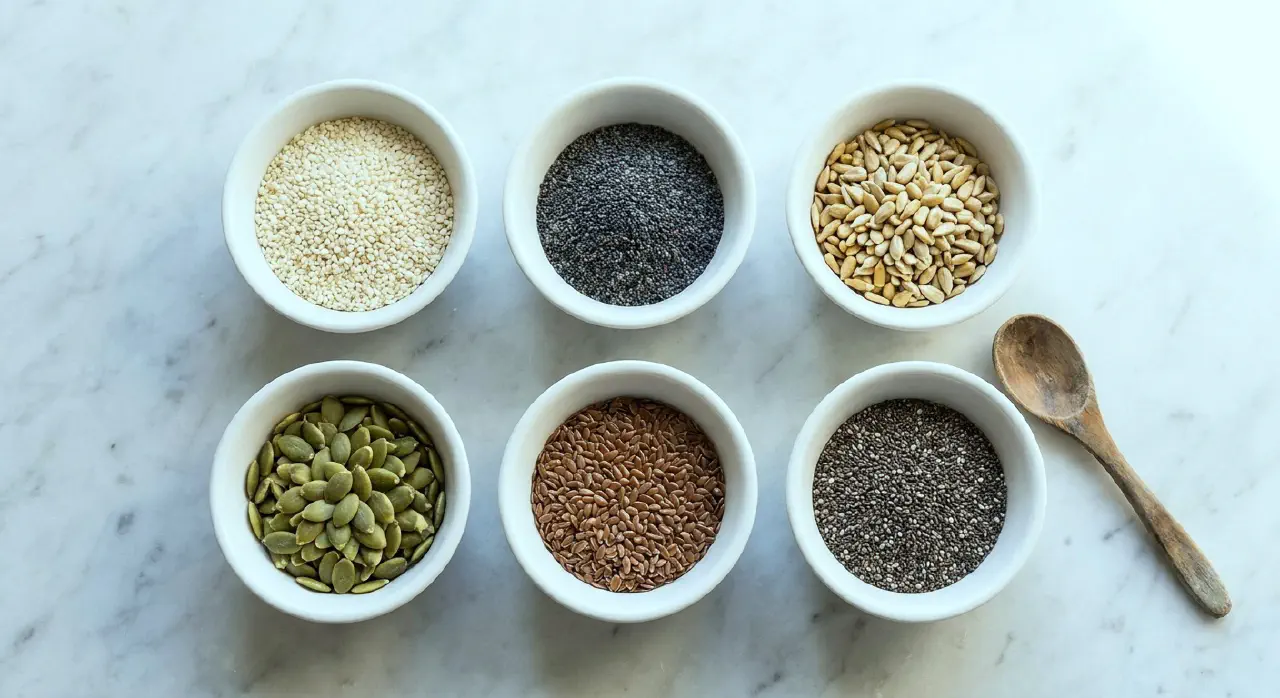
Seeds are the driest, most shelf-stable foods in the kitchen - concentrated parcels of energy locked behind a water-resistant coat, requiring both moisture and heat to become edible. The same three-part structure (protective coat, embryo, storage tissue) appears across all seeds, and understanding how starch, protein, and oil behave within that structure explains nearly every cooking property of grains, legumes, and nuts.
Seed structure
Every seed consists of three functional components:
Outer coat (bran/seed coat): Dense fibrous tissue designed to control water passage into the embryo. Rich in phenolic compounds, anthocyanins, and astringent tannins. Contains most of the seed’s fiber. In whole grains, this bran layer also carries the aleurone - only 1–4 cells thick - which is packed with oil, minerals, protein, vitamins, enzymes, and flavor compounds. Removing the bran (milling/pearling) sacrifices these nutrients but produces faster-cooking, lighter-colored results.
Embryo (germ): The living plant capable of growth. In grains, the germ concentrates much of the seed’s oil and enzymes - sources of both desirable cooked aromas and the rancidity risk of whole-grain flours. In legumes and nuts, the embryo is minimal.
Storage tissue (endosperm/cotyledons): The bulk of the seed - dead cells packed with carbohydrates, proteins, and oils to fuel the embryo during germination. In grains this is the starchy endosperm; in legumes it’s repackaged into two large cotyledons; in nuts, the cotyledons are swollen with oil.
Starch: amylose vs amylopectin
All grains and legumes store energy as starch - glucose chains packed into microscopic granules in two molecular forms with completely different cooking implications:
Amylose: ~1,000 glucose units in a mostly linear chain. Forms compact, orderly, tightly bonded clusters. Higher proportions in legumes (30%+) and long-grain rice (22%). Requires more water and heat to gelatinize; retrogrades quickly (within hours of cooling), creating firm texture in leftover grains. Amylose retrogradation also makes starch resistant to digestion - feeding gut bacteria and slowing blood sugar rise.
Amylopectin: 5,000–20,000 glucose units with hundreds of short branches. Large, bushy molecule that clusters loosely. Dominant in short-grain and sticky rices. Gelatinizes easily; retrogrades slowly (days), so short-grain rice stays tender longer when cold. High-amylopectin grains produce clingy, sticky textures.
Gelatinization and retrogradation
When seeds cook in water at 140–160°F (60–70°C), starch granules absorb water, the molecules separate, and granules swell and soften - gelatinization (unrelated to gelatin). Amylose-rich seeds require more water and heat; amylopectin-rich seeds gelatinize more easily.
After cooking, as the food cools below gelatinization temperature, starch molecules re-form clusters with pockets of water trapped inside - retrogradation. Amylose retrogrades within hours (hard leftover rice); amylopectin takes a day or more. Reheating to ~160°F re-gelatinizes the starch, restoring softness. Retrogradation is not a flaw - deliberately retrograded starch resists digestion, benefiting gut health and glycemic response.
Proteins: soluble vs insoluble
Seed proteins separate into two behavior classes that explain the texture difference between legumes and grains:
Soluble proteins (albumins, globulins): Found mainly in legumes and nuts. Dissolve in salt solution or water during cooking, dispersing into the cooking liquid and contributing to a soft, creamy, mouth-filling texture.
Insoluble proteins (glutelins, prolamins): Found mainly in grains - wheat, rice, corn. Don’t dissolve in ordinary water. Instead, they bond to each other and clump into compact masses, bonding with starch granules to create the characteristic chewy consistency of cooked grains. Wheat’s glutenin and gliadin are the extreme case - uniquely elastic, capable of forming the continuous stretchy network that traps gas bubbles and makes leavened bread possible.
Seed oils
Oil is stored in tiny oil bodies - microscopic droplets coated with phospholipids (relatives of lecithin) and proteins called oleosins. This surface coat prevents droplets from pooling together, giving oil-rich seeds their creamy-in-the-mouth character rather than greasy. The parallel to milk fat globules is exact - both are phospholipid-stabilized oil-in-water systems.
Oil bodies also make nut milks possible: soaking nuts before grinding keeps the oil bodies relatively intact and dispersed in water. Grinding dry nuts without pre-soaking merges the oil bodies, creating an oil-continuous paste rather than a water-continuous milk.
High-oil seeds (nuts, soybeans) are most vulnerable to rancidity: light, heat, oxygen, and physical damage fragment unsaturated fatty acids into cardboard-and-paint-smelling molecules. Polyunsaturated fats (walnuts, pecans, flaxseed) are most fragile. Refrigeration or freezing (seeds have little water content, so ice crystal damage is minimal) is the best storage strategy.
Cooking seeds: the key principles
Water penetration takes time: The bran coat is designed to control water entry. Much cooking time for whole seeds is simply waiting for water to reach the center - heat penetrates faster than water. Presoaking for several hours or overnight cuts cooking times by half or more.
Reaching edibility: Most seeds require 60–70% water by weight to become fully tender - roughly 1.7× their dry weight. Recipes call for excess water to account for evaporation.
Let them cool before handling: Fully cooked seeds are soft and fragile at temperature. Starch retrogrades to a useful firmness during cooling. Scooping hot grains breaks them; cooling first maintains appearance.
Seeds concentrate their cooking liquid: Dry seeds absorb water aggressively, effectively concentrating whatever is dissolved in it. Rice cooked in milk creates a richer, cream-like liquid between grains. Beans cooked in meat stock drive its concentration toward demiglace. This is a useful technique, not a side effect.
Sprouting
Sprouting activates the seed’s own enzymes to break stored starch into sugars, improving sweetness, digestibility, and vitamin content. Sprouted seeds have nutritional value midway between dry seed and leafy green: higher in vitamin C, lower in calories, higher in protein (~5%) and B vitamins than vegetables. The oligosaccharides that cause legume flatulence are consumed during germination, making sprouted legumes significantly less gassy. Further fermentation (miso, tempeh, soy sauce) consumes the remainder.
See also
- starch-gelatinization - detailed gelatinization chemistry and sauce-making applications
- wheat - glutenin/gliadin elasticity and wheat variety comparison
- rice - amylose/amylopectin divide in practice; indica vs japonica
- legumes - soluble protein behavior, cooking science, flatulence
- nuts - oil body structure, rancidity, nut milks
- soy-products - protein extraction and fermentation transformation of soybeans
- bread-baking - gelatinization setting crumb structure; retrogradation causing staling
- milk - parallel oil droplet / fat globule structure in seed vs animal milks