Nuts
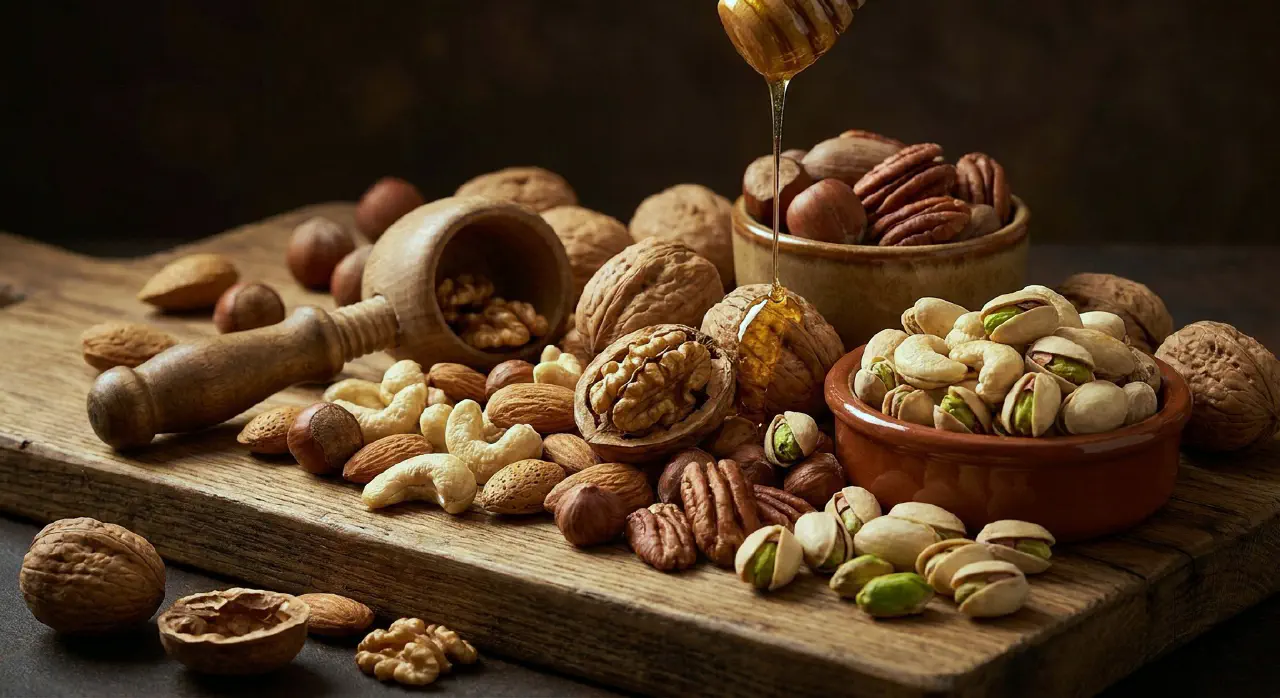
Nutritionally the richest plant foods after pure fats and oils - averaging ~600 calories per 100g, versus ~350 for dry grains - nuts are defined by their high oil content and the weak cell walls that make them uniquely edible raw or after brief dry heat, without the soaking and long cooking other seeds require. Their characteristic richness, creaminess, and depth come from abundant oil stored in oil bodies, the same phospholipid-stabilized structures found in milk fat globules.
Why nuts work differently from other seeds
Nut cotyledons (the storage leaves) have relatively weak cell walls and low starch - no floury grittiness. Oil gives mouth-watering moistness instead of greasiness, because the oil stays in its protective droplet packaging until cells are mechanically ruptured. This is also why grinding soaked nuts produces a milk-like emulsion (oil bodies remain dispersed in water) while grinding dry nuts produces a paste (oil bodies merge, making oil the continuous phase).
Nut skins contain concentrated tannins and phenolic compounds (~25% of dry skin weight) - nutritionally valuable antioxidants, but astringent and capable of discoloring other ingredients (walnut skins turn breads purple-gray). Cooks remove skins by brief toasting (peanuts, hazelnuts), boiling water soaking (almonds), or hot baking-soda water dissolving the hemicellulose cement (difficult skins).
Oil fragility and storage
The greatest challenge with nuts is their fragile polyunsaturated oils, which oxidize readily into cardboard-and-paint-smelling fragments. Rancidity is accelerated by light, heat, moisture, and physical damage (bruising releases oil from protective droplets into direct air contact). Walnuts, pecans, cashews, and peanuts are most vulnerable (richest in polyunsaturated fats). Almonds, with lower polyunsaturate content, keep relatively longer.
Best storage: opaque, airtight containers (glass preferred over permeable plastic) at cool temperatures. Shell-less kernels are best refrigerated. Since nuts have little water content, freezing causes no ice crystal damage - nuts can be frozen for months or years.
Fresh indicator: Look for opaque, off-white interior - translucency or darkening signals cell damage, released oil, and developing rancidity.
Roasting
Roasting transforms nuts from chewy, pale, mild to crisp, browned, intensely flavorful - Maillard browning from proteins and reducing sugars plus pyrazines from dry heat. Judge doneness by color and smell, not texture (heat softens them; crispness comes on cooling). Stop just short of ideal - carryover cooking continues after heat removal. Warm nuts slice cleanly; cool nuts crack and crumble.
Common nuts in detail
Almonds: World’s largest tree nut crop; a stone fruit seed (close relative of peach and plum). High in antioxidant vitamin E; relatively long shelf life from low polyunsaturate content. Marzipan and almond paste use finely ground almonds with sugar.
Bitter almonds: Contain a cyanide-generating defense system - its byproduct, benzaldehyde, is the “almond extract” flavor. Safe cultivated almonds lack this system and taste delicately nutty, not like almond extract. Bitter almonds are used sparingly in Europe as a spice (amaretti, amaretto); unavailable in the U.S. Apricot and peach kernels provide accessible benzaldehyde without the intense bitterness.
Walnuts: Second only to almonds in world trade. Exceptionally rich in omega-3 linolenic acid - the most nutritionally valuable nut fat but also most rancidity-prone. Keep cold and dark. Complex aroma from aldehydes, alcohols, and ketones. Black walnut (J. nigra) has stronger, more distinctive flavor.
Pecans: Distant walnut relative; native to central North America river valleys. Among the highest oil content of any nut. Easily bruised, with oil seeping to the surface - rapid oxidation makes storage critical. Flavor: generic nutty pyrazines plus a lactone (octalactone) shared with coconut.
Cashews: Amazon origin, transplanted to India and East Africa by Portuguese. Poison ivy relative - never sold in shell (shell oil is irritating; removed by heating). Unusual among oily nuts: significant starch (~12%), making cashews far more effective than most nuts at thickening water-based dishes (Indian curries, stews, milk desserts). The cashew apple (the swollen fruit stem) is enjoyed fresh or fermented in source countries; the “nut” is technically the seed.
Brazil nuts: Amazon forest giants; pods fall like 5-pound projectiles (harvesters carry shields). Edible portion is an enormously swollen embryonic stem. Highest selenium levels of any food - but two large Brazil nuts reach the WHO’s recommended daily limit. Caloric density: two large nuts ≈ one egg.
Hazelnuts: Distinctive aroma from filbertone (a single compound - heptenone) that increases 600–800-fold during frying or boiling. Turkey produces most of the world’s supply.
Chestnuts: The outlier nut - energy stored as starch (42%), not oil (2%). Must be thoroughly cooked; mealy texture. Before New World corn and potato, chestnuts were an essential subsistence food for mountain communities in Italy and France. Highly perishable (high initial moisture); refrigerate and eat quickly. Marrons glacés - chestnuts infused in vanilla syrup over 1–2 days - demonstrate how thoroughly cooking transforms chestnut starch into a vehicle for flavor absorption.
Coconuts: The most structurally unusual nut - what’s consumed is endosperm, not cotyledons. Coconut development spans ~12 months in distinct stages: at 5–7 months, the immature nut contains sweet water and a thin, gelatinous, translucent meat (prized for desserts in Southeast Asia); by 11–12 months, the water has diminished and the endosperm has matured into firm, fatty white meat (45% water, 35% oil, 10% carbohydrate, 5% protein). Mature meat has a uniquely persistent chewy texture because cell walls don’t dissolve, only crisp when toasted. Aroma from lactones (octa-, deca-, dodeca-lactones - shared with peaches); roasting generates pyrazines. Coconut oil (~90% saturated fats) is unusually stable.
Nata de coco: Coconut water fermented by Acetobacter xylinum produces a unique dessert - the bacteria synthesize a mat of pure cellulose on the liquid surface, yielding translucent, chewy cubes with a distinctive crunchy-springy texture unlike any other food. Popular throughout Southeast Asia and increasingly worldwide as a topping and drink inclusion.
Nut milks and butters
Nut milks: Soaking before grinding keeps oil bodies intact - proteins and oil disperse in water like milk. Straining solids produces a fluid containing oil droplets, proteins, sugars, and salts. Roasting a small fraction first dramatically intensifies flavor. Almond milk thickens most easily (high protein concentration); other nut milks thicken by boiling until proteins coagulate.
Nut butters and pastes: Dry grinding collapses oil bodies, making oil the continuous phase. Ruptured cell fragments are suspended in oil - hence the lubricating richness of tahini, peanut butter, almond paste. These add flavor, richness, and body to soups, stews, sauces, and baked goods across nearly every food culture.
Nut composition
| Nut | Water | Protein | Oil | Carbohydrate |
|---|---|---|---|---|
| Almond | 5 | 19 | 54 | 20 |
| Brazil nut | 5 | 14 | 67 | 11 |
| Cashew | 5 | 17 | 46 | 29 |
| Chestnut | 52 | 3 | 2 | 42 |
| Coconut (meat) | 51 | 4 | 35 | 9 |
| Hazelnut | 5 | 13 | 62 | 17 |
| Pecan | 5 | 8 | 68 | 18 |
| Walnut | 4 | 15 | 64 | 16 |
Chestnuts are the outlier - starch-fueled (42% carbohydrate) with almost no oil (2%), making them the one nut that must be thoroughly cooked like a grain. Cashews’ 29% carbohydrate (significant starch) explains their unusual ability to thicken sauces.
See also
- seed-biology - oil body structure and parallel to milk fat globules; rancidity chemistry; soaking strategy for milks vs pastes
- legumes - high-protein seeds that need water cooking; contrast with nuts’ edible-raw quality
- seed-oils - oil extraction from seeds; specific oil-rich seeds (sesame, flax, sunflower, pumpkin, poppy)
- maillard-reaction - roasting chemistry; pyrazine and pyrrole formation
- stone-fruits - almonds as stone fruit seeds; benzaldehyde in peach/apricot kernels
- tropical-fruits - coconut as tropical drupe fruit