Tropical Fruits
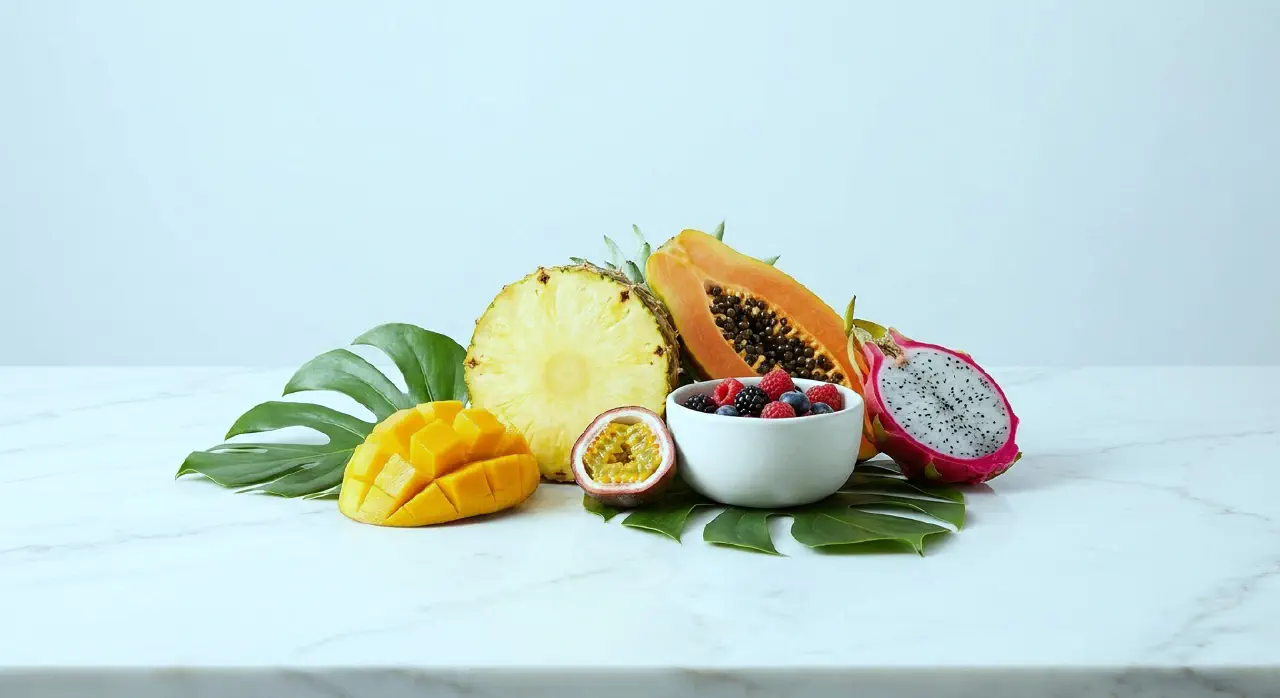
The tropical fruits are the most biochemically extreme in the kitchen - featuring the most dramatic starch-to-sugar conversions, the most powerful protein-digesting enzymes, and in durian, the most polarizing aroma chemistry in the plant kingdom. All are native to warm climates and most suffer chilling injury at refrigerator temperatures (see produce-handling). The group splits evenly between climacteric species (banana, mango, papaya, cherimoya) that can ripen after harvest and non-climacteric species (pineapple, lychee) that cannot.
Banana and plantain
A tree-sized herb related to grasses, native to Southeast Asia, and one of the world’s most important food crops (~30 lb/14 kg per capita worldwide, with staple regions consuming several hundred kg annually). Each plant produces a single flower structure with 1–20 “hands” totaling ~300 individual “fingers.”
The starch flip
The most dramatic sugar metabolism in the fruit world: unripe banana is 25:1 starch-to-sugar; ripe banana is 1:20 - reaching ~20% sugar, exceeded only by dates and jujubes. Plantains retain dry starchy character even when ripe (~6% sugar, ~25% starch) and function as potatoes: fried, mashed, cooked in chunks. The distinctive banana aroma comes primarily from amyl acetate and other esters, with green, floral, and clove (eugenol) notes.
Browning
Very prone to enzymatic browning from phenolic substances in defensive latex-bearing vessels. Phenolics decline ~50% during ripening. Ripe flesh can be refrigerated with relatively little discoloration (peel blackens but flesh survives).
Mango
Asian tree related to pistachio and cashew, cultivated for thousands of years in hundreds of varieties with very different qualities. Climacteric and starch-storing - can be picked green and will sweeten during ripening (proceeds from seed outward). Complex flavor profile featuring lactones (peach/coconut), fruity esters, medicinal or turpentiny terpenes, and caramel notes. Deep orange from carotenoid pigments. Green mangoes are extremely tart - made into pickles and dried into acidifying powder (Hindi amchur). Skin contains irritant phenolics related to cashew allergens.
Pineapple
Bromeliad family native to arid South America, made of 100–200 fused seedless fruitlets in a spiral. Non-climacteric and stores no starch - the great counter-intuitive fruit. It softens and yellows on the counter, but will not sweeten after harvest. This means exported pineapples, harvested early for shipping durability, may contain as little as 50% of their potential sugar with minimal aroma. Quality varies by zone within a single fruit: base fruitlets (oldest) are sweetest; acidity doubles from core to surface.
At its best, pineapple is intensely sweet and tart (citric acid), with a complex aroma of fruity esters, pungent sulfur compounds, vanilla and clove essences, and caramel/sherry overtones. Contains several protein-digesting enzymes, primarily bromelain - powerful enough to dissolve gelatin (must pre-cook for gelatin desserts) and break casein proteins in dairy into bitter fragments.
Papaya
A large herbaceous plant (looks like a tree but isn’t), American tropical origin. Climacteric but doesn’t store starch - ripening brings softening and carotenoid intensification but apparent sweetness increases mainly because softened tissue releases sugars more readily. Ripe flavor is low-acid, delicate, flowery from terpenes, with a surprising touch of cabbage-like pungency from isothiocyanates (the same cabbage-family defense compounds). Seeds concentrate these isothiocyanates and can be dried as a mildly mustardy seasoning. Contains papain in milky latex - the enzyme used in commercial meat tenderizers.
Durian
The fruit kingdom’s answer to the allium defense system. Southeast Asian native weighing 13+ lb, covered in thorns, apparently evolved to appeal to elephants and other large jungle creatures. The sulfur compound arsenal overlaps significantly with onion, garlic, overripe cheese, and skunk spray. The outer rind concentrates the most intense compounds; the fleshy segments inside are more conventionally fruity and savory, with exceptionally high dissolved solids (36%). Creamy, custard-like texture. Fermented into the even stronger Malaysian tempoyak.
Passion fruit
South American vine producing brittle-husked fruits where the edible portion (arils around hard seeds) is barely one-third of fruit weight. The sparse pulp has such concentrated flavor that it actually benefits from dilution. Relatively high citric acid (2%+ in purple types, double in yellow). Complex aroma combines fruity esters, lactones, and ionone with unusual musky sulfur compounds - the same “catty” sulfur found in black currants and sauvignon blanc.
Lychee and relatives
Subtropical Asian tree producing small plum-sized fruits where the edible portion is a fleshy seed covering (aril) - pale white, sweet, with a distinctively floral aroma from terpenes (rose oxide, linalool, geraniol) comparable to Gewürztraminer wine. Don’t improve off tree. Fresh lychees sometimes develop pink color during cooking as phenolic aggregates break apart and convert to anthocyanins. Rambutans, longans, and pulasans are related arils with similar qualities.
Cherimoya, guava, and others
Cherimoya (Annona genus): climacteric starch-storing fruit with soft, sweet, low-acid flesh - banana-like esters plus flowery terpenes. Must stay above 55°F until ripe. Guava: myrtle family (same as clove and nutmeg trees), with strong spicy/musky aroma, hundreds of small seeds and stone cells. Remarkable vitamin C - up to 1 g/100g, concentrated near the peel. High pectin content made it the New World’s quince paste. Star fruit: decorative star cross-section, Concord grape and quince notes, high oxalic acid in ridges.
Meat-eating fruits: the protease puzzle
Four tropical fruits contain powerful protein-digesting enzymes: bromelain (pineapple), papain (papaya), actinidin (kiwi), and ficin (fig). All dissolve gelatin and tenderize meat. The evolutionary puzzle: why would fruits meant to be eaten contain meat-digesting enzymes? Probable answer: parasite control - the enzymes may limit how much any animal eats, and may benefit seed-dispersing animals by eliminating intestinal parasites (tropical peoples use fig and papaya latex to dissolve tapeworms).
Breadfruit and jackfruit
Artocarpus genus relatives of mulberry and fig. Breadfruit: Pacific island staple with 65% starch by dry weight - boiled, roasted, fried, fermented, or ground into flour. Captain Bligh of Bounty mutiny fame was transporting breadfruit to the Caribbean. Jackfruit: Indian native, can reach 10× breadfruit weight, with musky-berry-pineapple-caramel aroma.
See also
- fruit-ripening - climacteric vs non-climacteric, the pineapple trap, starch-to-sugar conversion
- protein-denaturation - protease enzyme effects on gelatin, dairy, and meat proteins
- alliums - durian’s sulfur chemistry parallels onion/garlic
- cabbage-family - isothiocyanates shared with papaya
- plant-color - carotenoids in mango and papaya, anthocyanins in lychee
- produce-handling - chilling injury in tropical fruits
- dried-fruits - dried banana, mango, pineapple, dates