Stone Fruits
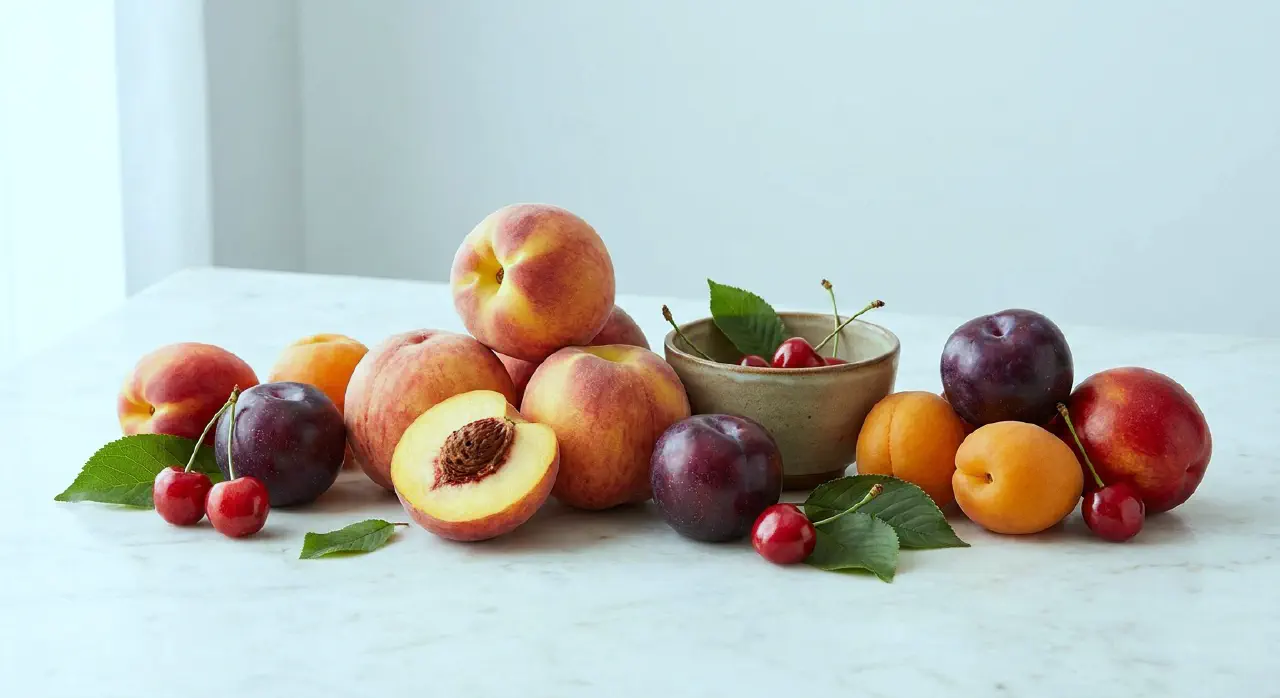
All species of genus Prunus in the rose family, defined by a stone-hard shell surrounding a single large central seed. Mostly Asian in origin, with ~15 species found across the northern hemisphere. The critical difference from their pome fruit relatives: stone fruits do not store starch - they cannot get sweeter after harvest. Ripening continues post-harvest (softening, aroma development), but the sugar level is locked in at picking. This makes them more seasonal and more dependent on good sourcing than the storable, sweetening pome fruits.
Shared chemistry
Seed benzaldehyde: Stone fruit seeds contain a cyanide-generating enzyme system that produces benzaldehyde - the aroma of almond extract. Seeds can replace bitter almonds in European pastries and lend almond character to preserves when included. Cherry clafoutis with pits left in is the classic application: heat intensifies the almond and flowery notes.
Sorbitol: All accumulate this indigestible sugar alcohol (the same compound in sugar-free products), especially prunes, where it reaches 15% of dry weight and drives the well-known laxative effect.
Phenolic antioxidants: Rich throughout the genus, concentrated in skin and flesh.
Apricots
Chinese native, spread to the Mediterranean during Roman times. The name derives from Latin praecox (“precocious”) for its early flowering. A rich aroma of terpenes (citrus, herbal, floral) mixed with peach-like lactones. Delicate and transport-poorly, so most are commercially processed. Excellent for drying - concentrate sweet-tart flavor. Sulfur dioxide treatment preserves beta-carotene and fresh flavor; unsulfured apricots turn brown with a flatter, more cooked taste.
Cherries
Two main types: sweet (P. avium, higher sugar) and sour (P. cerasus, far more grown commercially, mostly processed). Must be picked ripe and fragile - no post-harvest improvement. Color ranges from deep anthocyanin red (excellent antioxidant source) to pale yellow. The aroma combines almondy benzaldehyde, flowery linalool, and clove-like eugenol. Modern maraschino cherries bear almost no resemblance to the original northeastern Italian preserve - they’re bleached, brined, dyed, and flavored, leaving mainly the original cell wall skeleton.
Peaches and nectarines
Twin fruits - both Prunus persica (named for Persia, the route from China to the Mediterranean). Nectarines have smooth skin, are usually smaller, firmer, and more aromatic. Flesh ranges from white to yellow (carotenoid pigments), clingstone to freestone, firm to melting. The distinctive peach aroma comes from lactones - the same compound family responsible for coconut character - with some varieties adding clove-like eugenol.
The mealiness problem
Impaired pectin breakdown from cold storage below ~45°F (8°C) before ripening is complete produces the notorious mealy texture - especially common in supermarket fruit. The solution: avoid refrigerating peaches until fully ripe. Ripening begins at the stem end and along the groove (suture).
Plums
Two major lineages: European (P. domestica, Eurasian origin - prune plums, greengages, Reine Claude) and Asian (P. salicina, Chinese origin, improved by Luther Burbank after 1875 - Santa Rosa, larger, rounder). These are true climacteric fruits that can be harvested before ripening and stored briefly at 32°F. Aroma combines benzaldehyde, flowery linalool, peachy lactones, and spicy methyl cinnamate. Pluots and plumcots (plum-apricot hybrids) tend sweeter with more complex aroma.
Prunes
Sun-dried or dehydrated plums (18–24 hours at ~175°F/79°C to 15–20% moisture). Sugar concentrates to nearly 50% of weight, acids to 5%, and browning reactions generate caramel and roasted notes. Exceptional phenolic antioxidants (~150 mg/100g). Function as a natural flavor stabilizer in ground meats (prevents warmed-over flavor at 1–2% inclusion) and as a fat replacement in hamburgers and baked goods due to moisture-retaining fiber and sorbitol.
Cooking and preservation
Lower pectin content than pome-fruits means stone fruits don’t produce jellies as readily. More fragile tissue breaks down faster in cold storage. The seed benzaldehyde is a powerful flavor tool - including pits during cooking (cherry clafoutis, apricot jam) adds complexity. Dried forms (apricots, prunes, cherries) concentrate both sugar and phenolic compounds, working well in both sweet and savory applications.
See also
- fruit-ripening - why stone fruits can’t sweeten post-harvest (no starch storage)
- pome-fruits - rose family relatives that do store starch
- plant-color - anthocyanins in cherries, carotenoids in apricots and peaches
- dried-fruits - prunes, dried apricots, dried cherries
- maillard-reaction - browning reactions in dried stone fruits
- produce-handling - chilling injury, cold storage limits
- nuts - almonds are stone fruit seeds; bitter almonds and benzaldehyde chemistry; apricot/peach kernels as benzaldehyde source