Seed Oils and Oil-Rich Seeds
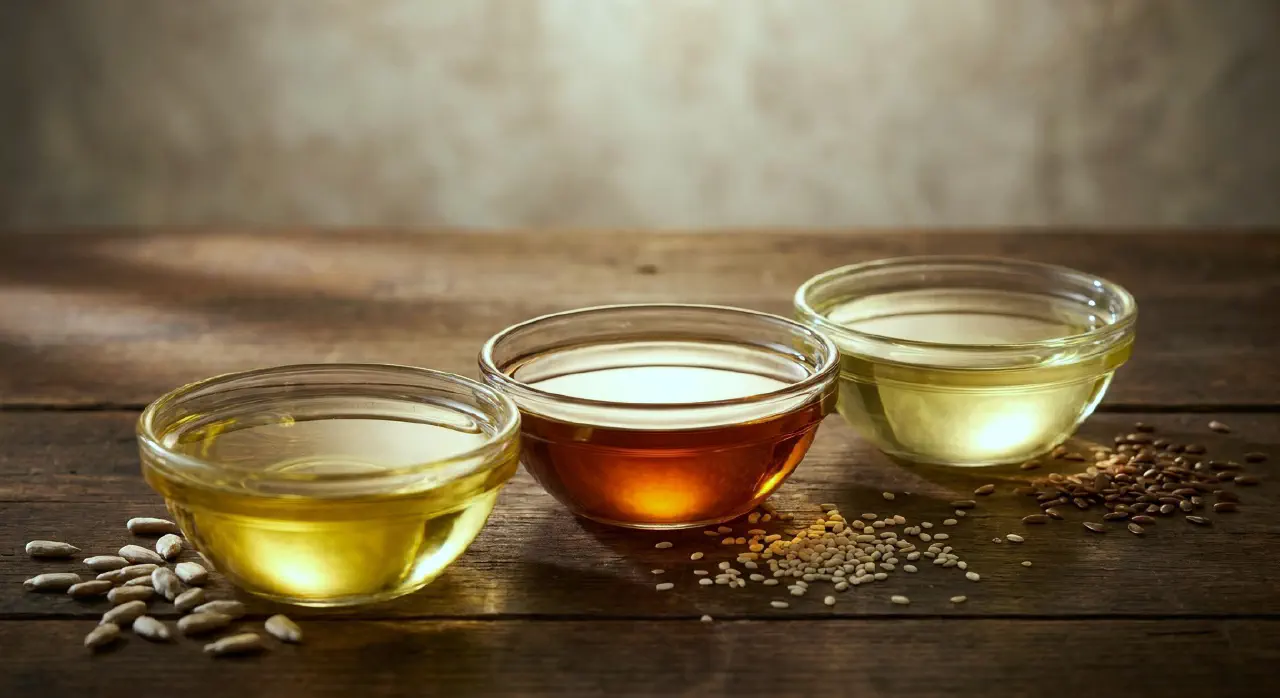
Seed oils extend the culinary reach of nuts and legumes into cooking fats and flavor carriers. The method of extraction - mechanical pressing or solvent dissolution - determines the oil’s flavor, allergenic potential, and suitable uses. Rancidity is the universal risk: all seed oils contain unsaturated fatty acids that oxidize into cardboard-and-paint-smelling fragments when exposed to light, heat, oxygen, or time.
Extraction methods
Cold-pressed (expeller-pressed): Cells are crushed and oil forced out by mechanical pressure. Heat from friction rarely exceeds boiling point. Trace compounds - including flavor molecules and potential allergens - remain. Used primarily as flavoring oils (stronger, distinct character). Flavor intensifies further if seeds are roasted before pressing.
Solvent-extracted: Oil dissolved from crushed seeds with solvents at ~300°F (150°C). More refined; fewer trace compounds - less flavorful, less allergenic, more neutral. The standard for cooking oils used at high heat.
Smoke points: Refined solvent-extracted oils (sunflower, peanut, refined sesame) handle high-heat cooking. Cold-pressed specialty oils (walnut, flaxseed, argan) contain trace compounds that lower smoke points - use for finishing, dressings, and low-heat applications.
Rancidity and storage
Unsaturated fatty acids - especially polyunsaturated - are oxidation-vulnerable. Polyunsaturates (linoleic, linolenic) are most fragile; monounsaturates (oleic) more stable; saturated fats (coconut) extremely stable. Key principles: dark bottles or opaque containers, cool temperatures, airtight sealing. Refrigeration is best for fragile oils. Since oils contain no water, they can be frozen without quality loss.
Sesame seeds
Central African origin (Sesamum indicum); now grown mainly in India, China, Mexico, Sudan. Small seeds (250–300 per gram); ~50% oil. Usually lightly toasted (250–300°F / 120–150°C, 5 minutes) before use - developing nutty flavor including sulfur aromatics (furfurylthiol) shared with roasted coffee.
Sesame oil extracted from thoroughly toasted seeds (360–400°F, 10–30 minutes) has remarkable rancidity resistance from a combination of antioxidant phenolic compounds (lignans), vitamin E, and browning reaction products. Used as a flavoring - not a cooking oil - and keeps significantly longer than other polyunsaturated oils. Tahini: sesame ground into paste; combined with chickpeas for hummus, with eggplant for baba ghanoush.
Flaxseed (linseed)
Small, tough reddish-brown seeds (~35% oil, ~30% protein, ~30% fiber) with over half the oil as linolenic acid (omega-3 fatty acid) - the richest plant food source of omega-3. The body can convert this to the long-chain DHA and EPA found in seafood, though conversion is inefficient.
Flax gel: Ground flaxseed in water forms a thick gel (seed coat gum - long sugar chains). An effective emulsifier and foam stabilizer; improves baked goods volume and acts as an egg substitute in vegan baking. Flax oil is extremely fragile (high omega-3 content) - always refrigerate; use raw, never heated.
Sunflower seeds
American Southwest origin; domesticated in Mexico ~3,500 years before European explorers; spread to Europe as a decorative plant (~1510), then cultivated for oil in 18th-century France and Bavaria. Now one of the top annual oil crops worldwide, with Russia the leading producer.
Rich in phenolic antioxidants and vitamin E (24% protein, 47% oil). The eating varieties have decoratively striped hulls and are larger than oil types. Sunflower oil - predominantly linoleic acid - is a widely used neutral cooking oil.
Pumpkin seeds
New World (Cucurbita pepo); notable deep green color from chlorophyll; ~50% oil, ~35% protein, no starch. Widely eaten as snack; used in Mexican cooking as sauce thickener. “Naked” varieties lack the tough adherent seed coat.
Pumpkin seed oil: A prominent Central European salad oil with intriguing color-shift properties from combined carotenoid and chlorophyll pigments. Cold-pressed raw seeds: green. When seed meal is wetted and heated for higher yield: more carotenoids extracted, making the bulk oil dark brown. But in a thin layer (bread dipped in oil), fewer pigment molecules absorb light, and chlorophyll dominates - appearing emerald green.
Poppy seeds
From Papaver somniferum - the same plant whose immature seed capsules yield opium. Seeds are harvested after latex flow stops and contain only trace opiate alkaloids (not physiologically active amounts, but detectable on drug tests after consumption of poppy-containing baked goods). Tiny (1–2 million per pound), 50% oil. Blue color is an optical illusion: the actual pigment layer is brown, but calcium oxalate crystals in outer cell layers refract light, selectively reflecting blue wavelengths.
Argan oil
From drought-tolerant Moroccan trees (Argania spinosa, chicle and miracle fruit relative). Shelled nuts roasted then ground and pressed. Distinctive almost-meaty aroma; valued as a culinary oil in North African cooking and increasingly globally.
See also
- seed-biology - oil body structure, rancidity chemistry, storage principles
- nuts - nut oils and their fragility; nut milks via oil body preservation; extraction parallels
- flavor-chemistry - fat solubility of aromatic compounds; phenolic antioxidants
- coffee - sesame oil’s sulfur aroma (furfurylthiol) shared with roasted coffee
- maillard-reaction - toasting sesame; antioxidant browning reaction products
- plant-color - pumpkin seed oil’s carotenoid/chlorophyll color shift
- lipid-chemistry - triglyceride structure, saturation mechanics, rancidity, omega-3s
- olive-oil - the fruit-oil counterpart; MUFA-dominant, polyphenol-rich, thermally stable