Pasta and Noodles
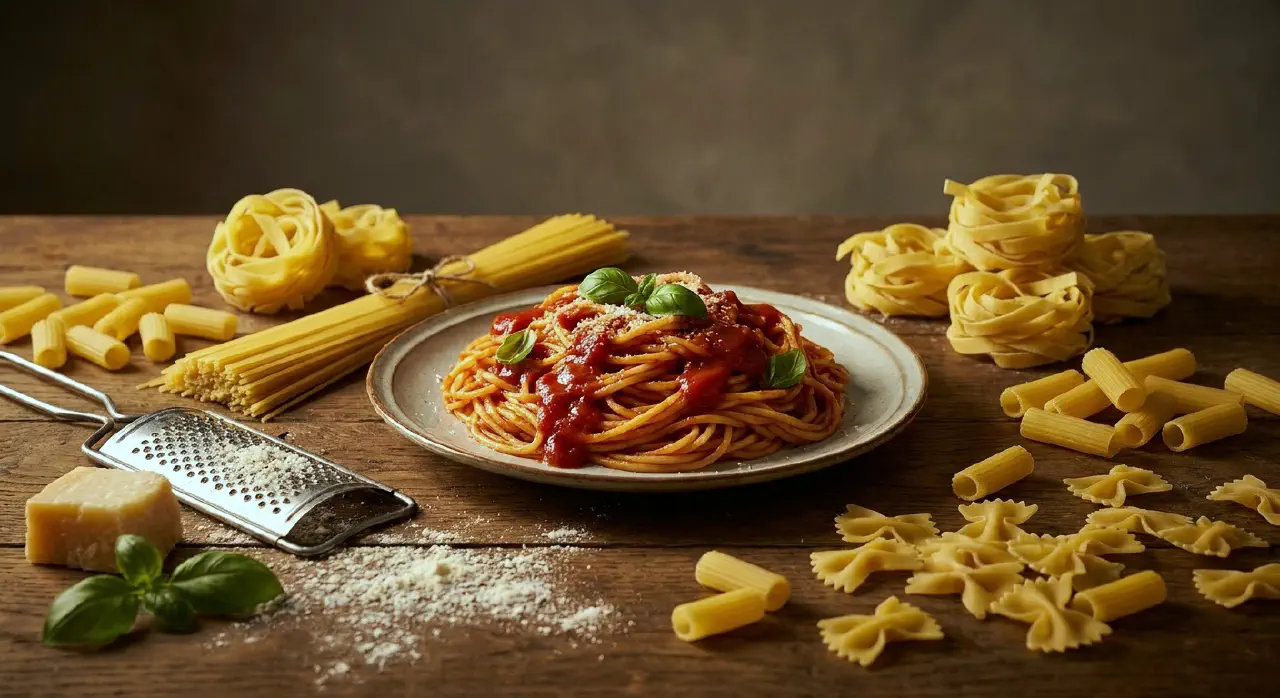
Pasta is a paste of flour and water (or eggs) mixed into a dense, cohesive mass - the structural opposite of bread. Where bread is an aerated foam held together by elastic gluten, pasta is a solid, continuous matrix where gluten provides cohesion and chewiness without any need for gas-trapping elasticity. This difference explains why durum wheat - strong but inelastic - is the ideal pasta grain, while bread wheat’s springy gluten would fight every attempt at shaping.
The durum–soft wheat divide
Durum semolina pasta (Italian dried pasta): Durum’s gluten is strong and cohesive but lacks elasticity - it holds together without springing back. The hard, glassy kernel mills into coarse, golden semolina (colored by the carotenoid lutein). Protein content is high (12–16%), producing a satisfyingly chewy texture. Durum absorbs nearly 50% more water than bread flour, contributing to slower cooking and firm bite. This is the pasta of spaghetti, penne, rigatoni - shaped by extrusion through dies.
Bronze vs Teflon dies: Traditional bronze dies cut a rougher surface that grips sauce. Modern Teflon dies produce smoother, shinier pasta that sheds sauce more easily - a meaningful difference in the finished dish.
Egg pasta (fresh pasta): Made from soft wheat flour enriched with eggs (whole or yolks). Eggs add fat, binding ability, and richness while reinforcing the weaker soft-wheat gluten with coagulable egg protein. The result is more tender, silken, and delicate than durum pasta - less chewy, more yielding. This is the pasta of tagliatelle, ravioli, lasagne - rolled thin, cooked fresh or briefly dried.
Asian noodles
Asian noodle traditions developed independently of Italian pasta, with different flours, additives, and techniques.
Alkaline noodles (ramen, chow mein): Soft wheat flour treated with kansui - a solution of potassium and sodium carbonate. The alkaline pH strengthens gluten (similar to salt’s tightening effect), toughens the noodle texture, creates the characteristic yellow color, and produces a subtle alkaline flavor. Ramen’s distinctive chew and snap come from this treatment, not from high-protein flour.
Hand-pulled noodles: High-hydration soft wheat dough, repeatedly stretched and folded - the noodle equivalent of lamination. Requires extensible gluten that can stretch extremely thin without snapping.
Rice noodles: Made from rice flour and water, sometimes with added tapioca starch for improved texture. No gluten at all - structure relies entirely on gelatinized starch. Very delicate, cook quickly, overcook easily. The translucent, slippery character is pure starch behavior.
Starch and bean noodles (cellophane/glass noodles): Made from mung bean, sweet potato, or tapioca starch. Transparent, slippery, mild-flavored - they absorb sauce flavors and contribute texture rather than flavor. Often soaked rather than boiled.
Pasta making
Durum dough: Very stiff - semolina absorbs water slowly, and the initial mixture is dry and crumbly. Extended kneading (or industrial mixing under pressure) develops the gluten network into a cohesive, firm mass that holds shape when cut or extruded. Standard ratio: ~100 parts semolina to 30–35 parts water.
Egg pasta dough: Softer and more elastic than durum. Eggs provide most of the liquid; additional water is minimal or none. Less kneading required. Rolled thin by hand or machine, then cut.
Drying: Fresh pasta (30–40% moisture) spoils quickly. Industrial drying reduces moisture to 12–13% (equilibrium with air) - shelf-stable for months or years. Slow, low-temperature drying produces better texture than rapid high-temperature methods.
Cooking science
Pasta cooking is a controlled hydration of the starch-gluten matrix:
- Starch gelatinization: As water penetrates, starch granules absorb it, swell, and release amylose - clouding the cooking water. The exterior gelatinizes first while the interior remains firm.
- Gluten’s structural role: The gluten network holds the swelling starch granules in place, preventing the pasta from disintegrating. Without gluten (rice noodles), structure is more fragile.
- Al dente (“to the tooth”): The moment when the exterior is fully gelatinized and tender but the interior retains a thin core of unhydrated starch - producing pleasant firmness when bitten. This is a gradient, not a binary.
- Overcooking: Continued hydration breaks down the gluten network, starch granules swell excessively and rupture, and the pasta becomes mushy. The structural integrity collapses.
- Carryover cooking: Pasta continues hydrating after draining from residual heat. Draining slightly before ideal doneness compensates.
Dried vs fresh cooking: Dried pasta (12% moisture) needs 8–12 minutes as water slowly penetrates inward. Fresh pasta (30–40%) needs only 2–5 minutes - much of the hydration is already done. Fresh pasta has a less distinct al dente point due to its higher initial moisture.
Pasta water: The starch released into cooking water is a valuable emulsifier and thickener for sauces - it helps bind sauce to pasta by creating a starchy bridge between the two.
Specialized forms
Couscous: Tiny balls of durum semolina and water - technically not pasta. Steamed (not boiled), so starch hydrates from steam rather than immersion. Creates a light, fluffy, grain-like texture. North African staple.
Dumplings: Soft wheat flour wrappers (high hydration, tender) filled with meat, vegetables, or seafood. Cooked by boiling, steaming, or pan-frying (potstickers combine two methods). The wrapper’s tenderness comes from minimal gluten development and thin rolling.
Spätzle: German egg noodles. Soft batter (flour, eggs, milk) pushed through a colander or slotted tool into boiling water - irregular, tender, fluffy pieces that float when done.
Gnocchi: Italian potato dumplings. Boiled potatoes mashed with flour and sometimes egg. Minimal mixing is critical - overdeveloped gluten makes gnocchi tough and rubbery rather than tender and pillowy.
See also
- gluten-science - glutenin vs gliadin, how gluten character shapes every dough type
- wheat - durum vs bread wheat, the species that define pasta vs bread
- starch-gelatinization - what happens to starch granules during pasta cooking
- flatbreads-specialty - other wheat preparations: flatbreads, dumplings overlap
- rice - rice noodles as a gluten-free alternative
- bread-baking - the aerated counterpart to pasta’s dense matrix