Flatbreads and Specialty Breads
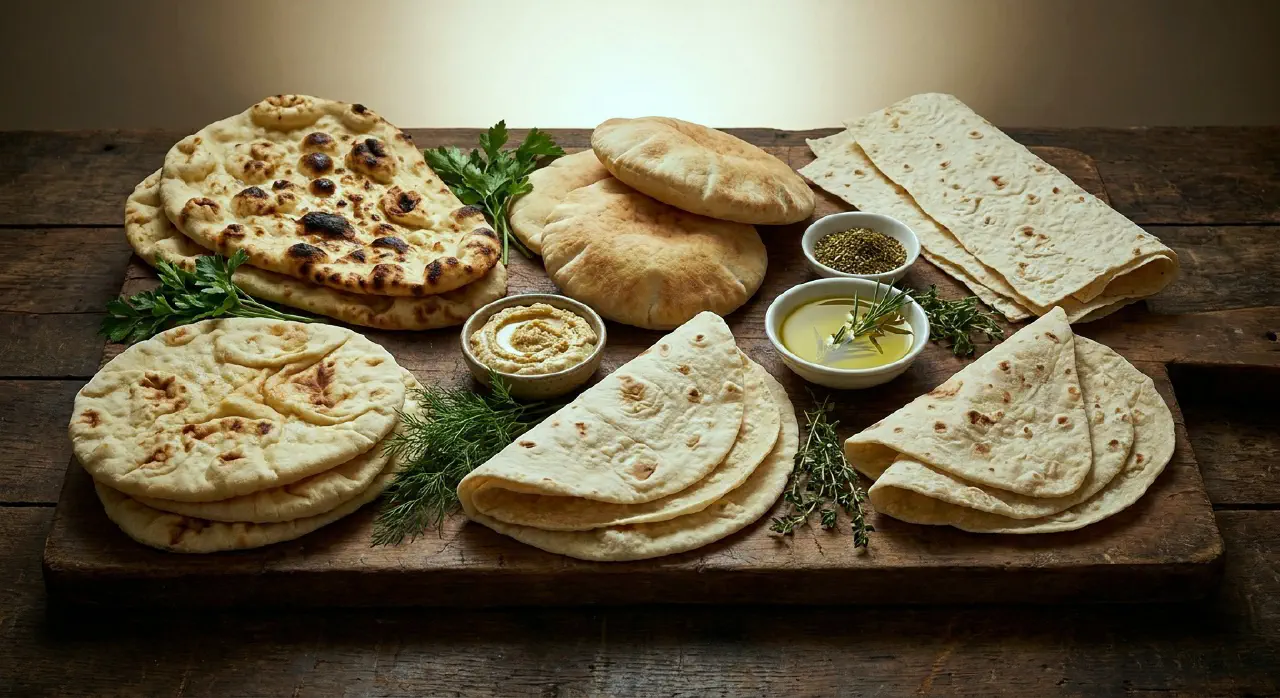
Flatbreads are the original breads - thin doughs cooked quickly on simple hot surfaces, predating ovens and leavening by millennia. They remain the daily bread for much of the world: Middle Eastern lavash and pita, Indian roti and naan, Latin American tortillas, North American johnnycake. Beyond flatbreads, this page covers the specialty breads that don’t fit neatly into the standard loaf-bread workflow: pretzels, bagels, steamed breads, enriched holiday breads, and gluten-free formulations.
Flatbread fundamentals
Flatbreads cook in 2 minutes or less on a simple hot surface - pan, oven floor, oven wall, or hot stones. Their essential characteristics all flow from thinness:
- Don’t require strong gluten - can be made from any grain flour
- Leavened by steam - tiny air pockets puff from rapidly vaporizing water, no fermentation needed
- Tender crumb - quick baking + thinness = minimal gluten development
- Extensive browning - high surface-to-volume ratio + intense heat = toasted flavor across large surface area despite short baking time
The puffing mechanism
When both surfaces of a thin bread set and harden before the interior, the softer interior layer accumulates steam. Pressure eventually tears the tender center, forcing the surfaces apart - creating an impressive, temporary balloon and a central cavity (pita’s pocket). This is exploited for filling.
Docking - pricking dough in a regular pattern - prevents puffing by creating dense gluten nodes that resist steam inflation. Used deliberately for crackers, which would be too fragile if puffed.
Regional flatbreads
Pita and pocket breads: High oven heat creates the conditions for full puffing. The central cavity forms a natural pocket for fillings. Traditionally baked on oven floors or hot stones.
Naan: Indian flatbread enriched with yogurt, baked in a tandoor - a clay oven at extreme temperatures. Dough adheres to the oven’s interior walls; intense radiant heat creates characteristic charred spots and a tender, slightly chewy interior.
Chapati and roti: Indian whole-wheat flatbreads made from just flour and water. Dry-roasted on a griddle; steam puffing occurs despite no added leavening. Phulka: chapati finished directly over flame for a final dramatic puff. Paratha: folded with ghee, creating flaky layers - a lamination technique parallel to Western puff pastry.
Tortilla: Mexican maize or wheat flour flatbread. Cooked quickly on a griddle. Corn tortillas use masa (nixtamalized corn), which requires no gluten at all.
Pizza: Leavened, fermented dough stretched thin and baked at extreme temperatures (up to 900°F/450°C in wood-fired ovens). The thinness allows high heat to develop intense browning without overcooking the interior.
Pretzels
Distinctive for their alkaline surface treatment. Stiff yeast dough of soft wheat flour is shaped, then sprayed with hot 1% sodium hydroxide (lye) or sodium carbonate solution for 10–15 seconds. This treatment:
- Gelatinizes surface starch into a shiny coating
- Creates strongly alkaline conditions that accelerate Maillard browning - producing the dark brown color and distinctive flavor
- The lye reacts with CO₂ during baking to form harmless edible carbonate
Salt sprinkled on the wet alkaline surface adheres firmly. A brief hot bake (~5 minutes) sets the shiny, dark crust; then a long slow bake dries the pretzel throughout for crispness.
Soft pretzels: Dough is allowed to rise, briefly boiled in baking soda solution (milder than lye), then baked 10–15 minutes. Softer, less dramatically flavored.
Bagels
Dense, chewy, ring-shaped bread from Eastern Europe (brought to New York by early-20th-century immigrants). The traditional bagel is defined by:
- Very stiff dough: Only 45–50 parts water per 100 flour (vs 65 for standard bread) - creating the characteristic density
- Strong-gluten flour: Required for chewiness
- Boiling before baking: Dough immersed in boiling water 1.5–3 minutes per side, which gelatinizes the surface starch into a thick, shiny crust and limits oven spring
- Optional retardation: ~18-hour cold retard gives better crumb and flavor
Modern mass-produced bagels skip the boil (substituting steam), use softer dough, and produce a puffier, lighter ring - a fundamentally different product with thinner crust and less chew.
Asian steamed breads
Chinese steamed breads and buns, made for ~2,000 years. Small, round, very white with smooth, shiny surfaces and moist, springy texture. Made from soft wheats with moderate gluten content.
Mantou: Chewy steamed bread. Bao: Tender, fluffy steamed bun, often filled.
Steaming (rather than baking in a dry oven) creates the characteristic moist, tender texture and preserves the white color - no Maillard browning occurs in the wet-heat environment.
Sweet and enriched breads
Rich doughs face a fundamental problem: fat and sugar both weaken gluten. Sugar binds water molecules away from gluten proteins; fat bonds to hydrophobic gluten portions, preventing protein-protein connections. Large sugar amounts also dehydrate yeast cells, slowing fermentation.
The building strategy: Mix flour and water first, knead to develop gluten, then add fat and sugar only after the network is established. More yeast compensates for sugar’s growth-slowing effect. Lower baking temperature prevents early surface browning (sugar browns faster than starch).
Brioche: Extremely rich in butter and eggs. Often retarded (chilled 6–18 hours) to stiffen the butter-laden dough for handling. Fine, tender, enriched crumb.
Panettone and pandoro: Italian holiday breads enriched with sugar, egg yolks, and butter, built from a sourdough starter. The sourdough fermentation provides complex flavor and better keeping quality. Remarkable for combining extreme enrichment with natural leavening.
Sourdough breads
Sourdough cultures contain wild yeasts plus acid-producing bacteria - no commercial yeast added. The bacteria produce lactic acid (mild) and acetic acid (sharp); their ratio depends on culture hydration and temperature. Acidity weakens gluten somewhat, producing denser loaves, but also generates complex flavor and extends shelf life (acid retards staling and inhibits mold).
See leavening for sourdough culture science and fermentation-overview for the broader microbial context.
Gluten-free breads
For people with celiac disease (autoimmune reaction to gliadin), bread without wheat, barley, or rye requires alternative structure. Gluten-free flours (rice, etc.) are supplemented with:
- Xanthan gum - a bacterial polysaccharide that provides modest gluten-like elasticity
- Emulsifiers - stabilize gas bubbles and slow CO₂ diffusion during baking
The result is a reasonable facsimile of raised bread, though texture remains less developed than wheat-based loaves.
See also
- bread-baking - standard loaf bread science: mixing, fermentation, baking, staling
- gluten-science - the protein network that flatbreads can do without but bagels demand
- leavening - steam (flatbreads), yeast (enriched breads), chemical (quick breads)
- fermentation-overview - sourdough microbiology, wild yeast + lactobacillus
- maillard-reaction - pretzel browning in alkaline conditions, pizza surface flavor
- pastry - paratha’s lamination parallels Western pastry technique
- wheat - wheat species suited to different bread types