Pome Fruits
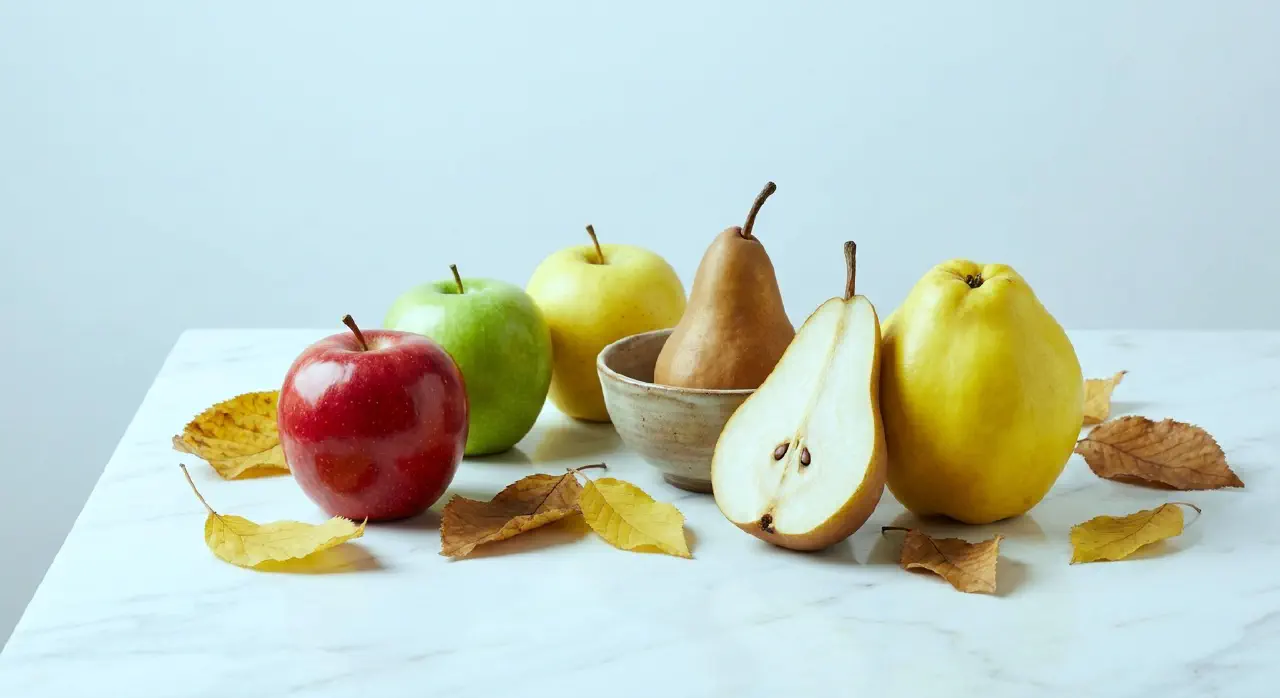
The pome fruits - apples, pears, quince, and their relatives - are all members of the rose family (Rosaceae), native to Eurasia. The defining structure is a thick fleshy portion derived from the enlarged flower stem tip (not the ovary alone), surrounding an inner tough-walled core containing seeds. All are climacteric, storing starch that converts to sugar during ripening, making them the temperate world’s most storable and versatile fresh fruits.
Apples
Central to the story because of sheer diversity - several thousand named varieties - and a unique structural property: up to 25% of apple volume is air, far more than any other fruit (pears have less than 5%). This air content explains both the pleasant crunch of a fresh apple and the mealy texture of an overripe one, where softened cell walls let biting push separated cells apart rather than rupturing them to release juice. During baking, those air cells fill with steam, potentially splitting the skin unless a vent strip is removed.
Flavor geography
Apple flavor ranges enormously by variety, from simple and refreshing (Gravenstein, Granny Smith) to honeyed (Fuji, Golden Delicious), winey (well-matured McIntosh), anise-scented (Ellison’s Orange), and nutty (Blenheim Orange). The distinctive cooked apple aroma comes from damascenone, a carotenoid fragment. Volatile esters are concentrated in the skin, where the aroma-creating enzymes are localized - another reason to eat apples unpeeled.
Cooking vs. dessert
Dessert apples (pH ~3.4, ~15% sugar) taste balanced raw but become relatively bland when cooked. Cooking apples (pH ~3.0, ~12% sugar) are distinctly tart raw but develop well-balanced flavor with heat and resist disintegration. Dual-purpose varieties (Golden Delicious, Granny Smith) serve both roles acceptably. The practical test: wrap slices in foil, bake 15 minutes at high heat, observe texture retention.
Post-harvest evolution
Apples consume malic acid for respiration energy during storage, gradually mellowing. 19th-century English connoisseurs sampled periodically from cold storage to capture the moment of peak “volatile ethers at maximum development, acids and sugars at most grateful balance.”
Products
Excellent pectin source - superior jellies. Applesauce (brief cook) and apple butter (slow reduction). Fresh juice darkens within an hour from enzymatic browning; rapid boiling inactivates the enzymes but introduces cooked flavor. Cider traditions in Spain, France, and England use slow cold-winter fermentation.
Pears
Called the “queen of fruit” for refinement of flavor and texture. Denser flesh than apples with distinctive stone cells (gritty cellulose-rich clusters, variable by variety - centuries of breeding reduced them in European eating varieties). Less tart than apples, with a characteristic “pear ester” (ethyl decadienoate) aroma. More flavorful at the flower end than the stem end.
The off-tree ripening rule
Pears are unique among common fruits: they achieve highest quality when picked mature but still hard, then ripened off-tree at 65–68°F (18–20°C) over several days. If left to begin ripening on the tree, the texture goes mushy and the core breaks down. Cannot be enclosed in plastic bags (CO₂ sensitivity). Higher respiratory rate than apples means shorter storage life.
Varieties
European pears (P. communis): summer (Bartlett/Williams), autumn (Bosc, Comice), winter (Anjou). The soft “butter” texture was bred in 18th-century Belgium and France. Asian pears (P. pyrifolia): juicy but crisp, apple-shaped or elongated, more bruise-prone (often marketed in protective sleeves).
Quince
The primitive pome - hard, gritty, astringent, and flowery even when ripe. Gives a taste of what apples and pears might originally have been. A distinctive lactone/ionone aroma is concentrated in the fuzzy yellow skin (Nostradamus noted that cooks who peel quince lose the best part).
The ruby transformation
Slow cooking in sugar over hours transforms quince from pale off-white through pink to translucent ruby red. The mechanism is remarkable: colorless phenolic compounds in the flesh convert to anthocyanins during cooking - one of the very few foods that generates new pigment rather than losing it. Pears contain the same precursor compounds but in much smaller quantities (1/25th to 1/2 of quince levels), achieving pale pink at best.
Traditional preserves exploit this: Spanish membrillo, Italian cotognata, and the original Portuguese marmelada (marmalade was originally quince paste, not citrus).
Medlar and loquat
Medlar (Mespilus germanica) is now rare but historically important as a winter fruit. Like quince, it’s hard and astringent when ripe, requiring bletting - a controlled self-digestion over 2–3 weeks where internal enzymes soften the flesh, consume astringent tannins and malic acid, and develop spice-apple-wine aromas.
Loquat (Eriobotrya japonica) is an early-ripening subtropical pome with mild, delicate flavor, orange carotenoid-tinted flesh, and good keeping qualities. Neither climacteric nor chill-sensitive.
Phenolic antioxidants
Pome fruits are rich in phenolic compounds, concentrated in the skin. Some apple varieties deliver antioxidant activity equivalent to the vitamin C in 30 orange servings. Both apples and pears contain sorbitol (~0.5%), an indigestible sugar alcohol that can cause digestive discomfort in large servings.
See also
- fruit-ripening - climacteric ripening, ethylene, starch-to-sugar conversion
- plant-color - anthocyanins (red apple/quince color), carotenoids, enzymatic browning in juice
- plant-preservation - pectin gelation, cider fermentation, drying
- plant-flavor - ester aroma families, tannin astringency
- stone-fruits - rose family relatives with different storage and ripening behavior
- produce-handling - ethylene management, cold storage strategy