Preserved Fish
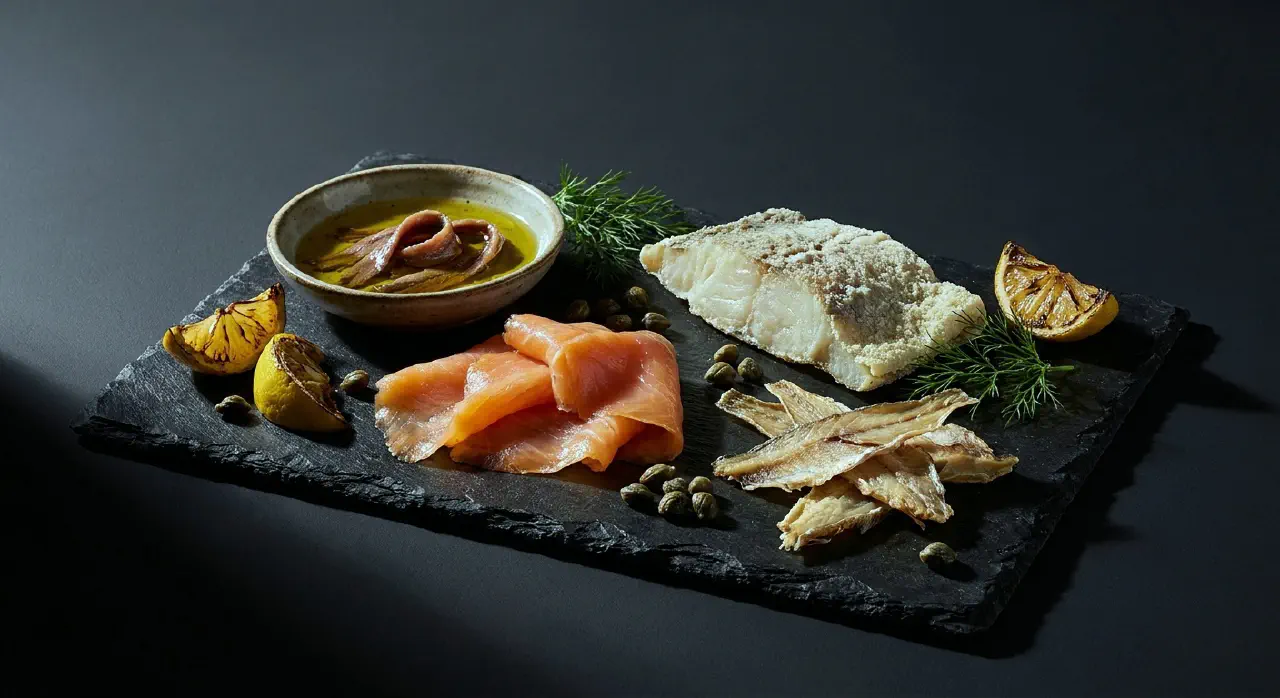
Fresh fish is about 80% water and spoils faster than any other animal protein. Before refrigeration, most harvested fish required immediate preservation - and the methods developed to solve this problem created some of the most complex flavors in any cuisine. Drying, salting, smoking, and fermenting didn’t just preserve fish; they transformed it into tradeable commodities that built European maritime prosperity and underpin Asian flavor systems to this day.
Drying
The simplest method. Below 25% water content bacteria can’t grow; below 15% molds can’t either. Dehydration intensifies flavor by disrupting cells (promoting enzyme action) and concentrating flavor molecules until they react with each other, creating additional complexity.
Lean fish and shellfish are the usual choice - fat oxidizes during air drying, causing rancidity. Fatty fish are smoked or salt-cured instead.
Stockfish (Scandinavian): Traditionally cod freeze-dried on cold, windy coasts for weeks. Modern process: mechanically air-dried 2–3 months at 40–50°F. Becomes hard and dense with pronounced, almost gamy flavor. Requires reconstitution in water for 1+ days.
Katsuobushi (Japanese): The most remarkable preserved fish. Made from skipjack tuna through a four-step, 3–5 month process combining boiling, daily hot-smoking (10–20 days), repeated mold fermentation (Aspergillus, Penicillium species - 2 weeks per cycle, 3–4 cycles), and sun-drying. The finished product sounds like resonant wood when struck. Flavor accumulates from every step: lactic acid and amino acids from muscle enzymes, pungent phenolics from smoke, roasted aromas from browning, and flowery/fruity notes from mold attacking fish fat. Used in fine shavings to make dashi - the Japanese equivalent of concentrated veal stock, delivering months of flavor development in moments.
Salting
Salt both preserves (inhibiting bacteria at 25% saturation) and develops flavor. At gentler concentrations and longer timelines, salt-tolerant bacteria (Micrococcus) break proteins and fats into savory amino acids, fatty acids, and smaller aromatic molecules. The resulting complexity can approach that of salt-cured hams.
Salt cod: Hard-cured for 15 days to saturate flesh, then held without drying for months. White pieces preferred (yellow/red indicates oxidation). Must be reconstituted by soaking with water changes. The Provençal brandade - pounded with olive oil, milk, and garlic - is the iconic preparation.
Salt herring: Medieval innovation. Quick-gutting leaves a portion of intestine rich in digestive enzymes. During 1–4 months in moderate brine, these enzymes create tender, luscious texture with complex fishy-meaty-cheesy flavor. Maatjes (“maiden”) herring are lightly cured seasonal delicacies.
Cured anchovies: Headed, gutted, layered with saturating salt, weighted and held 6–10 months at warm temperatures. Enzymes from muscle, skin, blood, and bacteria generate a remarkable spectrum: fruity, fatty, fried, cucumbery, floral, sweet, buttery, meaty, popcorn, mushroom, malty notes. Used as a general flavor enhancer since the 16th century, replacing ancient Roman garum.
Gravlax: Originally medieval buried, fermented salmon with powerful cheesy smell. Modern version is unfermented - salt, sugar, and dill pressed on salmon fillets for 1–4 days. Salt dissolves myosin, giving compact tenderness. The result is subtle, dense, silken, and glistening.
Fermentation
Many cultures ferment fish, but Eastern Asia is the world center, serving two purposes: preserving small coastal fish and providing concentrated savory flavors for rice-based diets. The tradition apparently originated thousands of years ago in southwest China and the Mekong River.
Simple fermentation (fish sauces and pastes): Small fish mixed with 10–30% salt, sealed 1–24 months. Produces nam pla (Thailand), nuoc mam (Vietnam), patis (Philippines), shottsuru (Japan). First-tapping sauce is most prized. Second-quality is supplemented with caramel or roasted rice. The ancient Roman version - garum - was valued more highly than perfume.
Mixed fermentation (fish + carbohydrate): Larger fish lightly salted and embedded in fermenting rice or grain. Microbial acids preserve the fish while contributing tart, rich, complex flavor. The most important example is narezushi - the original sushi. Funa-zushi from Lake Biwa ferments goldfish carp in rice; bacteria consume the carbohydrates and produce acids that soften even bones. Modern sushi retains the tartness through vinegar added to rice.
See fermentation-overview for broader fermentation science.
Smoking
Probably began with fishermen drying catch over fire. Smoke chemicals have antimicrobial and antioxidant properties, but modern smoking (post-19th century) is mainly about flavor - salt kept around 3%, smoking limited to a few hours.
The process starts with brining (drawing surface proteins, especially myosin, to form a sticky pellicle) and air-drying. Smoke aldehydes react with amino acids in the pellicle to produce golden-brown color.
Cold smoking (below 90°F / 32°C): Fish retains delicate raw texture. Keeps months refrigerated. Premium cold-smoked salmon is cold-smoked 5–36 hours with temperature rising toward 100°F at the end to bring glossy oil to the surface.
Hot smoking (rising to near boiling): Fish is essentially cooked, reaching 150–170°F internally. Produces cohesive but dry, flaky texture. Keeps days to weeks refrigerated.
See meat-curing for parallels with smoked meat.
Marination (Acid Preservation)
Acid cripples microbes while leaving fish with surprisingly delicate aroma - the heavy-smelling aldehydes that accentuate fishiness react with water in acidic conditions and become nonvolatile. Pickled herring is remarkably delicate despite being preserved fish.
Mediterranean inhabitants have marinated fish for thousands of years. “Escabeche” derives from 13th-century Arabic sikbaj. Japanese shimesaba (mackerel) is first dry-salted a day, then immersed in vinegar a day.
Canning
Fish were among the first foods canned (~1810). The two-heat method - cooking before sealing (to drain watery losses), then sterilizing under pressurized steam at ~240°F - softens bones by dissolving calcium salts. Canned salmon contains 200–250 mg calcium per 4 oz serving compared to ~5 mg in fresh fish. Premium canned fish is cooked once in the container, retaining juices without additives.
See Also
- fish - Biology and varieties
- fish-flavor-freshness - TMAO/TMA chemistry underlying preservation flavor development
- fish-safety - Safety considerations for preserved products
- meat-curing - Parallel preservation techniques for land meat
- fermentation-overview - Broader fermentation science
- salt - Salt’s preservation mechanisms