Meat Curing
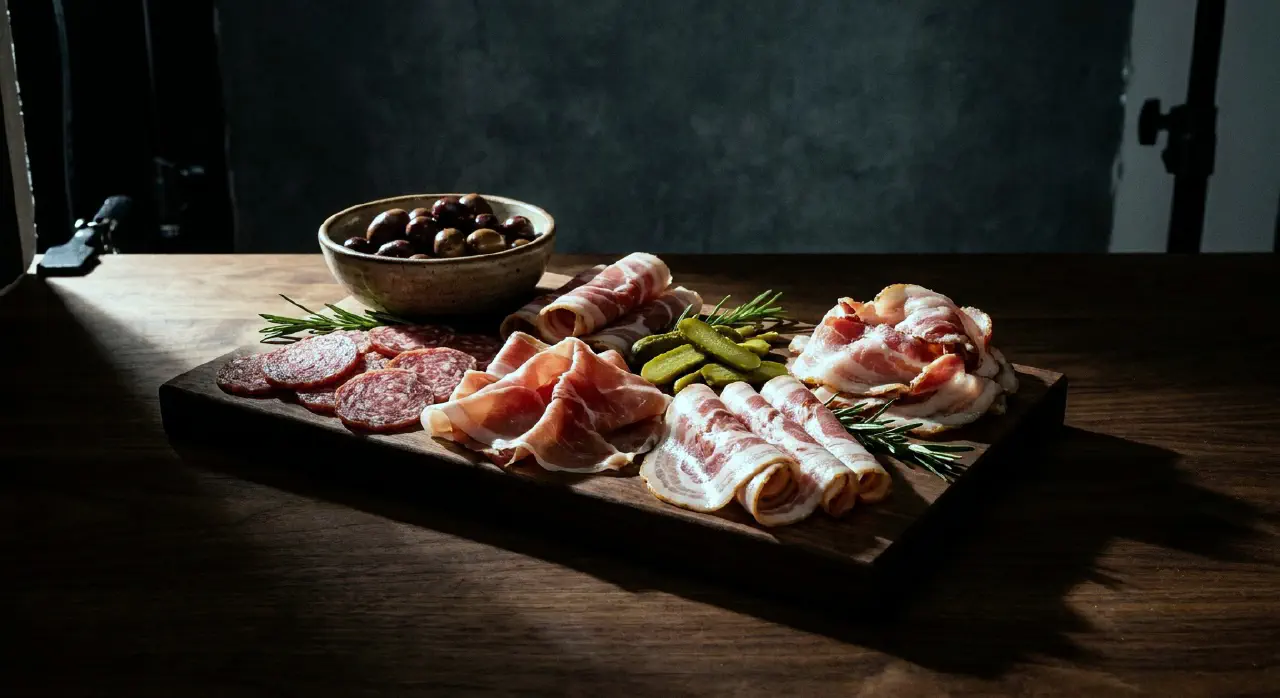
Curing is the ancient practice of making meat inhospitable to microbes through salt, drying, smoke, and fermentation - methods stretching back 4,000+ years. What began as preservation has become one of food science’s most complex flavor-development systems. A dry-cured ham is to fresh pork what aged cheese is to fresh milk.
Salting
Salt preserves meat by creating high dissolved ion concentrations that draw water out of microbe cells and disrupt their cellular machinery. Traditional salted meats contained 5–7% salt by weight and kept for months uncooked.
Salt also has a structural effect: high concentrations cause protein filaments to separate into individual strands too small to scatter light. This is why dry-cured meats are translucent rather than opaque. The same unbunching that produces translucency also weakens the muscle fibers, contributing to the tender-but-dense texture.
Nitrites: the active ingredient
The Middle Ages discovery that saltpeter (potassium nitrate) improved cured meat’s color, flavor, and safety was one of the great accidental advances in food science. German chemists identified the true active ingredient around 1900: nitrite (NO₂), produced from nitrate by salt-tolerant bacteria.
Nitrite does four things simultaneously: it forms nitric oxide which reacts with myoglobin to create the characteristic bright pink-red; it adds a sharp, piquant flavor; it binds to iron in myoglobin to prevent iron-catalyzed fat oxidation (rancidity); and it suppresses Clostridium botulinum - the botulism bacterium. The German word Wurstvergiftung (“sausage poisoning”) reflects how critical this protection is.
Nitrite can form nitrosamines (potential carcinogens) with other food components, but current evidence suggests the risk is small at regulated levels (200 ppm maximum in the US).
Dry-cured hams: the sublime transformation
The greatest achievements of meat curing - prosciutto di Parma, Spanish serrano, French Bayonne, American country hams - undergo one of food science’s most complex transformations over months or years of aging.
The process: meat is packed in dry salt for days, then hung to dry for months to years. During this time, surviving enzymes break flavorless proteins into savory peptides and amino acids. Over months, roughly one-third of the meat’s protein converts to flavor molecules. Glutamic acid (the amino acid behind umami) rises 10–20-fold. Tyrosine is freed in such quantity it may crystallize as visible white specks. Unsaturated fats break down into hundreds of volatile aromatic compounds - melon-like, apple, citrus, flowers, grass, and butter notes. Some compounds react with protein products to produce nutty and caramel flavors normally found only in cooked meats.
The Parma paradox
Parma and San Daniele prosciuttos use only sea salt - no nitrite. Scientists expected them to lack the characteristic pink color, but they develop it anyway through a recently discovered mechanism: specific ripening bacteria (Staphylococcus species) produce a stable red pigment that is not nitrosomyoglobin. More intriguingly, these nitrite-free hams contain more fruity esters than nitrite-cured Spanish and French hams. The hypothesis: nitrite’s antioxidant protection prevents the very fat breakdown that generates the most desirable flavors. Absence of nitrite may be what makes Parma exceptional.
Fermented sausages
The meat parallel to cheese-making: grinding, salting, inoculating with bacteria, then drying. Salt-tolerant Lactobacilli and related species produce lactic and acetic acids, lowering pH from ~6 to 4.5–5 and creating an inhospitable environment for spoilage microbes.
Two regional traditions: Southern Mediterranean (Italian salami, Spanish chorizo) are dried to 25–35% moisture, can be stored at room temperature. Northern European (summer sausages, German cervelats) stay at 40–50% moisture and require smoking, cooking, and refrigeration.
Fermentation temperature profoundly affects flavor: high temperatures produce volatile acids (sharp aroma); low temperatures produce complex nutty aldehydes and fruity esters - the traditional salami flavor. The powdery white coat that develops on the surface is harmless molds and yeasts (Penicillium, Candida, Debaromyces) that contribute to flavor and prevent spoilage.
Smoking
Smoke from burning wood contains hundreds of compounds: antimicrobials, antioxidants, and flavor compounds. Hot smoking (130–180°F/55–80°C, meat in same chamber as fire) cooks while it smokes. Cold smoking (60–80°F/15–25°C, separate firebox) flavors without cooking, developing higher concentrations of sweet-spicy phenolics - finer flavor but more potential carcinogens. Smoke vapors deposit faster on moist surfaces.
Confit
An ancient preservation method - meat cooked slowly in fat, then sealed under a layer of fat. Most famous as Southwest French duck and goose leg confit. The preliminary salting and very gradual cooking often leaves the interior pink (slow cooking preserves myoglobin - the same mechanism that makes slow-cooked meat stay red). Traditional confit flavor improves over months as fat slowly oxidizes - the slight rancidity is part of the desired character.
Sausages and pâtés
Fresh sausages are ground meat and salt in edible casings - salt’s role beyond preservation is dissolving myosin (a fiber protein) onto meat surfaces, where it acts as glue binding pieces together. Emulsified sausages (frankfurters, mortadella) are sheared into a fine paste where fat droplets are stabilized by muscle cell fragments - essentially a meat emulsion. Critical temperature during blending: if pork exceeds 60°F/16°C, the emulsion breaks and leaks fat.
Pâtés and terrines are the refined end: ground meat and fat (traditionally 2:1 ratio) cooked gently in a water bath. Hand-chopping is preferred - machine grinding heats the mixture and damages fat cells, causing separation during cooking.
See also
- meat - structure and the fibers that curing transforms
- meat-aging - the enzymatic breakdown that curing extends to an extreme
- meat-flavor - myoglobin chemistry and species-specific fat flavors
- salt - the fundamental preserving and structural agent
- fermentation-overview - the microbial transformation shared with cheese and yogurt
- cheese - the dairy parallel to fermented sausage production