Stem Vegetables
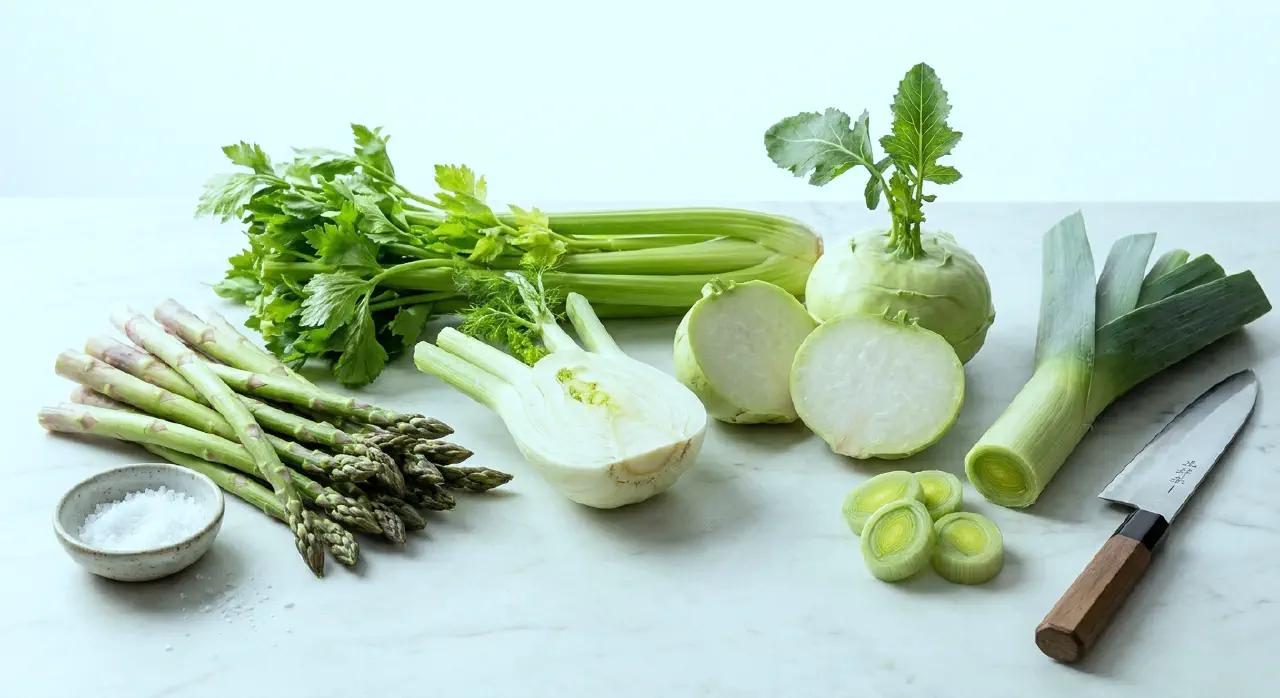
Stems and stalks support other plant parts and conduct nutrients, so they consist largely of fibrous vascular tissue and special stiffening fibers - 2 to 10 times tougher than vascular fibers alone. Cellulose reinforces them further as they mature, and lignin can make them woody. The central cooking challenge is always fiber management: strip it, cut around it, select young growth, or puree and strain.
Asparagus
Lily family native to Eurasia, prized as a tender spring delicacy since Greek and Roman times. The stalk grows from a long-lived underground rhizome, and the small projections along it are leaf-like bracts, not true leaves.
Post-harvest deterioration
Asparagus is the most perishable common vegetable. It continues consuming sugars faster than any other produce after harvest - flavor flattens, juiciness drops, and fibrousness increases from the base upward. Changes are especially rapid in the first 24 hours and accelerated by warmth and light. White asparagus (grown underground, more delicate aroma, some bitterness) toughens even faster.
Recovery: Losses can be partly remedied by soaking spears in dilute sugar water (5–10%) before cooking. The traditional break-point method - bending the stalk to find the mechanical stress border between tough and tender - is 500 years old and still the best approach.
Aroma
Green asparagus is rich in dimethyl sulfide and other sulfur volatiles. Asparagusic acid - a sulfur compound unique to asparagus - is metabolized into methanethiol, which gives asparagus urine its distinctive smell. Some people are genetically unable to produce it; others can’t smell it.
Celery
Mild, enlarged version of the bitter Eurasian herb “smallage,” apparently bred in 15th-century Italy. The greatly enlarged leaf stalks are pleasantly crunchy with a distinctive but subtle aroma from phthalides (shared with walnuts - explaining the Waldorf salad combination) and terpenes (light pine and citrus notes).
Celery, carrots, and onions form the aromatic base of French mirepoix, Italian soffrito, and Spanish sofregit. Louisiana’s Cajun “trinity” substitutes green capsicums for carrots.
Celery root (celeriac): Swollen lower stem with the same phthalide aromatics. Moderate starch content (5–6%). Used cooked like root vegetables or finely shredded raw for crunchy salad.
Fennel
Enlarged leaf-stalk bases forming a tight bulb-like cluster. Strong anise aroma from anethole (the same compound in anise seeds and star anise), plus a distinct citrus note from limonene terpene in the sparse foliage. More dominating and less versatile than celery - eaten raw in thin slices for crunch or braised/gratinéed for sweetness.
Bamboo shoots
Very young stems of tropical Asian bamboos (woody grass family members). Heaped with soil during growth to prevent light exposure, which triggers bitter cyanide-generating compounds. All cyanide is eliminated by boiling until no longer bitter.
Like water chestnuts and lotus root, bamboo shoots retain firm, crisp, meaty texture during and after cooking - even surviving the extreme temperatures of canning. Phenolic compounds in the cell walls cross-link and strengthen them, resisting the softening that breaks down other vegetables. Flavor includes an unusual medicinal or barnyard note from cresol plus brothy aromas from simple sulfur compounds.
Cardoons
Leaf stalks of a Mediterranean thistle, the probable ancestor of the artichoke - and sharing artichoke’s flavor along with abundant astringent, bitter phenolic compounds. The phenolics cause both rapid enzymatic browning when cut and toughening of cell-wall fibers (sometimes remarkably resistant to softening).
Handling: Often cooked in milk, where proteins bind to the phenolics and reduce astringency (the same mechanism as adding milk to strong tea). Gradual boiling in several water changes leaches phenolics and eventually softens the tissue - at the cost of flavor. Sometimes necessary to peel fibers from the stalk or cut into thin cross-sections.
Other notable stems
Hearts of palm: Growing stem tips of palm trees, especially the South American peach palm. Fine-grained, crisp, sweet, slightly nutty. Harvesting often kills the tree.
Cactus pads (nopales): Flattened stem segments of prickly-pear cactus. Mucilaginous (dry cooking methods minimize sliminess) and startlingly tart from malic acid. Pads harvested early morning contain 10× more malic acid than afternoon-harvested ones - cactuses use a special photosynthesis that stores CO₂ as malic acid overnight.
Fiddleheads: Immature fern fronds, a traditional springtime delicacy. Bracken fern contains a potent DNA-damaging chemical and should be avoided; ostrich fern stalks are considered safer.
Sprouts: Infantile stems pushing first leaves above ground. Tender, eaten raw or barely cooked. Wet, warm sprouting conditions favor microbe growth - a frequent food poisoning source. Keep refrigerated and cook thoroughly for safety.
Fiber management strategies
The keys to tender stem vegetables are farm-level solutions more than kitchen fixes: choose the right variety, provide plenty of water (stalks support themselves via turgor pressure when well-hydrated, reducing stress-induced fiber growth), and provide mechanical support (hilling soil or tying stalks). In the kitchen: strip fibers, cut thin, or puree and strain.
See also
- plant-biology - cellulose, lignin, vascular tissue, and turgor pressure
- vegetable-cooking - cooking methods and the pectin cliff
- plant-flavor - phthalides in celery, terpenes in fennel, sulfur in asparagus
- alliums - the aromatic base partner for celery in mirepoix
- potatoes - water chestnuts and lotus root share the phenolic crispness mechanism