Potatoes and Tubers
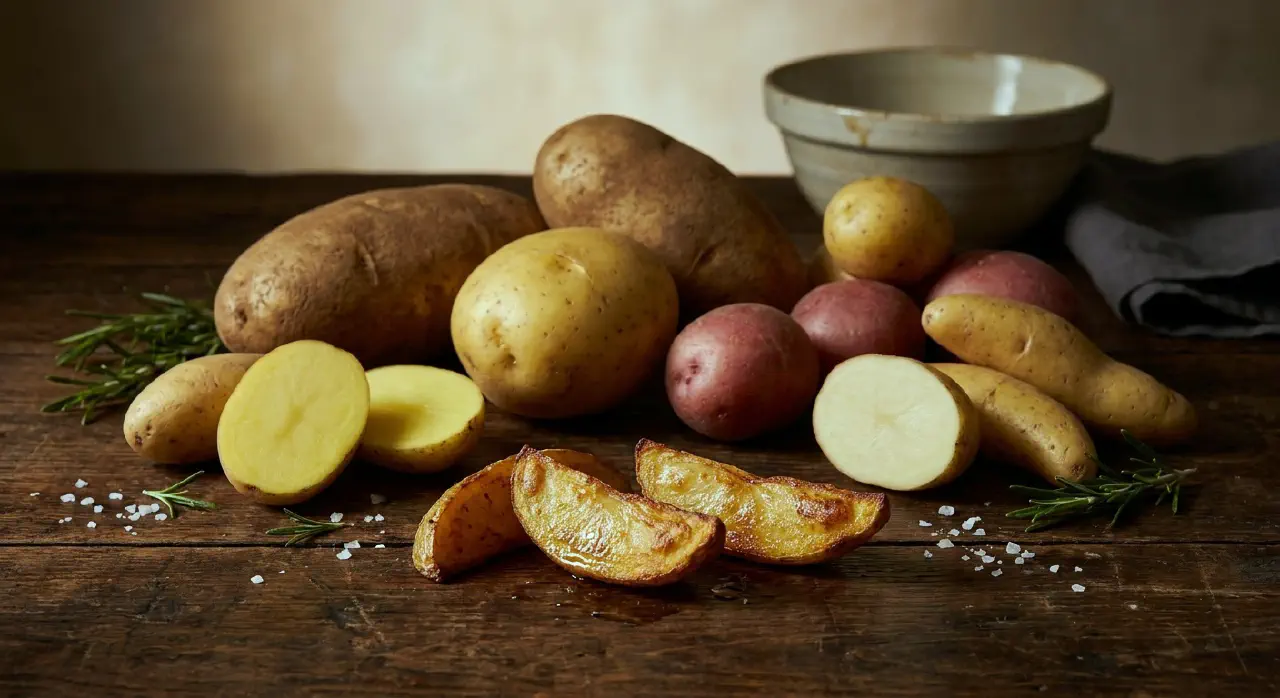
Potatoes and their fellow underground storage organs - sweet potatoes, cassava, taro, yams - are the world’s starchy workhorses. Their cooking behavior is governed by starch content and type, which determines whether the cooked result is fluffy and dry (mealy) or dense and moist (waxy). The potato is also a case study in how storage temperature quietly rewires food chemistry.
Potatoes
Central/South American native domesticated 8,000+ years ago. The tuber is a swollen underground stem tip, storing starch and carrying “eyes” (dormant buds). Mild earthy flavor comes from a pyrazine compound produced by soil microbes.
Mealy vs. waxy: the texture divide
Mealy types (russets, blue, purple, fingerlings): Higher starch concentration. When cooked, cells swell and separate from each other - producing the fine, dry, fluffy texture ideal for frying, baking, and mashing. The separated cells present large surface area for absorbing added butter and cream.
Waxy types (red, white, true new potatoes): Cells cohere even when cooked, producing a dense, moist, solid texture. They hold together in intact pieces - ideal for gratins, salads, and potato cakes.
The cold-storage starch paradox
At refrigerator temperatures, potato metabolism shifts: starch converts to glucose and fructose. This sounds beneficial but actually ruins chips and fries - the excess sugar causes them to brown too rapidly at frying temperatures and taste bitter. Chip manufacturers must “recondition” cold-stored potatoes at room temperature for weeks, allowing metabolism to reverse the sugar back to starch.
Ideal storage: 45–50°F/7–10°C in darkness. Flavor actually intensifies during storage as enzymes generate fatty, fruity, and flowery notes from cell-membrane lipids.
Greening: Light exposure triggers alkaloid production (solanine, chaconine). The green cast is chlorophyll, but it signals abnormally high alkaloid levels. Deeply peel or discard greened potatoes.
Flavor by cooking method
Boiled: Earthy and fatty/fruity/flowery notes intensified. After-cooking darkening (blue-gray discoloration) comes from iron ions + chlorogenic acid + oxygen - minimize by adding cream of tartar or lemon juice to cooking water after potatoes are half-done.
Baked: Additional Maillard reactions produce malty, sweet aromas. The dry heat of baking drives off moisture and concentrates flavor.
Stale potato flavor: Cardboard-like off-notes develop within days in the refrigerator. Antioxidant vitamin C temporarily stabilizes aromatic membrane fragments, but once depleted, the fragments oxidize to unpleasant aldehydes.
Induction power for boiling
The power vs temperature distinction matters most here. Once water reaches 100°C, additional wattage does not raise the temperature - it only produces more violent bubbles and faster evaporation. For potatoes, a gentle simmer (~95°C) is actually better than a rolling boil because it heats evenly without battering the surface into mush.
Practical induction settings (typical 3000W hob):
- Bring to boil at full power (2500–3000W) - cold water with potatoes, lid on. The goal is simply to reach temperature quickly.
- Drop to very low power immediately (150–300W) - once bubbles begin, reduce to the minimum that maintains a gentle percolation. With a lid retaining heat, surprisingly little energy is needed - visible but lazy bubbles, not a roiling surface.
- Lid on throughout - retains heat so even 150W can sustain a simmer. Removing the lid loses significant energy to steam escape, forcing higher power settings that create unnecessary turbulence.
The instinct to keep power high “so it cooks faster” is wrong for boiling. A pot at 100°C on 3000W and a pot at 100°C on 200W are the same temperature - the extra watts just boil off water and shake the potatoes apart. This is power vs temperature: the gas pedal vs cruise control principle.
For new potatoes specifically, the gentle approach preserves the waxy structure that holds the kartoffel together in intact pieces.
French fries
Two-stage frying is optimal. First fry at 130–160°C for 5–8 minutes: starch gelatinizes and the interior cooks through. Second fry at 180–190°C for 2–3 minutes: the dried surface crisps through Maillard browning while the interior simply heats through. Soufflée potatoes use a similar principle at higher second-stage temperature (~195°C), where interior moisture vaporizes into a hollow balloon against the stiffened surface.
The key physical properties for a good frying potato are high starch content (roughly 16–18% of fresh weight), low reducing sugar content, and high dry matter (typically 20–22%). Waxy varieties have only 14–16% dry matter and produce dense, greasy fries without a fluffy interior.
| Variety | Origin | Dry matter | Use |
|---|---|---|---|
| Russet Burbank | USA | 20–22% | North American commercial frying, McDonald’s |
| Bintje | Netherlands | 18–20% | Belgian frites (traditional standard since 1910) |
| Maris Piper | UK | ~22% | British fish-and-chip shops |
| Agria | Germany | 20–22% | Premium restaurant fries in Europe, NZ, Australia |
Soaking cut potatoes in cold water for 30 minutes to 2 hours removes surface reducing sugars (glucose, fructose) that would otherwise cause premature exterior browning and increase acrylamide formation. The soaking water turns visibly cloudy and starchy. After soaking, thorough drying is essential - residual surface water suppresses the Maillard reaction and lowers oil temperature on contact, producing a soggy result. See deep-frying for the double-fry mechanism and oil absorption rates.
Mashed potatoes
Mealy types fall apart into individual cells, creating large surface area for coating with enrichment - easily achieving creamy consistency. Waxy types require more mechanical work, which exudes gelated starch from broken cells, producing a gluey texture unless handled carefully. The French pommes purées technique deliberately exploits this: waxy potatoes passed through a fine sieve and worked hard with butter until light.
Sweet potatoes
Morning glory family, not related to potatoes at all. True storage roots (not tubers). The enzyme-driven sweetening mechanism is the key to cooking them well.
The sweetening enzyme
An enzyme breaks starch into maltose (~1/3 the sweetness of table sugar), but only when starch granules have swelled by absorbing moisture - which happens in the 135–170°F/57–77°C temperature window. Slow baking maximizes enzyme working time: the flesh spends longer in the sweet spot, converting up to 75% of starch to maltose in moist varieties. Fast cooking (microwave, boiling, steaming) shoots through this window quickly, producing noticeably less sweetness.
Freshly harvested (“green”) roots have less enzyme activity and don’t sweeten as much. Curing at 86°F/30°C for several days after harvest develops the enzyme and heals skin damage.
Varieties
Dry/starchy types (common in tropics): Pale, some with red/purple anthocyanin skins. Firmer, less sweet.
Moist/sweet types (U.S. “yams”): Dark orange from beta-carotene. The 1930s marketing term “yam” is misleading - true yams are an unrelated African/Asian genus. Orange types have heavier, pumpkin-like aroma from carotenoid fragment compounds.
Storage
55–60°F/13–16°C optimal. Chilling injury can cause “hardcore” - a hard center that persists even after cooking.
Tropical roots
Higher starch than potatoes (up to 36% vs. 18%), producing floury texture when baked, dense and waxy when boiled. Short storage life; chill damage if refrigerated.
Cassava/manioc: “Bitter” varieties generate defensive cyanide and require thorough processing (shredding, pressing, washing). “Sweet” varieties have only surface cyanide. Processed into flour and tapioca (which becomes jelly-like when remoistened - a starch-gelatinization behavior).
Taro: Defended by crystalline calcium oxalate needles with protein-digesting enzymes - essentially poison-tipped darts when raw. Cooking denatures the enzymes and dissolves the crystals. Remains waxy when cooled, with a pronounced chestnut or egg-yolk aroma.
True yams: Can grow over 100 pounds. Some varieties contain toxic alkaloid dioscorine, removed by grating and leaching.
Carrots, parsnips, and specialty roots
Carrots: Distinctive terpene aroma (pine, wood, citrus, turpentine notes) shared with Mediterranean herbs - explaining the success of carrots in mirepoix with celery and onions. Cooking adds a violet-like note from fragmented carotene. The core carries water and less flavor than the outer storage layers. Peeling the thin outer layer removes bitterness and browning compounds.
Parsnips: More starch than carrots, converted to sugars by cold - winter-harvested parsnips are sweeter than autumn ones. Before cheap sugar, they were used for British cakes and jams.
Sunchoke/Jerusalem artichoke: Stores energy as fructose chains (not starch) that humans can’t digest - intestinal bacteria ferment them, causing gas. Long slow cooking (12–24 hours at 200°F/93°C) converts the carbohydrates to digestible fructose, producing sweet, translucent brown flesh.
Water chestnuts and lotus root: Stay remarkably crisp even after cooking and canning - phenolic compounds in their cell walls cross-link and strengthen them, resisting the softening that defeats other vegetables.
See also
- starch-gelatinization - the science of how starch granules absorb water and swell
- maillard-reaction - browning reactions in baked and fried potatoes
- deep-frying - the steam armor principle, double-fry technique, and oil absorption rates
- acrylamide - the asparagine-based browning byproduct; cold-stored potatoes are high-risk
- vegetable-cooking - the pectin cliff and general vegetable cooking principles
- plant-biology - cell structure, turgor, and how underground storage organs work
- plant-color - carotenoids in carrots and sweet potatoes, anthocyanins in purple varieties
- precision-cooking - power vs temperature principle, why more watts ≠ faster cooking once water boils