Braising
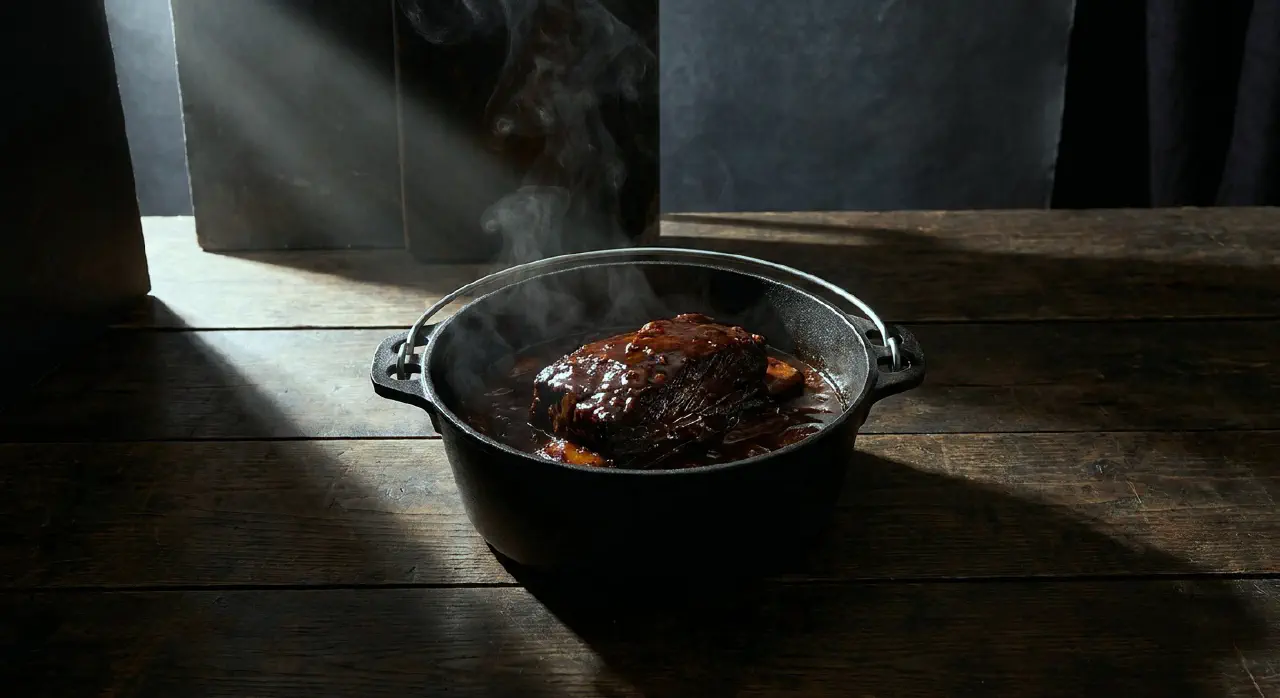
Braising is the slow cooking of food partially submerged in liquid, typically at a gentle simmer (180–200°F/82–93°C). It is the definitive method for transforming tough, collagen-rich cuts of meat into tender, flavorful dishes - and it works because of a specific protein transformation that only time and wet heat can achieve.
The science: collagen to gelatin
The key to braising is collagen - the tough connective tissue protein that holds muscle fibers together in cuts like chuck, short ribs, and shanks. Collagen is organized in strong, rope-like triple helices that are essentially insoluble and extremely chewy when raw.
Above ~160°F/71°C in the presence of moisture, collagen’s triple helix slowly unwinds and converts to gelatin - a soluble, silky protein that dissolves into the cooking liquid and lubricates the remaining muscle fibers. This conversion takes time: hours at a gentle simmer, or even longer at lower temperatures.
This is why braised meat has a unique texture - the muscle fibers themselves have actually been overcooked (squeezed dry by protein-denaturation), but the dissolved gelatin coats everything with richness and the sensation of succulence. The meat is technically dry but feels moist because of the gelatin.
Why wet heat, not dry
Water limits cooking temperature to 212°F/100°C - well below the Maillard threshold of 280°F/140°C. This means braised food cannot brown during the braise itself. That’s why most braise recipes start with a dry-heat sear: browning the meat first captures Maillard flavor, then the gentle wet heat handles the collagen conversion.
The wet environment is essential because collagen hydrolysis requires water molecules - dry heat at any temperature is far less effective at converting collagen to gelatin.
The braising liquid
The liquid serves multiple roles: conducting heat gently and evenly, providing water for collagen hydrolysis, extracting and concentrating flavors, and becoming a sauce enriched with dissolved gelatin. A properly braised dish yields a liquid that is naturally thick and glossy - that’s the gelatin.
Acidic ingredients (wine, tomatoes, vinegar) accelerate collagen breakdown slightly and add flavor complexity. Aromatics (onions, carrots, herbs) build the flavor base of the eventual sauce.
Temperature and time
The ideal braising temperature is a gentle simmer - not a rolling boil. Vigorous boiling agitates the meat, can make it stringy, and causes excessive evaporation. Many cooks braise in an oven at 300–325°F/150–163°C with the lid on; the enclosed pot maintains a steady liquid temperature around 180–200°F/82–93°C.
Collagen conversion is time-dependent. The tougher the cut (more collagen), the longer the braise. Short ribs may need 3–4 hours; a pot roast may need 4–5. The meat is done not at a specific internal temperature but when it’s fork-tender - when enough collagen has converted to make the fibers yield easily.
See also
- meat - the structural foundation: fibers, collagen, and their opposite responses to heat
- meat-cooking - the full framework for matching method to meat type
- meat-aging - how enzyme activity during slow cooking acts as accelerated aging
- protein-denaturation - what happens to muscle fibers during braising
- maillard-reaction - why we sear before braising (flavor, not moisture sealing)
- starch-gelatinization - thickening the braising liquid with a roux or slurry
- heat-transfer - conduction and convection physics
- wet-heat-methods - boiling, simmering, poaching, steaming
- pan-frying - the initial browning phase
- cookware-materials - cast iron and Dutch ovens for braising