Meat Cooking
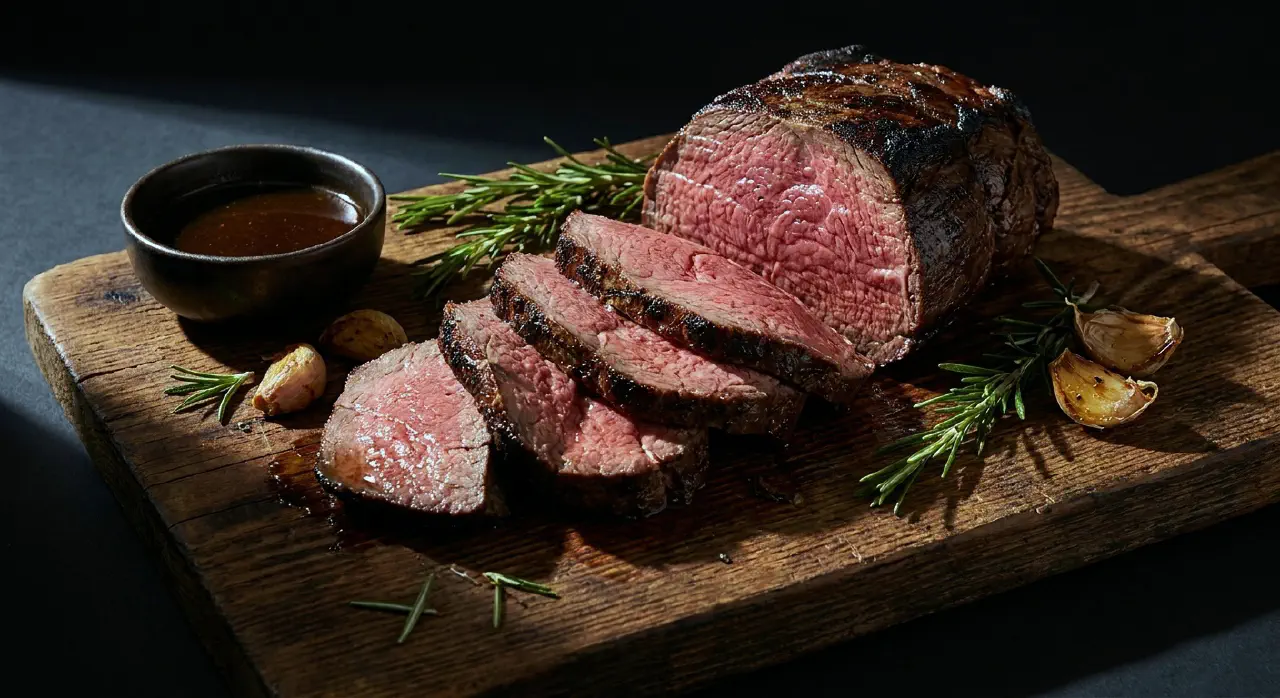
Cooking meat has four purposes: safety (killing pathogens), digestibility (denaturing proteins for easier enzymatic access), flavor development (creating hundreds of aromatic compounds via the Maillard reaction and other chemistry), and texture change (transforming raw mushiness into appetizing firmness). The central challenge is that meat’s two protein systems - muscle fibers and collagen - respond to heat in opposite ways.
The texture progression
As meat heats, the texture changes follow a dramatic and non-linear path:
~120°F / 50°C (rare): Myosin coagulates, creating firmness and opacity. Water squeezed from coagulating proteins collects around the solid core. The meat is firm and very juicy - maximum juice release.
140–150°F / 60–65°C (medium-rare to medium): More proteins coagulate. Then the critical event: collagen in connective-tissue sheaths denatures, shrinks, and squeezes fluid-filled cells. Fluid flows copiously. The meat loses ≥1/6 of its volume and shifts from juicy to dry.
160°F+ / 70°C+ (well-done and beyond): Fibers compact further and dry out. But with time, collagen dissolves into gelatin, which lubricates the stiff fibers and makes them easy to push apart. The meat “falls apart” - this is the texture of braises, stews, and barbecue.
Matching method to meat
Tender cuts (low collagen - tenderloin, rib, loin): Fast, high-heat methods (grilling, frying, roasting) to 130–140°F/55–60°C. The goal is minimizing fiber damage. The cooking window is narrow - center temperature can rise ~10°F per minute in an inch-thick cut, and the juiciness window spans only about 30°F.
Tough cuts (high collagen - shoulder, leg, neck, chest): Slow, moist, prolonged methods (braising, stewing, slow-roasting) to 160°F+/70°C+ for hours. Collagen dissolution compensates for fiber drying, and the gelatin provides succulence. These methods are forgiving - slight overcooking is absorbed by the gelatin buffer.
The searing myth
Searing does not “seal in juices.” It actually squeezes more moisture out than gentle cooking alone. The reason seared meat tastes juicier is entirely about flavor: the intense Maillard compounds on the browned surface trigger salivation, and it’s the saliva - not the meat’s own juice - that creates the sensation of juiciness. Searing is valuable for flavor, not moisture retention.
The grey band rule
The “grey band” is the overcooked outer ring visible when you slice a steak - the zone that has exceeded the target temperature. Its width is a function of pan temperature minus target core temperature: the greater the differential, the thicker the grey band. This is one of the most important concepts in meat cooking, and it connects directly to the Arrhenius / 10°C rule.
Pan temperature by thickness: Thicker cuts need lower pan temperatures. A thin slice (<1 cm) needs 210–230°C because speed is critical - the center overcooks in seconds. A standard steak (2–3.5 cm) does best at 170–190°C. A thick roast (>5 cm) needs 140–160°C, or a two-stage approach.
Frequent flipping: Flipping every 1–2 minutes pulses heat from alternating sides, preventing a deep gradient from building on either side. This produces a thinner grey band than the traditional “flip once” advice.
The crust trade-off: A flash sear (210–230°C, 30 seconds–2 minutes per side) produces a thin crust of 0.5–1 mm - maximum tenderness, minimal grey band. An “engineered” crust (175–195°C, 3–6 minutes per side) produces a thick crust of 2–3 mm with deeper, more complex Maillard flavor - but a wider grey band. The choice depends on the cut and the desired result.
Carry-over cooking by size
After removing meat from heat, residual thermal energy continues cooking the interior. The larger and denser the piece, the more stored heat drives the temperature upward:
Small pieces (~150 g, thin chops): +3–5°C rise. Remove close to target.
Standard steaks (250–400 g): +6–10°C rise. Remove 8–10°C below target. Rest minimum 5 minutes.
Large roasts (1+ kg): +8–12°C rise. Remove 10–12°C below target. Rest 10–15 minutes.
This is the single most important practical technique for avoiding overcooking. No formula can predict cooking time reliably (starting temperature, oven accuracy, fat content, and bone structure all vary), but monitoring internal temperature and accounting for carry-over works every time.
Three additional strategies for the overcooking problem
Beyond the grey band rule and carry-over, three approaches widen the doneness window:
Two-stage cooking (reverse sear): Cook low first (oven at 120°C or sous vide) to bring the center near target temperature, then finish with a brief high-heat sear. Because the interior is already warm, the sear creates a thin grey band and a well-developed crust simultaneously.
Insulation: Covering the surface with fat strips, bacon, breading, or pastry slows heat penetration and extends the cooking window.
Butter basting: Sear at 190–200°C to build the crust, then lower to 140°C and baste with butter, garlic, and herbs. Butter milk solids burn at ~175°C, so the lower temperature allows gentle browning without burning - adding flavor while slowing the interior temperature rise.
Doneness and safety
Intact muscle (steak, chop): Bacteria live on the surface only. A rare interior is safe if the surface is properly cooked. Minimum surface temperature: ~160°F/70°C.
Ground meat (hamburger): Grinding spreads surface bacteria throughout. Interior must reach 160°F/70°C minimum. Exception: blanch the surface before grinding for safer rare burgers.
Why time-per-pound formulas fail
Starting temperature, actual oven temperature, number of oven-door openings, fat content (fat insulates - fatty cuts cook slower), bone structure, and surface treatment (basting cools by evaporation) all vary unpredictably. No formula can predict cooking time reliably. Monitor temperature directly.
Professional touch test
Chefs assess doneness by pressing the meat surface: rare feels like the relaxed pad between thumb and forefinger, medium feels like that pad when fingers are squeezed together, and well-done feels stiff. This is unreliable for beginners - use a thermometer.
The nature of juiciness
Juiciness perception has two phases: the initial moisture impression at the first bite (meat’s own free water), and continued moisture during chewing (fat and flavor stimulating salivary flow). Well-browned, flavorful meat that has lost more actual juice can taste juicier than pale, moisture-rich meat - because flavor drives saliva production, and saliva is perceived as juiciness.
See also
- meat - the structural foundation: fibers, collagen, and fat
- meat-flavor - what creates the taste of cooked meat
- meat-aging - how enzyme activity tenderizes and flavors before cooking begins
- braising - the slow, wet-heat strategy for collagen-rich cuts
- deep-frying - another approach to surface browning and moisture dynamics
- maillard-reaction - the chemistry that makes searing worthwhile
- protein-denaturation - the molecular events behind texture changes
- cooking-temperatures - the Arrhenius rule and the decision tree framework
- crust-engineering - browning and crust formation strategies
- precision-cooking - temperature precision techniques and tools