Melons
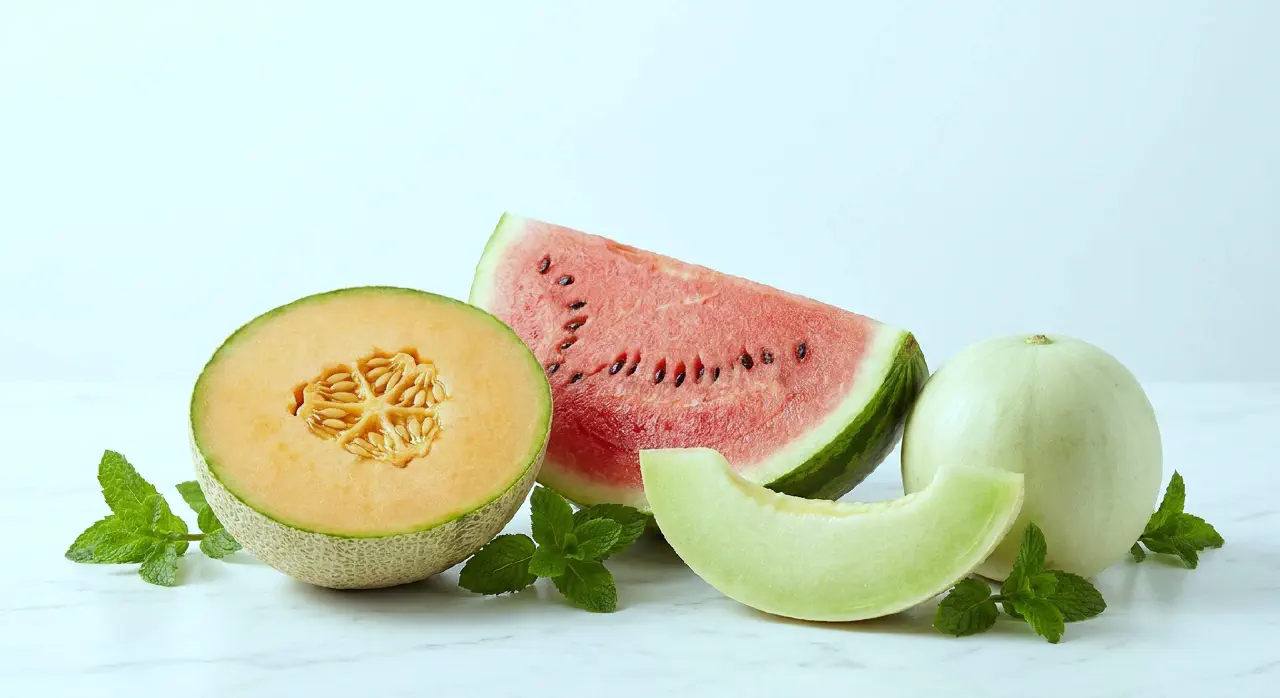
Most melons belong to Cucumis melo, a relative of cucumber, native to the semiarid subtropics of Asia. Large, rapid-growing fruits that symbolized fertility and abundance in ancient cultures. The melon family divides cleanly into two groups that mirror the climacteric/non-climacteric divide - aromatic, perishable summer melons and mild, durable winter melons - plus the distantly related watermelon, which stands alone as one of the world’s most remarkable fruits.
The fundamental rule: no starch, no post-harvest sweetening
Melons do not store starch. Sweetness is entirely fixed at harvest - a melon picked with 8% sugar will never reach 12%. Post-vine aroma may develop slightly, but it won’t match vine-ripened fruit. This makes vine-ripening critical and good sourcing the most important kitchen decision. For aromatic summer melons, a stem remnant signals premature harvest.
Summer melons (aromatic, perishable)
Generally climacteric, with rough or netted rinds. Active enzymes generate 200+ different esters from amino acid precursors, creating characteristically rich aromas. Keep only 1–2 weeks. True cantaloupes separate from stems when ripe (a reliable indicator).
Key types: true cantaloupe (smooth or lightly netted, orange flesh, rich flavor - Charentais, Cavaillon), muskmelon (deeply netted, most U.S. varieties - often misnamed “cantaloupe”), green-fleshed summer types (Galia, Ha Ogen), large orange Persian, pale translucent Sharlyn/Ananas, and hybrid Pancha.
Winter melons (mild, durable)
Generally non-climacteric (like cucumbers and squashes), with smooth or wrinkled rinds. Low ester-enzyme activity produces milder flavor. Keep weeks to months. Ripe winter melons carry a stem piece even when ready (unlike summer types, where the stem piece signals under-ripeness).
Key types: honeydew (smooth rind, green or orange flesh, sweet, mild), casaba (wrinkled, white flesh, less sweet), canary (slightly wrinkled, white flesh, crisp, aromatic - the exception among winter types).
Watermelon
A distant relative of other melons - Citrullus lanatus, an African vine domesticated in Egypt 5,000+ years ago. World production is double all other melons combined.
Remarkable properties
Storage cells reach visible size with the naked eye - unique among melons and most fruits. Can exceed 60 lb (30+ kg). Unlike other melons, the edible portion is seed-bearing placental tissue, not the ovary. Seedless varieties (first bred in Japan in the 1930s) actually contain small undeveloped seeds.
Lycopene surprise
Classic dark red color comes from the carotenoid lycopene - and watermelon is a much richer source than tomatoes. Yellow-orange varieties also exist.
Flavor and quality
Moderately sweet with a crunchy, crisp yet tender texture and delicate, almost green aroma. Quality signs: substantial heaviness for size, yellow undertones on skin (chlorophyll loss signaling ripeness), solid resonance when thumped.
Culinary range
Beyond fresh consumption: flesh pickled or candied (often after preliminary drying), cooked down to syrup or thick puree, dense rind made into sour/sweet preserves. Seeds roasted, ground, or infused for beverages in several traditions.
Aroma chemistry
Beyond the dominant fruity esters, melons contain green/grassy compounds (from the same lipoxygenase mechanism that produces cucumber flavor) and sulfur compounds that provide a deeper, savory dimension. Orange-fleshed melons are excellent beta-carotene sources.
Enzyme challenge
Melons contain the protein-digesting enzyme cucumisin, which prevents gelatin gels from setting unless denatured by cooking or overwhelmed with excess gelatin - the same challenge posed by pineapple, papaya, and kiwi.
Food safety note
Melon surfaces pick up microbial contamination in the field, which transfers to the flesh during cutting. Thoroughly wash melons in hot soapy water before preparing.
See also
- fruit-ripening - climacteric summer vs non-climacteric winter melons, starch absence
- squash-cucumbers - cucurbit relatives with shared biology
- plant-color - lycopene in watermelon, carotenoids in orange-fleshed melons
- plant-flavor - ester production, lipoxygenase aroma mechanism
- tomatoes - lycopene comparison, watermelon as richer source
- produce-handling - chilling injury in warm-climate fruits