Grains (Corn, Oats, Rye, Barley, and Ancient Grains)
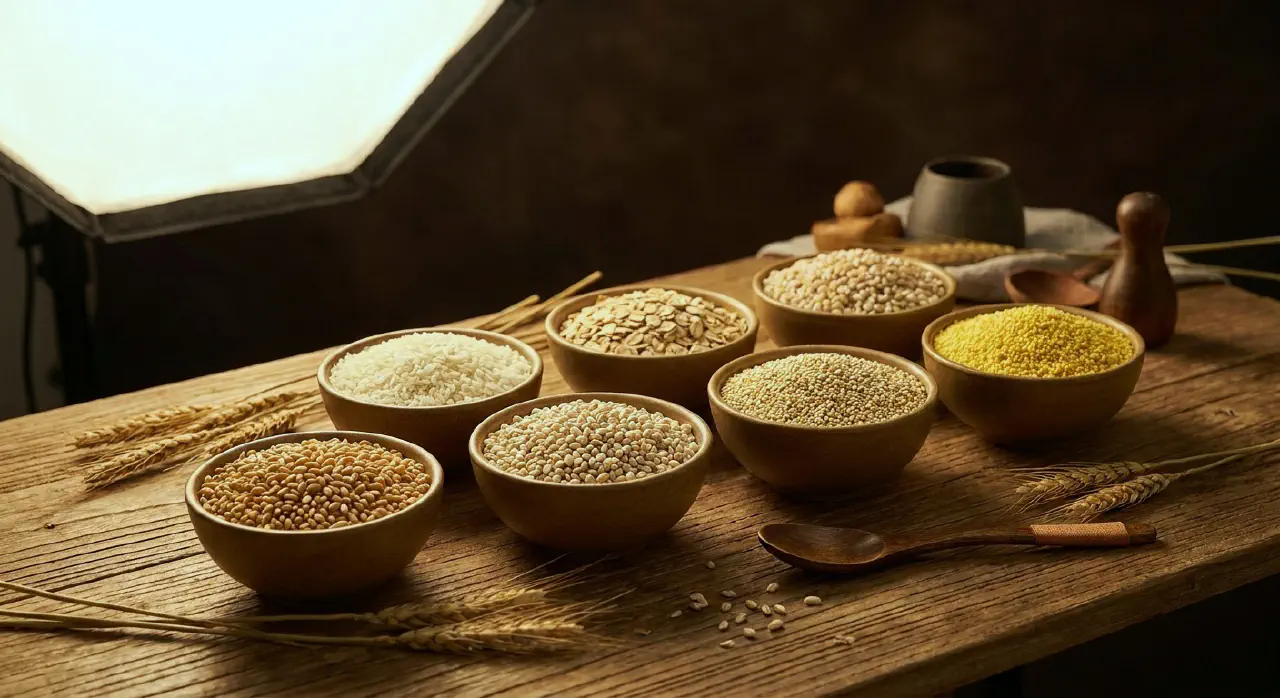
Beyond wheat and rice, a dozen cereal species and several pseudo-cereals have shaped human diets across climates and cultures. Each has a distinct carbohydrate or protein chemistry that explains both its culinary limitations and its special strengths. Several (corn, rice, buckwheat, quinoa, amaranth, teff, millet) contain no gliadin - the protein implicated in celiac disease - making them safe for gluten-intolerant cooks.
Corn (Maize)
Domesticated in Mexico 7,000–10,000 years ago from teosinte - a transformation more drastic than any other cultivated grain, concentrating the female flowers into a cob along the main stalk. Now the world’s third largest human food crop (after wheat and rice), though more fed to livestock and processed for industrial uses in Europe and the U.S.
Five types based on endosperm composition:
- Popcorn and flint corn: Large protein network surrounding high-amylose starch granules - the protein network traps steam, causing explosive puffing.
- Dent corn: Most common for animal feed and milled products (grits, meals, flours). Has a localized “waxy” low-amylose starch at the kernel crown that produces a dent when dried.
- Flour corn (including blue corn): Soft, easily ground; discontinuous endosperm with air pockets and mostly waxy starch.
- Sweet corn: Stores sugar rather than starch - translucent kernels, loose wrinkled skins. A vegetable, not a grain in culinary terms.
Color and nutrition: Yellow corn gets color from nutritionally valuable fat-soluble carotenoids (beta-carotene, lutein, zeaxanthin). Blue, purple, and red kernels carry water-soluble anthocyanins in the aleurone layer.
Polenta: Cornmeal mush; traditional preparation requires 1+ hour of slow cooking and constant stirring to develop flavor and prevent scorching (pot bottom reaches above-boiling temperatures). Modern shortcut: partially covered pot in a 250°F oven, heated evenly from all sides, stirring only occasionally - comparable flavor with far less effort.
Barley
Possibly the first domesticated cereal alongside wheat, barley is exceptionally hardy (grows Arctic Circle to tropical India; short growing season) and was the dominant grain of ancient Babylon, Egypt, and the Mediterranean world until displaced by wheat. Today: roughly half production feeds livestock; a third goes to malt for beer.
Distinctive carbohydrates: Contains significant quantities (~5% each) of pentosans (arabinoxylans) and beta-glucans - non-starch polysaccharides absent in wheat. In the endosperm cell walls and bran, they contribute distinctively springy cooked texture. Beta-glucans lower blood cholesterol. Barley flour absorbs twice as much water as wheat flour.
Barley malt: The most important consumption form. Moistened barley is germinated for several days, during which the embryo produces amylase enzymes that break endosperm starch into sugars (maltose, glucose) and proteins into amino acids - the grain becomes visibly sweet. Germination is then halted by kiln drying. Light kilning produces pale malt (high enzyme activity, for beer brewing); higher temperatures produce darker specialty malts with caramel and roasted flavors but reduced enzyme power. Malt extract - concentrated syrup from mashing pale malt - is used in baked goods, confections, and as a sweetener. The same amylase enzymes, added as diastatic malt powder, accelerate fermentation in bread doughs by providing yeast with readily available sugar.
Pearled barley: Most barley has adherent hulls that require more processing than rice; pearling removes more grain than rice milling. Pot barley (7–15% removed) retains more germ and bran flavor; fine pearled (33% removed) cooks faster and more uniformly.
Rye
Originated as a weed in early wheat and barley crops, gradually domesticated as it proved better suited to poor, acid soils and cold, moist climates. The last century’s predominant bread grain for northern European peasantry; Germany’s wheat production exceeded rye only in 1957.
What makes rye bread different: A large quantity (~7% dry weight) of pentosans (arabinoxylans) - medium-sized sugar aggregates that absorb water voraciously (rye flour absorbs 8× its weight in water vs wheat’s 2×) and create a thick, viscous, sticky consistency. Unlike starch, pentosans don’t retrograde after cooking and cooling - they remain soft and moist, giving rye breads a shelf life of weeks versus days for wheat bread. They also swell in the stomach and digest slowly, providing a sense of fullness.
Oats
Originating as a wheat and barley companion plant in southwest Asia, oats couldn’t make leavened bread (no gliadin proteins) and were considered diseased wheat by Greeks and Romans. By 1600 they were an important northern European crop. Today 95% fed to animals; the culinary remainder powers oatmeal, granola, and muesli.
Why oats need heat treatment: Oat kernels carry unusually large amounts of a fat-digesting enzyme (lipase) - necessary for the seed but destructive once the grain is milled. Without heat inactivation during processing, rolled oats would become rancid within days as lipase frees fatty acids from the kernel’s 7% oil. The industry solves this with a low-temperature roasting (kilning) step before rolling, which simultaneously inactivates lipase, partially denatures storage proteins (making flakes hold together better during cooking), and generates the characteristic toasty, sweet flavor of oatmeal through mild Maillard reactions.
Beta-glucans: Rich in beta-glucan, a soluble fiber concentrated in the outer endosperm under the aleurone. Gives hot oatmeal its smooth, thick consistency; has a genuinely proven cholesterol-lowering effect. Also tenderizes and moistens baked goods.
Processing forms: Steel-cut oats (whole groats cut into 2–4 pieces - slower cooking, chewy); rolled oats (steamed, pressed flat - standard 0.8mm or quick-cooking 0.4mm); instant oats (even thinner). All have identical nutritional value; texture and rehydration time differ only with thickness. The common perception that steel-cut oats are “healthier” is unfounded - they simply rehydrate more slowly due to greater thickness, producing a chewier porridge.
Buckwheat
Not a true cereal - a member of the Polygonum family, related to rhubarb and sorrel. Tolerates poor growing conditions; matures in two months. Triangular kernels (~80% starch, 14% protein as soluble globulins, ~2% oil, ~0.7% phenolic compounds giving characteristic astringency).
Flavor: Distinctive cooked aroma - nutty, smoky, green, slightly fishy - from pyrazines, salicylaldehyde, aldehydes, and pyridines. Contains a small amount of mucilage (complex amylopectin-like carbohydrate) that barely holds all-buckwheat noodle doughs together without wheat gluten.
Applications: Soba noodles (Japan, China, Korea); blini (Russia); crêpes bretonnes (Brittany); kasha (toasted whole groats, porridge); pizzoccheri (northern Italian flat noodles mixed with wheat); pancakes (U.S.). No gliadin - safe for celiac disease.
Quinoa
Native to the Andes, domesticated near Lake Titicaca ~5,000 BCE; the Inca staple second only to potato. Member of the beet and spinach family (Chenopodium quinoa) - a pseudo-cereal, not a grass. Small yellow spheres (1–3mm); 13% protein, 69% carbohydrate, 6% oil.
Saponin warning: The outer pericarp often contains bitter defensive saponins that must be removed by brief cold water washing and rubbing. Do not soak prolonged - extended soaking deposits saponins within the seed. Cooked like rice; also popped or ground for flatbreads.
Teff
Major Ethiopian crop; tiny seeds (1mm); made into injera - the spongy, slightly sour flatbread that stays soft and chewy for several days (unlike most breads). Varieties range from dark to white; pigmented varieties reportedly more flavorful.
Millet
Not one grain but a group of small-seeded species (Panicum, Setaria, Pennisetum, Eleusine) native to Africa and Asia, cultivated 6,000+ years. Essential in arid lands - lowest water requirements of any cereal; thrives in poor soils. Remarkable protein content (16–22%). Popped, porridge, breads, malts, beers.
Sorghum
Drought-tolerant African grass domesticated ~2,000 BCE; now grown in warm countries with marginal croplands worldwide. Boiled like rice, popped, used in porridges, flatbreads, and beer variations. Safety note: sorghum should not be sprouted - the seed generates a protective cyanide system during germination, unlike most other grains.
Triticale, Fonio, and other minor grains
Triticale: Modern artificial wheat × rye cross (first documented late 19th century). Grains more wheat-like; breadmaking quality inferior to wheat. Mostly animal feed. Fonio: Ancient West African grain (Digitaria spp.), tiny, made into porridge and couscous. Amaranth: Pseudo-cereal (also in beet family); 18% protein - highest of any grain listed - and 8% oil.
Grain composition (% dry weight, ~10% moisture)
| Grain | Protein | Carbohydrate | Oil |
|---|---|---|---|
| Wheat | 14 | 67 | 2 |
| Barley | 12 | 73 | 2 |
| Barley, pearled | 10 | 78 | 1 |
| Rye | 15 | 70 | 3 |
| Oats | 17 | 66 | 7 |
| Rice, white | 7 | 80 | 0.5 |
| Rice, brown | 8 | 77 | 3 |
| Rice, wild | 15 | 75 | 1 |
| Corn (maize) | 10 | 68 | 5 |
| Millet | 13 | 73 | 6 |
| Sorghum | 12 | 74 | 4 |
| Teff | 9 | 77 | 2 |
| Buckwheat | 13 | 72 | 4 |
| Quinoa | 13 | 69 | 6 |
| Amaranth | 18 | 57 | 8 |
Oats stand out for oil content (7% - 2–5× wheat), amaranth for protein (18%), and white rice for the starch dominance (80%) that comes from aggressive milling.
See also
- seed-biology - amylose/amylopectin, protein classes, cooking principles
- wheat - for comparison; the gluten-producing grain
- rice - the other dominant starch grain; indica/japonica divide
- bread-baking - rye’s pentosans in sourdough, oat beta-glucans in bread
- fermentation-overview - barley malt, beer fermentation, sorghum beer
- plant-color - corn carotenoids and anthocyanins, buckwheat phenolics
- beer-brewing - barley malting for brewing, kilning spectrum, mashing
- sake - rice polishing for sake, mold-based starch conversion
- distilled-spirits - grain as base for whiskey, bourbon, rye