Dried Fruits
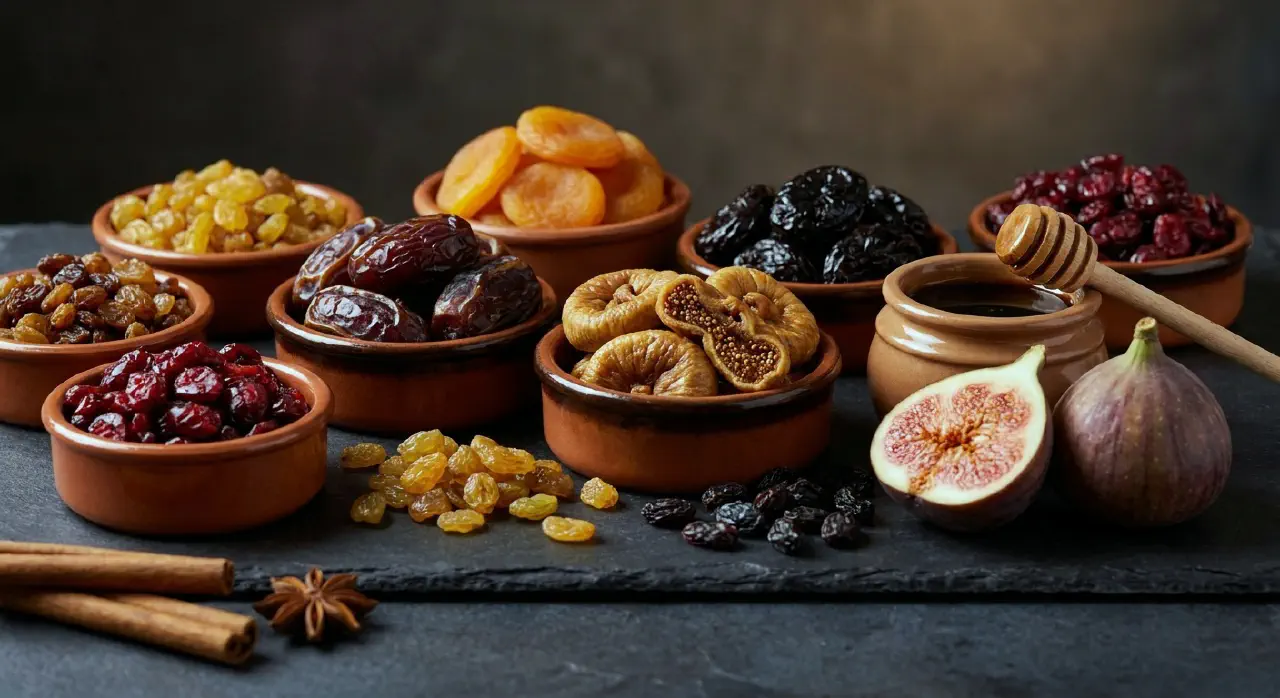
Drying is among the oldest preservation methods, reducing fruit to 15–25% moisture where microbial growth is inhibited and shelf life extends from days to months or years. The process concentrates sugars dramatically - dried dates reach 60–80% sugar - and drives two types of browning reactions (enzymatic oxidation of phenolics and Maillard reactions between sugars and amino acids) that generate complex caramel, roasted, and spice notes absent in the fresh fruit.
Dates
Fruits of the desert palm Phoenix dactylifera, cultivated with artificial irrigation and pollination in Middle Eastern and African oases for over 5,000 years. Four developmental stages: green/immature → mature but hard and astringent (yellow/red) → ripe and soft (Arabic rhutab, golden brown, delicate) → dried and wrinkled (brown, powerfully sweet at 60–80% sugar).
Dates usually dry on the tree. Thousands of varieties differ in size, shape, color, and ripening schedule. Some phenolic-rich varieties (notably Deglet Noor) develop increased astringency and red coloration when heated. Ground dried dates make “date sugar.” Notable antioxidant and antimutagenic activities from phenolic compounds.
Figs
More flower than fruit - the main body is a fleshy flower base folded in on itself, with inner florets pollinated by tiny wasps entering through a pore opposite the stem. This unusual structure means fertilized figs develop fuller flavor but suffer more spoilage (wasps carry microbes inside). Smyrna/Calimyrna varieties won’t set fruit without wasp pollination, requiring inedible “caprifig” trees nearby.
Fresh figs are 80% water and extremely perishable; the vast majority of world production is dried (beginning on tree, concluding on orchard floor or in mechanical dryers). Contain the protein-digesting enzyme ficin in latex vessels (one of the four meat-eating fruit enzymes). Remarkable phenolic compound content, large amounts of calcium, and a ripe aroma of spicy phenolics and flowery linalool.
Pomegranate
Native to arid Mediterranean and western Asia, with the finest varieties in Iran. A dull dry rind surrounds two layered chambers of translucent ruby-like fruitlets - strongly pigmented with anthocyanins and related phenolic antioxidants. Rind so rich in tannins it was once used for leather tanning. Whole-fruit crushing produces much more tannins than fruitlets alone.
Each fruitlet contains a prominent seed, so processing usually yields juice - consumed as-is, cooked to syrup/“molasses,” or fermented to wine. Grenadine is true pomegranate juice mixed with hot sugar syrup (modern versions are mostly synthetic). Northern Indian tradition dries and grinds fruitlets for acidifying powder.
Jujube (Chinese date)
Central Asian native, tolerant of heat and drought. Small, somewhat dry and spongy, more sweet than tart. Excellent vitamin C source - double the amount in equal weight of oranges. Eaten fresh, dried, pickled, in rice cakes, or fermented into alcoholic drinks.
Cactus pear (prickly pear)
American cactus (Opuntia ficus-indica) that spread like a weed across the southern Mediterranean after arriving in the 16th century. Thick green-to-red skin, many hard seeds in reddish flesh. The pigment is betain (as in beets), not anthocyanin - a different pigment family entirely. Mild, melon-like aroma. Contains a protein-digesting enzyme like pineapple and kiwi. Made into juice, salsas, syrup, paste, candies.
Raisins and prunes
Raisins: Sun-dried grapes over ~3 weeks, browned by both enzymatic phenolic oxidation and Maillard reactions. Golden raisins are sulfur-dioxide-treated and mechanically dried for fruitier, lighter character. Zante “currants” (from small black Corinth grape) are tarter with higher skin-to-pulp ratio.
Prunes: Dried plums (18–24 hours at ~175°F/79°C to 15–20% moisture). Nearly 50% sugar, 5% acid. Exceptional phenolic antioxidants (~150 mg/100g). Function as natural flavor stabilizers in ground meats (prevent warmed-over flavor at 1–2%) and as fat replacements in baked goods via moisture-retaining fiber and sorbitol. The laxative effect is primarily sorbitol (up to 15% of weight), which humans cannot digest.
General principles
All dried fruits share concentrated sugars, intensified browning products, high phenolic antioxidants, elevated fiber, and chewy texture. The drying-driven Maillard reactions produce spice undertones and complex notes absent in fresh fruit, making dried fruits valuable in both sweet and savory applications. Sulfur dioxide treatment before drying preserves lighter color, fresher flavor, and heat-sensitive nutrients like vitamin C and carotenoids.
See also
- fruit-ripening - how fresh fruit characteristics determine drying behavior
- maillard-reaction - browning reactions during drying
- plant-color - enzymatic browning, anthocyanins in pomegranate, betains in cactus pear
- plant-preservation - drying as preservation, sugar concentration, sulfur treatment
- caramelization - sugar browning in high-sugar dried fruits
- stone-fruits - prunes, dried apricots, dried cherries
- berries - raisins, dried cranberries
- fermentation-overview - pomegranate wine, date and jujube fermentation