Basic Egg Dishes
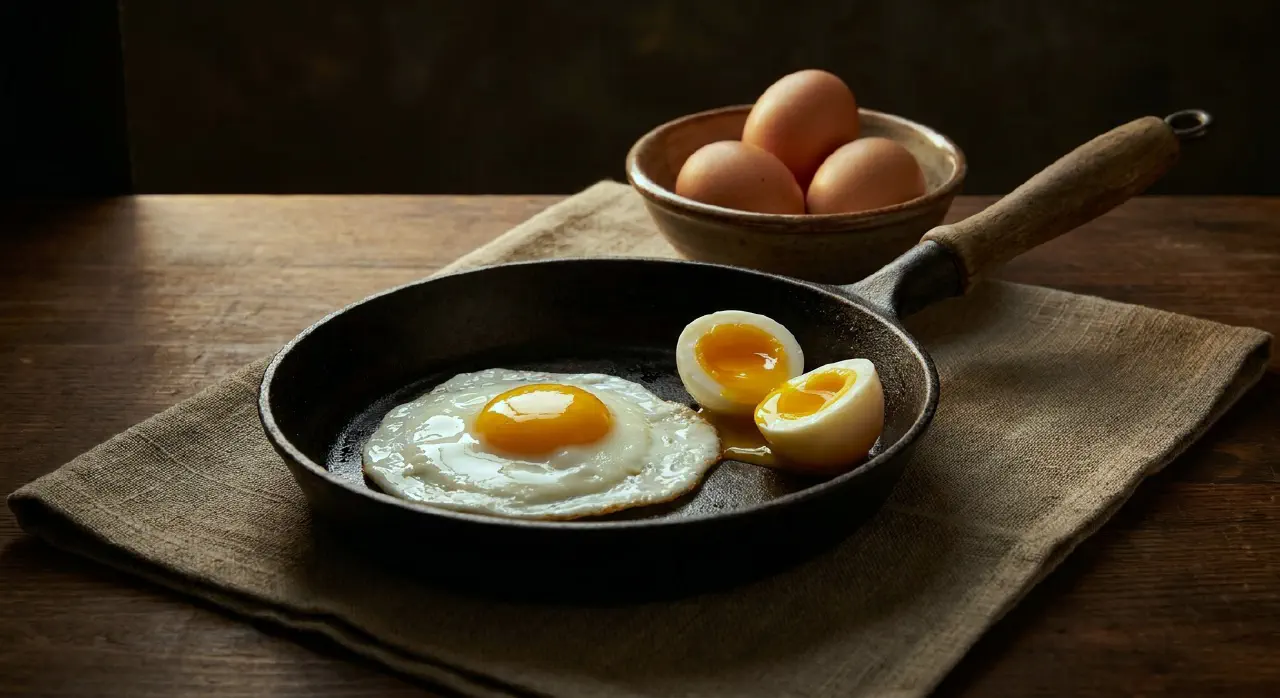
The simplest egg preparations - boiled, poached, fried, scrambled - are exercises in temperature control. Each dish exploits the staged coagulation of egg proteins at different temperatures, and the quality difference between a perfectly cooked egg and an overcooked one is always a matter of just a few degrees.
Boiled eggs
“Boiled” eggs should never actually boil. A rolling boil is violent enough to crack shells, and the sustained high temperature overcoagulates the proteins. A gentle simmer - 180–190°F/82–87°C - is the correct cooking medium.
Soft-boiled
3–5 minutes in barely simmering water. Target: a tender, barely solid outer white, a milky-translucent inner white, and a warm, runny yolk. The outer white reaches ~150°F/65°C (ovotransferrin coagulates), while the center stays below the yolk’s ~150°F/65°C threshold.
Hard-cooked
10–15 minutes at a gentle simmer. At 10 minutes: dark yellow yolk, moist and pasty. At 15 minutes: light yellow yolk, dry and granular. Beyond that, the yolk develops the characteristic green ring - iron sulfide formed by iron from the yolk reacting with hydrogen sulfide released from overheated white proteins. Harmless, but a reliable sign of overcooking. Older eggs produce more green because their higher-pH whites release hydrogen sulfide more readily.
Peeling
Older eggs peel more easily because CO₂ loss raises the white’s pH, weakening the bond between albumen and shell membrane. Very fresh eggs are notoriously difficult to peel cleanly.
Poached eggs
The egg is slipped gently into barely simmering water (180–190°F/82–87°C) and cooked 3–4 minutes until the white is just set and the yolk is still liquid. The challenge is keeping the white compact rather than having it trail into wispy strands.
Adding a splash of vinegar to the poaching water helps: the acid lowers the coagulation temperature of the surface proteins, causing the white to set faster and wrap around the yolk before it can disperse. Salt has a similar effect. Swirling the water before adding the egg creates a vortex that also helps.
Fresh eggs poach better than old ones - the thick albumen (maintained by intact ovomucin) clings to the yolk, while the thin, watery white of an old egg disperses immediately.
Fried eggs
A fried egg is a study in temperature gradients. The bottom surface, in contact with the hot pan, can easily exceed 300°F/150°C, while the top surface (exposed to air) heats slowly through conduction from below.
Gentle heat allows the white to set through evenly without the bottom overcooking. The white near the pan reaches ~150°F/65°C while the top of the white and the yolk warm gradually.
High heat produces a crispy, lacy brown edge (the thin white layer undergoes the Maillard reaction) but risks rubbery texture in the thicker parts of the white and an undercooked top. Basting with hot fat, or covering the pan to trap steam, helps cook the top surface without flipping.
Scrambled eggs
The ideal scrambled egg is cooked low and slow - 140–160°F/60–71°C over several minutes with frequent stirring. The stirring breaks the forming protein network into soft, moist curds rather than allowing a continuous gel to set.
Remove scrambled eggs from heat while they still look slightly underdone - residual heat finishes the cooking. Overheated scrambled eggs separate into tight, dry curds swimming in expelled whey.
Acid and salt make scrambled eggs more tender, not tougher - both cause proteins to coagulate sooner while still compact, forming a looser network. Moroccan cooks beat eggs with lemon juice before cooking; 17th-century French cooks scrambled eggs with verjus (sour grape juice) for the same effect.
Omelets
An omelet is essentially scrambled eggs allowed to set into a cohesive sheet. The technique differs by tradition: French omelets are cooked quickly over moderate-high heat with vigorous stirring until barely set, then folded - the interior should still be creamy (baveuse). American-style omelets are cooked more slowly and folded around fillings, with a fully set interior.
Long-cooked eggs
An ancient technique from the Middle Eastern Sabbath tradition: eggs cooked in their shells for 6–18 hours at 160–165°F/71–74°C. The temperature must be maintained carefully - too high and the whites toughen; too low and the proteins don’t fully set. At this temperature and time, the glucose naturally present in the white (~250 mg) reacts with albumen proteins via the Maillard reaction, turning the white tan and developing a deeper, more complex flavor. The yolk becomes extraordinarily creamy.
See also
- eggs - protein composition and staged coagulation temperatures
- protein-denaturation - the science behind every dish on this page
- custards - what happens when you dilute eggs with milk and cook them more gently
- egg-foams - the other direction: incorporating air into eggs
- salt - the counterintuitive tenderizing effect in egg cookery
- precision-cooking - temperature precision techniques and tools
- crust-engineering - browning and crust formation strategies