Egg Foams
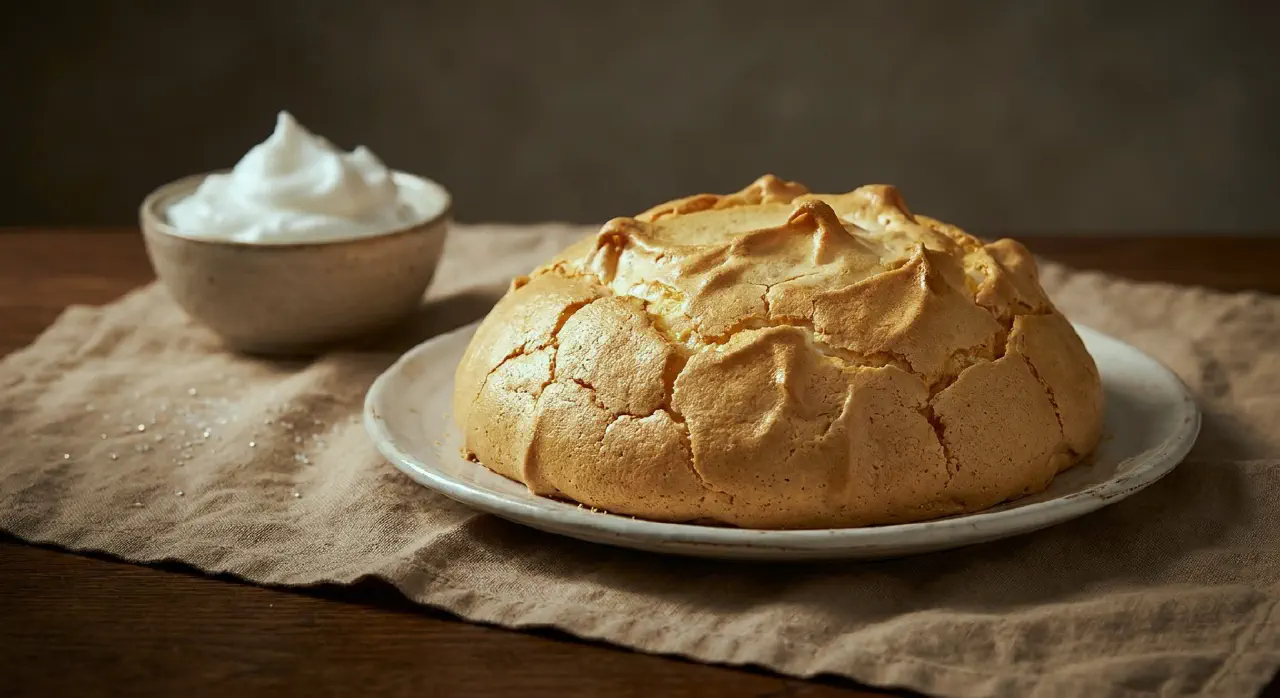
An egg foam is a mass of air bubbles stabilized by a protein network - a structure unique to egg whites. When whisked, egg white proteins unfold at the air-water interface and bond into a continuous film that reinforces bubble walls, turning a liquid into a semi-solid that can hold its shape against gravity. This is the basis of meringue, soufflé, angel food cake, mousse, and many other preparations.
How proteins stabilize bubbles
Pure water can’t sustain foam - surface tension pulls it into a compact puddle and any bubbles collapse instantly. Egg white succeeds because its proteins reduce surface tension and increase viscosity, buying time for a more permanent structure to form.
During whisking, two forces unfold the proteins: the mechanical stress of the whisk wires dragging through liquid, and the physical environment at the air-water interface (a drastic boundary that tugs proteins out of their folded shape). The unfolded proteins gather at bubble surfaces - water-loving portions in the liquid film, water-avoiding portions projecting into the air - and bond to each other, forming a continuous solid network throughout the foam.
Globulins and ovotransferrin do the initial work. They’re the most sensitive to physical stress and set up the basic foam structure. Ovalbumin (54% of the white) is relatively immune to beating and contributes little to raw foam - but when the foam is cooked, ovalbumin coagulates at ~180°F/80°C, more than doubling the solid protein reinforcement and transforming the transient semi-liquid foam into a permanent solid. This is why baked meringue holds its shape indefinitely.
The enemies of egg foams
Three substances inhibit foaming: egg yolk, oil/fat, and detergent. All are chemically similar - they compete with proteins for position at the air-water interface but provide no structural reinforcement, disrupting the protein network.
Even a trace of yolk in the whites impedes foaming dramatically. The practical rule: separate each white into a clean bowl before adding to the main bowl, so contamination is caught immediately. Equipment must be impeccably clean and grease-free - residual soap is worse than residual fat.
Importantly, yolk and fat can safely be mixed into a finished foam (this happens in mousses, enriched soufflés, and many cake batters). The prohibition is on their presence during whipping.
Controlling foam stability
The sulfur bond problem
The strongest bonds between egg white proteins are disulfide bonds (S-S), formed when sulfur-hydrogen groups on adjacent proteins shed their hydrogen and link together. A moderate number of these bonds is good - they reinforce the foam. But excessive disulfide bonding causes the proteins to cluster too tightly, squeezing out water. The foam goes grainy, loses volume, and separates into dry froth and runny liquid. This is overwhipping, and it’s irreversible.
Copper bowls
Copper ions form extremely tight bonds with reactive sulfur groups, preventing those groups from forming disulfide bonds with other proteins. The result: the foam stays glossy, stable, and never develops grains regardless of whipping time. This has been documented since at least 1771 (illustrated in the French Encyclopédie). Safety is not a concern - a cup of foam from a copper bowl contains about 0.1× normal daily copper intake.
Acid (the practical alternative)
Cream of tartar, lemon juice, or vinegar increases free hydrogen ions, which suppress the shedding of hydrogen from S-H groups. No hydrogen shedding means no disulfide bonds, which means no overwhipping. The foam takes just as long to whip but stays stable indefinitely once formed.
Dosage: 1/8 teaspoon cream of tartar or ½ teaspoon lemon juice per egg white, added at the beginning of beating.
Meringues: three solutions to one problem
All three meringue types solve the same challenge: how to incorporate sugar into an egg foam without deflating it. Sugar stabilizes foam by increasing viscosity but slows the whipping process.
French meringue (uncooked)
Sugar beaten directly into whipped whites. Simplest method, least stable result. Sugar timing affects texture: early addition produces a stiffer foam, late addition a softer, larger-volume foam. 2–3 tablespoons sugar per white. Best used within hours (raw, unstable). Becomes crisp outside and chewy inside when baked.
Swiss meringue (heated over water bath)
Whites and sugar heated together to ~160°F/71°C over gentle heat, then whipped. The heat partially coagulates proteins, producing a very smooth, silky, stable foam. Also pasteurizes the eggs, eliminating salmonella risk. Excellent for piping, frosting, and decorative work. Stores well.
Italian meringue (hot syrup)
Hot sugar syrup (240°F/115°C) poured into whipping whites. The heat simultaneously pasteurizes and partially sets the protein, producing the most stable meringue. Smoother and silkier than French. The syrup temperature is critical: too cool and it won’t coagulate the proteins; too hot and it cooks the whites too aggressively.
All meringues are hygroscopic - they absorb moisture from humid air and go soft. A dry environment is essential for storage.
Soufflés
A soufflé is an egg white foam anchored to a flavored base (typically a yolk-enriched béchamel or custard). The foam provides lift and lightness; the base provides flavor and structural support.
Structure and proportions
The base is usually ~2 tablespoons flour + 2 tablespoons butter + 1 cup milk or broth, enriched with egg yolks and flavoring. The foam uses 4–6 whites per 1–2 yolks in the base. More whites per yolk = lighter soufflé.
The rise
Two mechanisms provide lift: expansion of the trapped air bubbles as they heat, and steam from the water in the foam. Coagulating egg white proteins then set this expanded structure into a (mostly) permanent shape.
Technique
Fold whipped whites gently into a room-temperature base - vigorous stirring deflates the foam. Bake at 375–400°F/190–200°C. Remove when the top jiggles slightly in the center - the interior should still be creamy, not fully set. Overcooked soufflés fall because overcoagulated proteins squeeze out water and can no longer support the expanded structure.
Yolk foams: sabayon and zabaglione
Egg yolks can form foams despite their high fat content, because yolk proteins unfold with mechanical stress and the phospholipids (lecithin) act as emulsifiers that stabilize bubble membranes. The result is inherently denser and richer than a white foam.
Zabaglione (Italian): Yolks + sugar whisked over gentle heat (~160°F/71°C, using a double boiler) until warm, fluffy, and mousse-like. The heat partially coagulates proteins, stabilizing the foam far beyond what mechanical whipping alone can achieve.
Sabayon (French): The same technique applied more broadly - savory or sweet, using broth, juice, or wine as the liquid. Can serve as a sauce base. Butter can be folded in gently at the end (don’t whisk it - that would pop the bubbles).
Both are best served immediately. The protein bonds gradually relax and bubbles coalesce over time.
See also
- eggs - protein composition and coagulation temperatures
- custards - the other major branch of egg cookery
- protein-denaturation - the molecular events behind foam formation
- basic-egg-dishes - practical egg cooking applications
- emulsions - related physics of stabilized dispersions