Berries
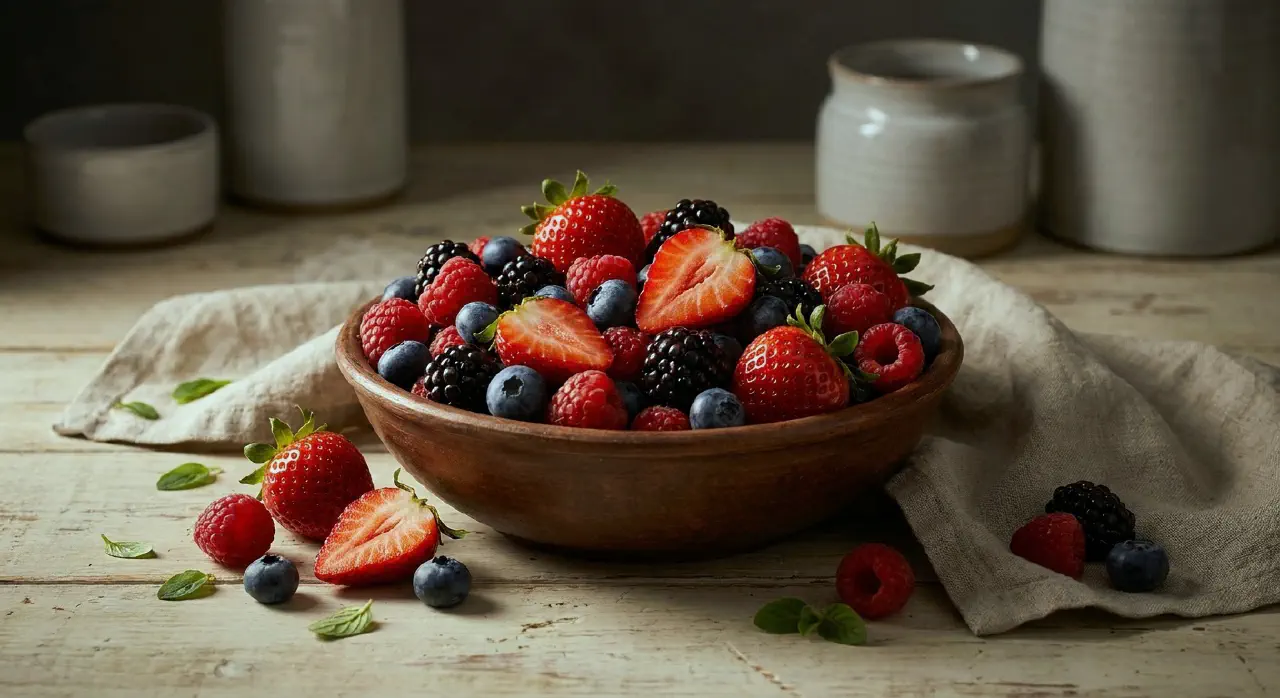
In culinary terms, the small fruits borne on bushes and low plants (rather than trees) - most native to northern woodlands. As a group, berries are the most fragile, perishable, and phenolic-rich fruits in the kitchen. Most are non-climacteric or nearly so, meaning quality is essentially fixed at harvest. Their intense colors come from anthocyanin pigments, and their concentrated flavors - far more intense in wild forms - make them both the most rewarding and most time-sensitive fresh fruits to work with.
Caneberries: blackberries and raspberries
Genus Rubus, growing on thorny canes across the temperate northern hemisphere. Each fruit is a composite of 50–150 separate fruitlets (like miniature plums with stony seeds), held together by surface hair entanglement - a structure that reportedly inspired the invention of Velcro. Blackberries separate from the cane at the flower base (base comes with fruit); raspberries separate from the base itself, creating the hollow interior.
Despite being climacteric, caneberries have among the highest respiration rates of any fruit, making them extremely perishable. Raspberry flavor centers on raspberry ketone plus violet-like ionones (carotenoid fragments); blackberry flavor varies from mild (European) to intense with spicy terpenes (American). Wild berries of both show far more intense flavor than cultivated. Phenolic antioxidants including ellagic acid actually increase during jam-making.
Hybrid caneberries (boysenberry, loganberry, tayberry) cross blackberry and raspberry parentage. Cloudberries (yellow-orange, Scandinavian) and Arctic bramble (intensely aromatic) are the exotic northern cousins.
Blueberries
North American Vaccinium species - weedy pioneers of burned fields, not cultivated until the 1920s. Spicy terpene-driven aroma. Rich in anthocyanins and phenolic antioxidants, especially in the skin. Freeze exceptionally well and retain shape when baked. The main hazard: anthocyanin pigments turn green in alkaline conditions - a dose of baking soda in muffin batter can produce an unsettling color shift. European bilberries (V. myrtillus) are the close relative.
Cranberries
North American bog vine with exceptional chemistry. The highest acidity of any berry (surpassed only by lemons and limes), phenolic content up to 200 mg/100g, and antimicrobial compounds evolved for survival in its damp habitat. A pigment precursor prevents bacterial adhesion to tissues - the basis of cranberry’s UTI-prevention reputation. Very high pectin content: barely cooked puree thickens immediately to sauce, and the pectins can even gel alcohol when macerated. Complex spicy-vanilla-almond bouquet from terpenes, cinnamates, benzoates, vanillin, and benzaldehyde. Lingonberries (V. vitis-idaea) are the European ecological equivalent.
Currants and gooseberries
Ribes genus, northern Europe and North America, not cultivated until ~1500. U.S. cultivation restricted because they harbor white pine disease. Black currants are the standout: intense aroma from spicy terpenes, fruity esters, and a musky “catty” sulfur compound - the same molecule responsible for the distinctive character of sauvignon blanc wines. Exceptionally high in vitamin C and phenolic antioxidants (~1% of weight, about a third anthocyanins). Made into preserves and the French liqueur crème de cassis.
Grapes
Vitis vinifera accounts for two-thirds of world production (wine), with the remainder split between fresh eating and raisins. Flavor ranges from fairly neutral (Thompson seedless) to flowery/citrusy (muscat, from terpenes) to musky (Concord, from anthranilate esters - the same compound in mandarin orange aroma). Raisins: sun-dried over ~3 weeks, browned by both enzymatic phenolic oxidation and Maillard reactions; golden raisins are sulfur-dioxide-treated and mechanically dried for fruitier, lighter character. Verjus: juice from thinned unripe grapes, a tart-sweet-green alternative to vinegar. Saba/grape syrup: ripe grapes cooked to thick syrup, an ancient sweetener predating cheap sugar, possibly the ancestor of balsamic vinegar.
Kiwi fruit
Chinese vine (Actinidia deliciosa), marketed as “kiwi” by New Zealand producers in the 1970s. Stores large amounts of starch, making it a true climacteric fruit that sweetens over months of cold storage. Striking green flesh (chlorophyll) with ~1,500 small black seeds in a visually attractive cross-section. Contains the potent protein-digesting enzyme actinidin (dissolves gelatin, irritates sensitive skin; heat inactivates but muddies color) and irritating calcium oxalate crystals that become more apparent when pureed. Yellow, red, and purple chlorophyll-free varieties now cultivated.
Strawberries
Botanically bizarre - a “false fruit” where the fleshy portion is the swollen flower base (receptacle), not the ovary, and the “seeds” (achenes) sit on the surface rather than inside. A remarkably young hybrid: modern strawberries (F. × ananassa) are less than 300 years old, an accidental cross around 1750 in Brittany between two American species (F. virginiana and F. chiloensis). The pineapple note (reflected in the species name ananassa) comes from ethyl esters, with furaneol adding a complex caramel character. Cannot improve once picked, limited to a few days’ shelf life. Poor in pectin - preserves usually need supplementation.
Other notable berries
Elderberries: pleasantly aromatic but too tart raw, containing lectins that require heating to inactivate. Barberries: like miniature cranberries, much used in Persian cooking as tart rubies in jeweled rice. Ground cherries/cape gooseberries: miniature yellowish tomato-relatives with floral-caramel notes, unusually good keepers at room temperature.
See also
- fruit-ripening - climacteric vs non-climacteric behavior across berry types
- plant-color - anthocyanin pigments, pH sensitivity (frozen blackberries turning red)
- plant-preservation - pectin in cranberries, jam-making, raisin drying
- plant-flavor - terpenes, esters, sulfur compounds (black currant/sauvignon blanc)
- fermentation-overview - wine, verjus, grape syrup
- dried-fruits - raisins, dried cranberries, dried cherries
- citrus - mandarin shares anthranilate ester with Concord grape