Water in Cooking
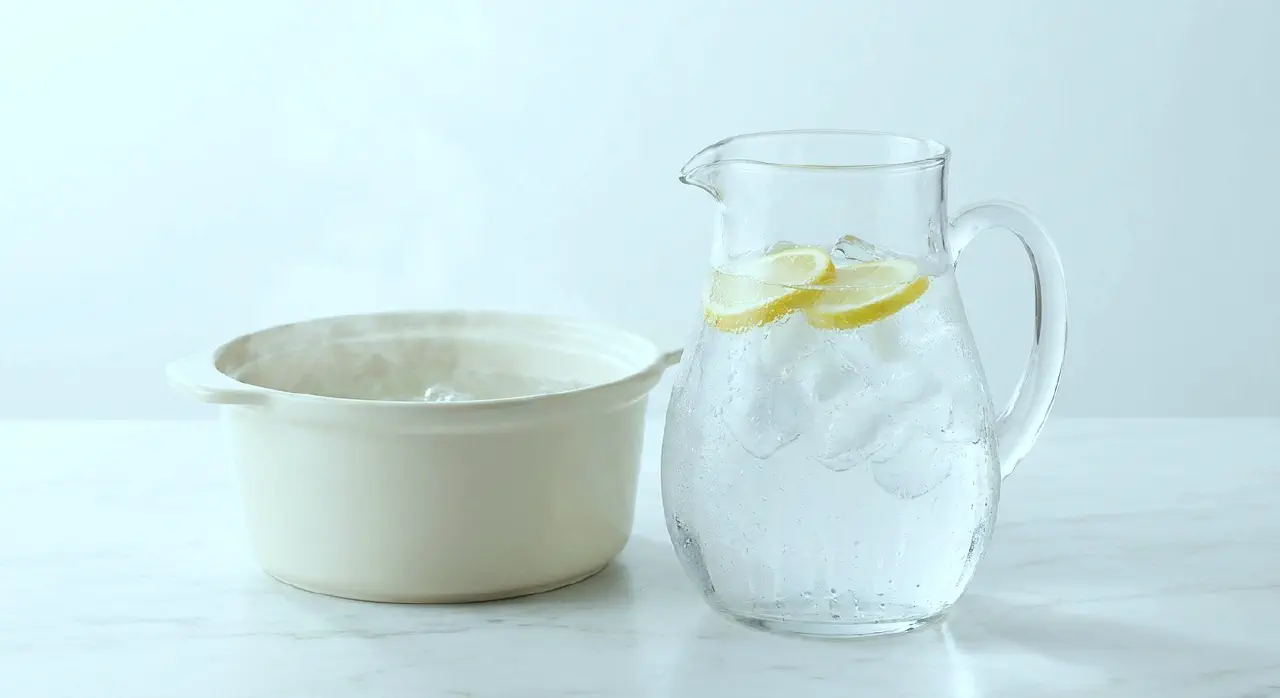
Water is the dominant molecule in nearly all foods - raw meat is ~75% water, fruits and vegetables up to 95%, human bodies ~60%. Its seemingly simple structure (two hydrogens, one oxygen) conceals unusual physical properties that govern almost every aspect of cooking: how food heats, how it freezes, why steam scalds, why salt preserves, and why oil and water won’t mix.
Hydrogen bonding: the master property
Oxygen pulls more strongly on shared electrons than hydrogen does, making water an electrically asymmetrical (polar) molecule - positive at the hydrogen end, negative at the oxygen end. This polarity creates hydrogen bonds: weak electrical attractions between the negative oxygen of one molecule and the positive hydrogen of another. In liquid water, each molecule participates in 1–4 hydrogen bonds at any moment, constantly forming and breaking.
Hydrogen bonding explains water’s dissolving power (it surrounds and separates other polar molecules like sugars and proteins), its high boiling point (hydrogen bonds resist separation into gas), and its incompatibility with fats (nonpolar fat molecules cannot form hydrogen bonds, so water molecules bond with each other and exclude the fat).
Heat absorption: specific heat and latent heat
Water has an unusually high specific heat - the energy required to raise its temperature. It takes roughly 10 times more energy to heat an ounce of water by 1°F than an ounce of iron. A covered pan of water takes about twice as long as oil to reach a given temperature, but it also holds temperature longer after heat is removed. This property makes water baths ideal for gentle cooking - custards, low-temperature roasting - because the large thermal mass resists temperature spikes.
Water’s latent heat of vaporization is even more consequential. Converting liquid water to steam absorbs an enormous amount of energy without raising the temperature - the energy goes into breaking hydrogen bonds rather than increasing molecular speed. This is why:
- Steam scalds: When steam condenses on skin or food, it releases all that stored energy at once. Steam at 212°F delivers far more heat than dry air at the same temperature.
- Steaming is efficient: The latent heat released during condensation on food surfaces makes steaming a surprisingly effective cooking method.
- Evaporative cooling works: Sweating, porous clay vessels, and the surface cooling of roasting meat all exploit water’s high latent heat.
- Bread benefits from steam: Initial steam in the oven increases oven spring and produces lighter loaves.
Ice: the anomalous solid
Water is nearly unique among common substances: its solid phase (ice) is less dense than its liquid. Ice crystals require even hydrogen-bond distribution, spacing molecules about 1/11 further apart than in liquid water. This expansion is why water pipes burst in freezing conditions, bottles shatter if overfilled, and - critically for cooking - frozen foods leak fluid when thawed. Expanding ice crystals rupture cell membranes and walls; the released water cannot be reabsorbed, producing the characteristic weeping and texture loss of thawed meat, fish, and produce.
Acidity and pH
Pure water slightly dissociates: a hydrogen occasionally breaks off one molecule and bonds to another, creating a negatively charged OH⁻ group and a positively charged H₃O⁺ ion. Under normal conditions only ~2 ten-millionths of a percent exists in this state, but these mobile hydrogen ions (protons) have drastic effects on other molecules.
Acids release protons into solution; bases (alkalis) accept them. The pH scale (0–14) measures proton concentration: each unit represents a 10-fold change (pH 5 has 1,000× more H⁺ than pH 8). Common food pH values: lemon juice 2.1, yogurt 4.5, black coffee 5.0, milk 6.9, egg white 7.6–9.5. Cooking medium pH influences vegetable color, protein texture, and browning reactions.
Water activity and preservation
The amount of available water - not total water - determines how quickly food spoils. Dissolving salt or sugar in water “ties up” water molecules around solute particles, reducing the water available for microbial growth. This is the principle behind salt-curing, sugar preserves, and fermented foods where salt creates an osmotic environment hostile to spoilage bacteria while allowing flavor-producing microbes to thrive.
Hard water
Tap water dissolves calcium and magnesium salts that can affect cooking: altering vegetable color and texture, changing bread dough consistency, and leaving mineral deposits. Hard water can be softened by precipitating minerals or using ion exchange to replace calcium/magnesium with sodium.
See also
- lipid-chemistry - nonpolar molecules that water excludes (the oil-water divide)
- protein-structure - water-loving vs water-avoiding amino acids in protein folding
- carbohydrate-overview - sugars and polysaccharides that dissolve via hydrogen bonding
- heat-transfer - water’s role in convection and phase-change heat delivery
- wet-heat-methods - boiling, simmering, steaming, poaching
- emulsions - bridging the water-fat divide
- salt - osmotic preservation through water activity reduction