Cooking Temperatures
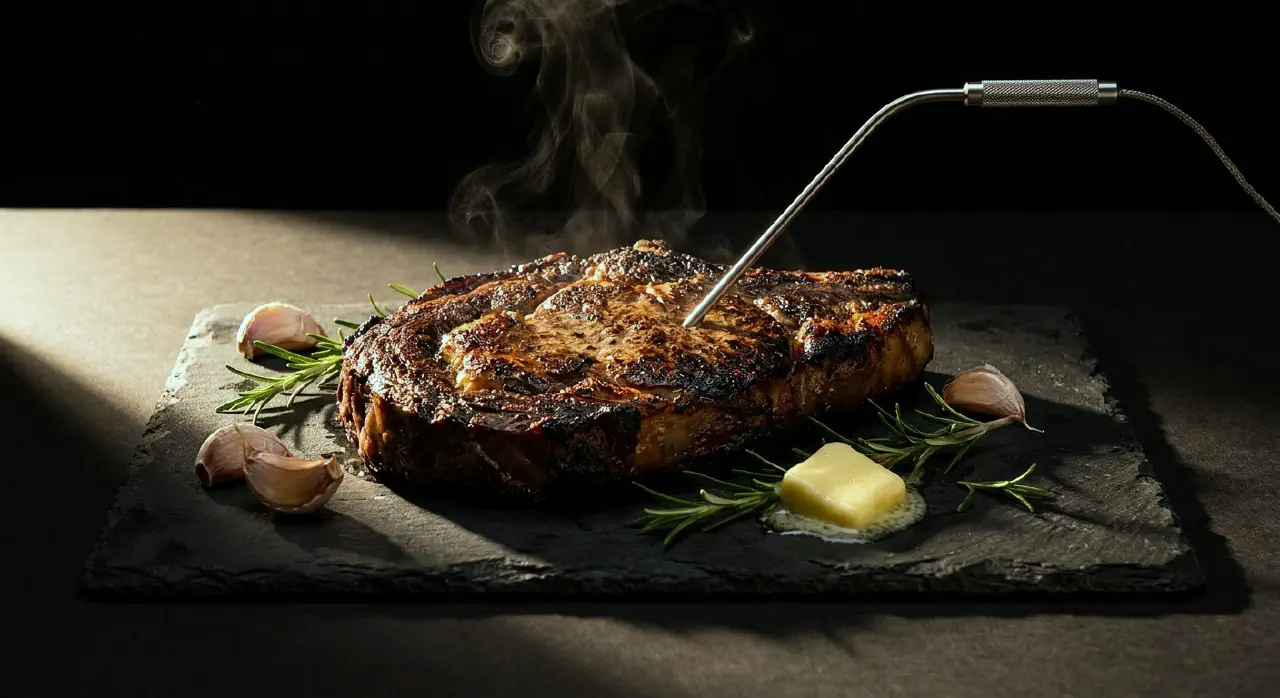
Temperature is the single most important variable in cooking. Every major transformation - protein-denaturation, starch-gelatinization, caramelization, the maillard-reaction - is a chemical reaction governed by temperature. Understanding a few foundational principles lets you reason about almost any cooking situation from first principles.
The Arrhenius rule: 10°C doubles the rate
The Arrhenius equation from physical chemistry predicts that chemical reaction rates roughly double with every 10°C increase. In the kitchen, this means a 5°C difference is noticeable (~1.4× speed change), a 20°C swing produces a 4× difference in browning speed, and small temperature errors compound into large outcome differences.
This single principle explains why searing at 230°C browns in seconds while cooking at 170°C takes minutes, why vegetables go from crunchy to mush in a narrow window, and why fermentation organisms have such tight optimal bands - enzymatic reactions follow the same rule until the enzyme denatures.
Heat transfer in food
Heat travels from the cooking medium to the food surface by conduction (pan contact), convection (moving liquid, oil, or air), or radiation (infrared from coals or broiler elements). But once heat reaches the food surface, it travels inward almost exclusively by conduction - and food is a poor conductor, behaving more like a ceramic insulator than a metal.
This means the primary variable controlling internal cooking time is thickness, not weight. A steak twice as thick takes roughly four times as long to cook through (thermal diffusion follows a square law). Shape matters too: a flat fillet heats faster than a cylinder of the same weight because it has more surface area relative to its thickest point.
The grey band problem
In any piece of meat cooked from the outside, there is a gradient from the hot surface to the cooler center. The “grey band” - the overcooked outer ring - is a function of pan temperature minus target core temperature. Three strategies minimize it:
Lower pan temperature for thick cuts: A 5 cm steak seared at 230°C will have a 1 cm grey band. The same steak cooked at 160°C will have a thin one - the smaller temperature differential means more of the meat lands in the target range.
Frequent flipping (every 1–2 minutes) pulses heat from alternating sides, reducing the continuous gradient on any one side.
Reverse searing: Cook low first (oven at 120°C or sous vide) to bring the center near target temperature, then finish with a brief high-heat sear. Because the interior is already warm, the sear has less work to do and the grey band stays thin.
The temperature map of cooking
Different food components transform at different temperatures. Knowing where these thresholds sit - and how narrow some windows are - is the essence of cooking by temperature rather than by time.
Proteins
Meat and fish have quite different doneness windows. Red meat has roughly 10°C of usable range, pork ~5°C, but fish has only 3–5°C - and the entire scale is shifted 10–15°C lower. Fish myosin shrinks at ~50°C, dries at ~60°C, and collagen dissolves at just 50–55°C (vs 70°C+ for beef). The key meat thresholds are myosin denaturation (~50°C, firmness begins), collagen shrinkage (~60–65°C, major moisture loss), and collagen dissolution (~70°C+, slow conversion to gelatin that compensates for fiber drying in braises). See fish-cooking for fish-specific temperature targets, including the enzyme danger zone for mush-prone species.
Carry-over cooking - the continued rise in internal temperature after removing from heat - must be factored in. Small pieces (150 g) rise 3–5°C, standard steaks (250–400 g) rise 6–10°C, and large roasts (1+ kg) rise 8–12°C.
Starch coatings
Starch needs more energy than bare protein to brown. Bare protein begins browning at ~140°C, but starch coatings (breading, flour, batter) need ~180–195°C because starch must first lose water (100°C), then undergo dextrinization (150–180°C), then finally Maillard-brown (180°C+). This three-step sequence is why breaded fish fries at 195°C while a bare fillet pan-fries at 175°C.
Vegetables
Vegetables occupy a razor-thin temperature window. Pectin - the glue holding plant cells together - is stable below 80°C but dissolves rapidly above 90°C. The sweet spot at 84°C produces tender-crisp results. Only 10°C separates “still raw” from “mush” - see vegetable-cooking for the full picture.
Sugar
Caramelization temperatures vary dramatically by sugar type: fructose begins breaking down at 105°C, glucose at 150°C, and sucrose at 170°C. Practical caramel-making in the kitchen runs from 160°C (light) through 200°C (medium golden) to 220°C (dark, bordering on burnt).
Emulsified sauces
Egg-based emulsified sauces (hollandaise, béarnaise) work at 58–60°C and curdle at ~82°C. The working range is narrow and must not be exceeded. Butter-based mounting works at ~75°C.
The decision tree
When encountering an unfamiliar ingredient, a few questions map directly to temperature and method:
What type? Protein, starch, vegetable, egg, or sugar - each has its own temperature regime. Proteins follow the thickness rule. Starches need higher heat than bare protein. Vegetables depend on desired texture. Eggs are the purest temperature-as-texture dial.
How thick? Thinner pieces need higher pan temperatures and shorter times (speed is critical before the center overcooks). Thicker pieces need lower pan temperatures and longer times (the center needs time to heat before the surface burns).
Is it coated? A starch coating raises the required temperature: bare protein browns at 140°C, flour-dusted at 185°C, breaded at 190–195°C, battered at 180–190°C.
What method? Pan-fry (use thickness rules), deep-fry (170/180/190°C bands), poach (65°C for fish, 95°C for vegetables, 100°C for eggs), braise (85–95°C), sous vide (see specific temperature targets).
See also
- protein-denaturation - the molecular events behind meat texture changes
- maillard-reaction - the browning chemistry that begins at ~140°C
- caramelization - pure sugar browning and its temperature thresholds
- starch-gelatinization - how starch absorbs water and sets structure
- vegetable-cooking - the pectin cliff and the three temperature regimes
- deep-frying - the steam armor principle and temperature bands
- meat-cooking - the grey band, carry-over, and matching method to meat
- fish-cooking - the 20°F gap, mush-prone species, and the enzyme danger zone
- heat-transfer - conduction, convection, radiation physics
- cookware-materials - how material conductivity affects temperature control
- grilling-broiling - high-temperature radiation methods
- wet-heat-methods - the 212°F moist-heat ceiling
- precision-cooking - temperature precision techniques and tools
- crust-engineering - browning and crust formation strategies
- temperature-switches - phase transitions driven by temperature
- starch-browning - the browning process specific to starch coatings
- precision-fermentation - temperature control in fermentation