Olive Oil
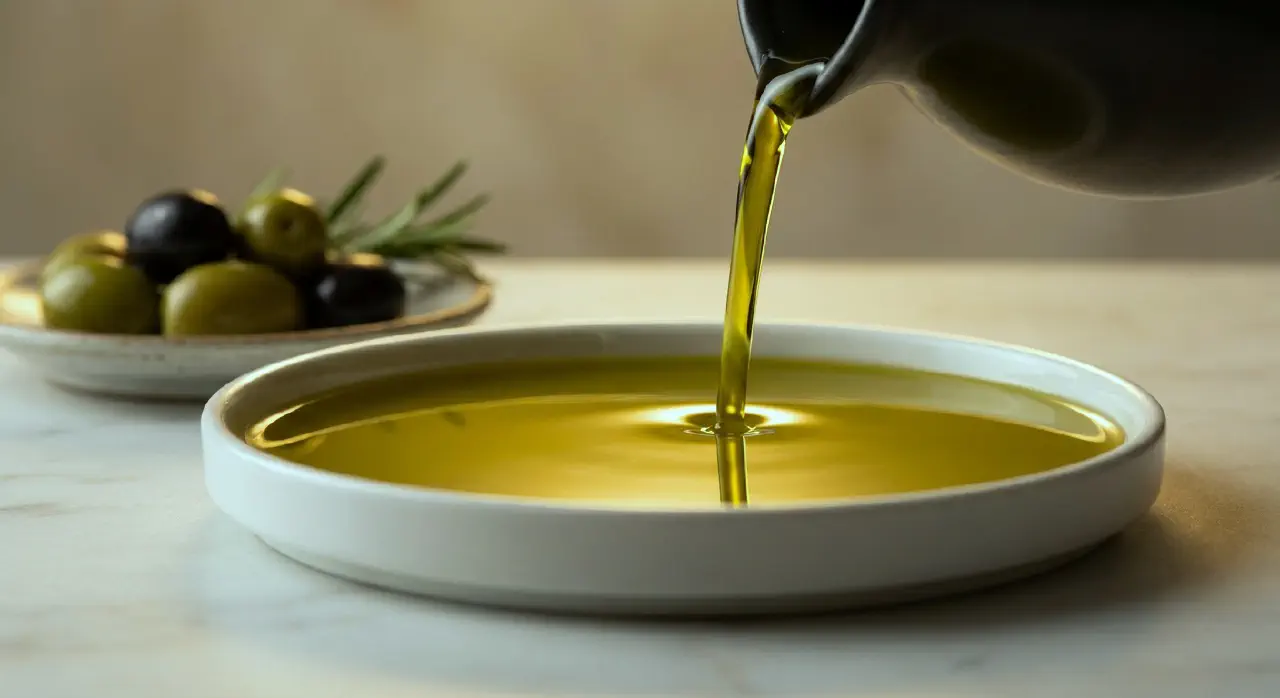
Olive oil is a fruit oil - pressed from the flesh of Olea europaea - and the only widely used cooking fat extracted from fruit rather than seeds or animal tissue. Its distinctiveness comes from a high monounsaturated fatty acid content that makes it thermally stable, and from polyphenol compounds unique to olives that contribute bitterness, pungency, and significant antioxidant activity.
Flavor chemistry
Fresh extra virgin olive oil (EVOO) carries two separate flavor systems: volatile aromatics and polyphenols.
Volatile aromatics
The green, grassy, cut-hay character of fresh EVOO comes from C6 aldehydes and alcohols produced enzymatically when olive cells rupture during milling:
- trans-2-Hexenal - the dominant green, cut-grass note; the most abundant volatile in freshly pressed oil
- Hexanal - fruity, apple-like
- Cis-3-Hexen-1-ol - intensely grassy, fresh-cut green
These are terpene-like compounds - highly volatile and the first to dissipate. Heat drives them off within seconds of cooking. They largely disappear within 12–18 months of harvest even in well-stored oil, which is why harvest date matters more than best-by date.
Polyphenols
Polyphenols are responsible for the bitterness and the characteristic throat burn of high-quality EVOO, and are the primary carriers of health benefit:
- Oleocanthal - produces the burning, coughing sensation at the back of the throat (not the front) that distinguishes high-polyphenol EVOO. It inhibits COX-1 and COX-2 enzymes by the same mechanism as ibuprofen - the throat irritation is the same receptor activation. A 50 mL serving of high-polyphenol EVOO provides roughly 10% of the COX-inhibitory activity of a standard ibuprofen dose.
- Oleacein - responsible for the palate bitterness
- Hydroxytyrosol - the most potent antioxidant polyphenol in olive oil; contributes to the oil’s oxidative stability and provides bioactive antioxidant effects when consumed
- Tyrosol - milder antioxidant
Polyphenol content ranges from ~50 mg/kg in mild cultivars to 800+ mg/kg in early-harvest Koroneiki or Coratina. Refined olive oil contains negligible polyphenols. The EU permits a health claim on oils with polyphenol content ≥ 250 mg/kg.
Oxidative stability and cooking
The smoke point misconception
EVOO’s smoke point (190–210°C) is lower than many refined seed oils, which is widely cited as a reason not to cook with it. This reasoning is wrong.
Smoke point is not a reliable indicator of cooking safety. A 2018 study testing ten cooking oils at temperatures up to 240°C found that EVOO produced the lowest quantity of polar oxidation compounds of all oils tested - including at temperatures above its smoke point. Refined seed oils with higher smoke points (canola, sunflower, grapeseed) produced significantly more harmful breakdown products because they are rich in polyunsaturated fatty acids (PUFAs), which are chemically unstable at heat.
The better predictors of cooking safety are:
- Oxidative stability - resistance to oxidative breakdown under heat; EVOO scores very high
- PUFA content - the lower the PUFA content, the more thermally stable the oil
See lipid-chemistry for the underlying fatty acid saturation mechanics.
EVOO in practice
EVOO is safe and practical for all normal cooking including shallow frying. The practical limits:
- Sustained frying above 200°C will burn off the expensive volatile aromatics quickly - at normal frying temperatures (170–190°C), EVOO is both safe and stable
- Premium single-estate EVOO is wasteful for cooking; its flavor advantage disappears in the pan. Use mid-range certified EVOO for cooking, reserve premium oil for finishing
- “Refined” or “Pure” olive oil (blended refined + a small percentage of virgin) has a higher smoke point and neutral flavor, suitable for high-heat frying where olive character is not needed
Grades
| Grade | Free acidity | Polyphenols | Extraction | Flavor |
|---|---|---|---|---|
| Extra Virgin (EVOO) | ≤ 0.8% | 50–800+ mg/kg | Mechanical only, ≤ 27°C | Complex, fruity to robust |
| Virgin | ≤ 2.0% | Moderate | Mechanical | Milder, minor defects possible |
| Pure / Light | ≤ 1.0% (blend) | Very low | Refined + virgin blend | Neutral to mild |
| Refined | ≤ 0.3% | Negligible | Chemical/thermal | Nearly flavorless |
| Pomace | ≤ 1.0% | Negligible | Solvent-extracted from spent paste | Neutral, off-notes possible |
Cold extraction (EU legal term): malaxation and extraction temperature ≤ 27°C. This is the meaningful label claim - higher temperatures increase yield but degrade polyphenols and volatile aromatics. “Cold pressed” and “first cold pressed” are largely obsolete marketing terms.
Cultivars
Polyphenol content and flavor profile are determined as much by cultivar as by production method:
| Cultivar | Origin | Flavor | Polyphenol level |
|---|---|---|---|
| Picual | Andalusia, Spain | Robust, peppery, bitter, tomato leaf | Very high |
| Koroneiki | Greece (Peloponnese) | Intense, herbal, peppery, artichoke | Very high |
| Coratina | Puglia, Italy | Very bitter, very peppery | Extremely high |
| Frantoio | Tuscany, Italy | Medium-robust, herbal, artichoke, dried fruit | High |
| Moraiolo | Umbria, Italy | Intense, bitter, peppery | Very high |
| Arbequina | Catalonia, Spain | Mild, fruity, buttery, almond | Low–medium |
| Taggiasca | Liguria, Italy | Very mild, buttery, sweet | Low |
| Hojiblanca | Andalusia, Spain | Medium intensity, sweet with slight bitterness | Medium |
Harvest timing
Harvest timing is the most consequential decision in olive oil quality after cultivar:
Early harvest (olives still green or turning): lower oil yield per fruit, but dramatically higher polyphenol concentrations. More bitter, peppery, and intensely grassy. Associated with maximum health benefit and flavor complexity. All serious premium producers harvest early.
Late harvest (fully ripe, purple-black): higher oil yield, lower polyphenols, milder flavor - sometimes buttery or sweet. Economically rational for volume production, but the finished oil has less character and shorter effective shelf life.
Storage and freshness
EVOO degrades through two routes: volatile loss (the fresh aromatic character) and oxidation (rancidity). Both are accelerated by heat, light, and oxygen exposure.
- Container: dark glass, tin, or opaque bottle - chlorophyll in olive oil is photo-reactive and accelerates oxidation under light
- Temperature: cool room temperature; never near the stove or in direct sunlight
- Freshness window: best within 12–18 months of harvest, not of bottling
- After opening: use within 3–6 months
- Rancidity signs: waxy, crayony smell (hexanal rancidity from oxidized linoleic acid) or musty, wine-vinegar quality (fermentation defects)
Harvest date on the label is more useful than best-by date for judging freshness.
Health evidence
Olive oil is approximately 70–80% oleic acid, a monounsaturated fatty acid (omega-9). The low PUFA content explains its thermal stability. The polyphenols contribute antioxidant activity and are associated with cardiovascular benefit.
The PREDIMED trial (Spain, ~7,400 participants) found a 30% relative reduction in major cardiovascular events in participants assigned a Mediterranean diet supplemented with EVOO (≥4 tbsp/day). The study was retracted in 2018 after randomization protocol violations were found at some sites, then republished in the same journal with corrected analysis - which supported the original conclusion. The benefits are associated with genuine high-polyphenol EVOO consumed at meaningful quantities, not trace amounts.
See also
- lipid-chemistry - triglyceride structure, MUFA vs PUFA saturation, oxidative stability
- seed-oils - seed oil extraction, PUFA-heavy oils for comparison
- deep-frying - oil selection, oxidative stability, reuse
- emulsions - how olive oil forms stable emulsifications
- maillard-reaction - heat-driven browning in cooked olive oil dishes
- plant-flavor - phenolic antioxidants and pungency mechanisms
- flavor-chemistry - volatile aromatic extraction and stability