Lipid Chemistry
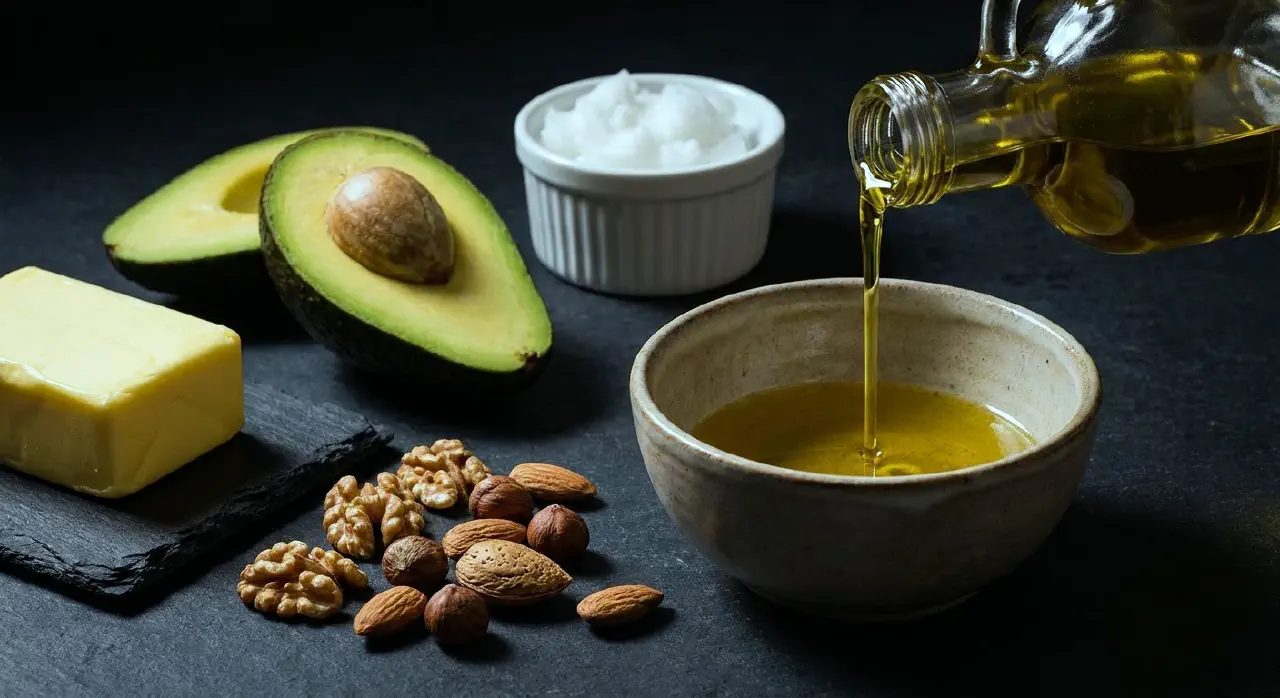
Lipids (from Greek for “fat”) are a large chemical family - fats, oils, phospholipids, pigments (carotenoids, chlorophyll), vitamin E, cholesterol, waxes - all consisting mainly of long carbon chains with projecting hydrogen atoms. Their defining property is hydrophobia: carbon-hydrogen bonds are nonpolar (atoms pull with equal force on electrons), so lipids cannot form hydrogen bonds with water. When mixed, polar water molecules bond with each other and nonpolar lipids segregate, minimizing contact. This single property - the oil-water divide - explains emulsions, fat rendering, oil-based extraction of aromas, and why fats float.
Triglycerides: the basic unit
Cooking fats and oils are triglycerides: one glycerol molecule (a 3-carbon backbone) bonded to three fatty acid chains. Fatty acids are long hydrocarbon chains (typically 14–20 carbons) with an acidic oxygen-hydrogen group at one end. The properties of any fat depend on which fatty acids are attached and where they sit on the glycerol frame.
Oils vs. fats is a melting-point distinction, not a chemical one - liquid at room temperature versus solid. What determines which? Saturation.
Saturation: the master variable
Saturated fatty acids have no double bonds between carbons - every carbon carries its full complement of hydrogen atoms. The chains are straight, regular, and pack together tightly (like zippering), forming organized solid structures. This is why butter (62% saturated) and coconut oil (86% saturated) are solid at room temperature.
Unsaturated fatty acids have one or more double bonds, each creating a rigid kink in the chain. Kinks prevent tight molecular packing, making the fat harder to solidify. Monounsaturated fats (one kink) are liquid at room temperature but can solidify when chilled; polyunsaturated fats (multiple kinks) stay liquid even when cold.
| Fat/Oil | Saturated | Monounsaturated | Polyunsaturated |
|---|---|---|---|
| Coconut oil | 86% | 6% | 2% |
| Butter | 62% | 29% | 4% |
| Cocoa butter | 60% | 35% | 2% |
| Beef tallow | ~50% | ~42% | ~4% |
| Olive oil | 13% | 74% | 8% |
| Canola oil | 7% | 55% | 33% |
| Safflower oil | 9% | 12% | 75% |
Three factors set melting point: saturation level (straight chains pack tighter), chain length (shorter = lower melting point), and molecular variety (mixed triglycerides resist crystallization). Most fats soften gradually over a broad temperature range rather than melting sharply - different triglycerides within the mixture melt at different temperatures. This is why cocoa butter’s six crystal polymorphs and butter’s broad softening range matter so much.
Hydrogenation and trans fats
Manufacturers convert liquid oils to solid shortenings by exposing oil to hydrogen gas with a nickel catalyst at high temperature and pressure. Hydrogen atoms add to double bonds, increasing saturation and raising the melting point. But a side reaction also occurs: some double bonds rearrange from cis geometry (kinked, the natural form) to trans geometry (less kinked). Trans fats behave like saturated fats - they pack more easily, crystallize more firmly, and resist oxidation - but they also mimic saturated fats physiologically, raising blood cholesterol and contributing to heart disease. Manufacturers are now implementing alternatives (interesterification, fractionation) to harden fats without trans fat formation.
Rancidity and stability
Unsaturated fats are vulnerable because double bonds leave carbon atoms unprotected by hydrogen - atmospheric oxygen can break chains at these points, creating volatile fragments with off-flavors and off-odors. More unsaturated = more prone to rancidity. Shelf life correlates directly with saturation: coconut oil (90% saturated) keeps longest; walnuts and safflower oil (high polyunsaturates) go rancid fastest. Sesame oil is uniquely stable for a polyunsaturate-rich oil thanks to lignans, vitamin E, and browning-reaction antioxidants.
Not all lipid fragments are undesirable - crushed green leaf and cucumber aromas come from phospholipid fragments (via oxygen and plant enzymes), and deep-fried food’s characteristic smell comes from fatty acid fragments created at high temperatures.
Smoke point
A fat’s smoke point is the temperature at which it breaks down into visible gaseous products. Key factors: free fatty acid content (lower = higher smoke point), refinement level, freshness, and additives. Vegetable oils smoke around 400–450°F; animal fats around 375°F; butter ~350°F (milk proteins burn first). Smoke point drops with each reuse as breakdown accumulates.
Smoke point is a poor indicator of cooking safety. The more relevant predictor is oxidative stability - resistance to producing harmful polar compounds under heat. A 2018 study testing ten oils at up to 240°C found that extra virgin olive oil (EVOO, smoke point ~190–210°C) produced fewer harmful oxidation products than refined canola or sunflower oil (smoke points ~220–230°C), because EVOO’s high monounsaturated fat content and polyphenol antioxidants resist oxidative breakdown better than PUFA-rich oils. PUFAs have multiple double bonds - multiple vulnerable sites for chain-reaction oxidation. MUFAs have one. The gap in oxidative stability between a MUFA-dominant oil and a PUFA-dominant oil is larger and more consequential than the gap in smoke point.
See olive-oil for cooking stability in practice; pan-frying and deep-frying for temperature management.
Emulsifiers
Phospholipids and monoglycerides are the molecular bridges between water and fat. Each has a polar (water-soluble) head and one or two nonpolar (fat-soluble) tails. In emulsions like mayonnaise, the tails dissolve into fat droplets while the charged heads project outward, shielding droplets from each other and preventing coalescence. Egg yolk’s lecithin (about ⅓ of yolk lipids) is the most important natural emulsifier in cooking. In baking, monoglycerides retard staling by complexing with amylose and blocking starch retrogradation.
Omega-3 fatty acids
Most common unsaturated fats are omega-6 (first double bond at the sixth carbon from the chain end). Omega-3s place the first double bond at the third carbon and are essential for immune and cardiovascular function. Linolenic acid (18 carbons, 3 double bonds) is found in green leaves and some seed oils; EPA (20 carbons, 5 double bonds) is found almost exclusively in seafood - explaining why fish consumption carries specific nutritional benefits.
See also
- water-science - the polar molecule that lipids cannot mix with
- protein-structure - hydrophobic amino acids fold into protein interiors (lipid-like behavior)
- emulsions - how lecithin and monoglycerides stabilize oil-water mixtures
- butter - the inverted emulsion: water droplets in fat
- seed-oils - extraction, specific oil profiles, smoke points
- olive-oil - the MUFA-dominant fruit oil; oxidative stability in cooking
- deep-frying - oil degradation, smoke point management
- chocolate-cooking - cocoa butter polymorphism, tempering
- cream - fat globule structure in dairy