Fish Cooking
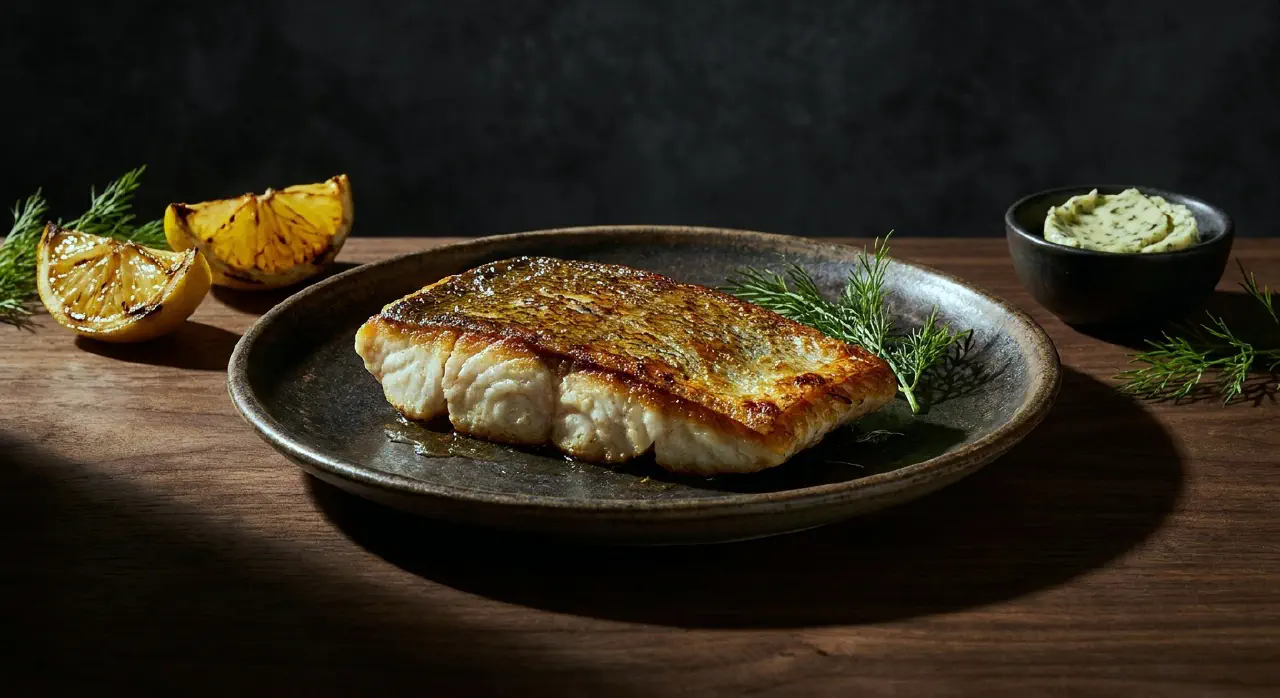
Cooking fish requires different logic than cooking meat. Fish proteins are adapted to cold water, unfold and coagulate more readily, and reach every thermal milestone about 20°F lower than land animal muscle. This means fish reaches target texture in minutes, overcooks in seconds, and responds to heat in ways that sometimes contradict meat-cooking intuition.
Temperature Targets
| Target | Temperature | Texture | Best For |
|---|---|---|---|
| Maximum succulence | 120°F (50°C) | Translucent, jelly-like | Dense fish: tuna, salmon |
| Standard | 130–140°F (55–60°C) | Firm but moist | Most fish and shellfish |
| Safety minimum | 140°F (60°C) | Thoroughly firm | Bacteria/parasite elimination |
| Enzyme deactivation | 160°F (70°C) | Drier but intact | Mush-prone species cooked slowly |
| Virus inactivation | 185°F (83°C) | Very dry | Rarely needed |
Collagen-rich species (shark, skate) benefit from 140°F+ to convert collagen to gelatin. See cooking-temperatures for the broader Arrhenius framework.
The Mush Problem
This is where fish cooking most dramatically contradicts meat-cooking wisdom. Certain species contain highly active cathepsin enzymes that become increasingly destructive as temperature rises, peaking at 130–140°F (55–60°C) - precisely the gentle-cooking sweet spot. These enzymes digest muscle fibers from within during slow cooking.
Mush-prone species: sardine, herring, mackerel, tuna, chum salmon, whiting, pollack, tilapia, shrimp, lobster.
Two strategies work: cook quickly to 160°F (70°C) to inactivate enzymes before they do damage (accept some drying), or cook gently to 120–130°F and serve immediately before enzymes accumulate damage at resting temperature. There is no safe middle ground for these species.
Sedentary fish (rockfish, snapper, cod, mahimahi) have fewer enzymes and are much more forgiving. They remain moist at 130°F and above.
The Uneven Thickness Problem
Fish fillets taper from thick center to thin edges. Thin areas overcook while thick areas finish. Four strategies:
Slashing: Cut slashes every 1–2 cm into thick portions. Creates smaller heat-penetration units for more even cooking.
Protective covering: Loosely cover thin areas with foil to block radiant heat. Useful for large fillets and whole fish.
Gentle heat: Poaching and low-temperature baking transfer heat slowly enough for thick areas to finish without devastating thin edges. Can follow with brief high-heat treatment for browning.
Doneness checking: Thermometer (most reliable), visual inspection (incision in thickest part), bone test (bone releases when collagen dissolves), skewer test (resistance from coagulated fibers). The “10 minutes per inch” rule is a starting point only.
Dry Heat Methods
Grilling/broiling: High surface temperature creates maillard-reaction browning. Use firm fish (tuna, swordfish, halibut) that holds together. Wire basket racks solve the sticking problem. Thin fillets on preheated buttered plate, broiled without turning.
Pan-frying (sautéing): High heat browns surface quickly. Coatings (flour, breadcrumbs, batter) absorb heat before fish cooks through. For crisp skin: pre-salt to draw moisture, start skin-side down in hot pan, press gently, leave on high heat until crisp, flip, finish on lower heat.
Deep frying: Oil at ~350°F (175°C) is actually a relatively gentle heat conductor. Coating acts as insulation. Fish heats evenly from all directions with more leeway for timing. See deep-frying.
Baking: Hot air is inefficient at heat transfer. Low-temperature baking (200–225°F) creates custard-like texture but can produce white globs of escaped cell fluid. High-temperature baking (475–500°F) after pan-browning finishes fish evenly.
Moist Heat Methods
Poaching: Best temperature control of any method. Start in liquid just below boil to sterilize surface, add cool liquid to drop to 150–160°F, cook gently. Let fish cool in liquid for maximum moisture. Court bouillon (water, salt, wine/vinegar, aromatics) should be cooked 30–60 minutes first; add pepper only in last 10 minutes (longer cooking releases bitter compounds).
Steaming: Rapid for thin fillets. All pieces must be same thickness. For thick pieces, steam below boil with lid ajar (~180°F effective). Chinese method without lid: steam mixes with room air for ~150–160°F effective temperature.
En papillote: Parchment, foil, clay, salt crust, or leaves shield fish from direct heat. More even, gentle cooking. Moisture recirculates. Traditional leaf wraps (fig, banana, lotus, hoja santa) add flavor.
Fish Stock (Fumet)
From bones, skins, trimmings, and heads. Equal weights water and fish (2 lb per quart). Don’t cook beyond 1 hour - long simmering dissolves calcium salts that cloud the liquid. Keep uncovered to prevent accidental boiling. Omit gills (flavor deteriorates quickly).
Tempura
Cold water + egg yolk + flour, barely mixed with chopsticks just before frying. Cold water makes batter viscous; flour has no time to absorb water. Minimal mixing creates lacy, uneven coating rather than monolithic shell. Result: crisp exterior, moist interior.
Reducing Fishiness
Acid (lemon, vinegar, tomato) works by bonding with TMA so it can’t reach the nose, and by converting stale aldehydes into nonvolatile forms. See fish-flavor-freshness for the full chemistry. Enclosure during cooking (covered pan, parchment, poaching liquid) contains vapors. Aromatics (green tea, ginger, onion, bay) limit oxidation and mask odors. Cooling fish before unwrapping reduces volatility.
Handling Fragile Cooked Fish
Even perfectly cooked fish is troublingly fragile. Sparse connective tissue means muscle layers separate easily. Minimize manipulation. Support whole fish with racks, foil stretchers, or cheesecloth. Cut portions before cooking when tissue is still cohesive - after cooking, even a sharp knife shreds the weakened structure.
See Also
- fish - Biology and muscle structure
- fish-flavor-freshness - Why acid works, aroma families
- cooking-temperatures - Arrhenius rule, heat transfer
- deep-frying - Oil temperature dynamics
- meat-cooking - Contrast with land animal techniques
- protein-denaturation - Coagulation science
- quick-thawing - rapid protein denaturation effects during thawing
- precision-cooking - temperature precision techniques and tools