Protein Structure and Enzymes
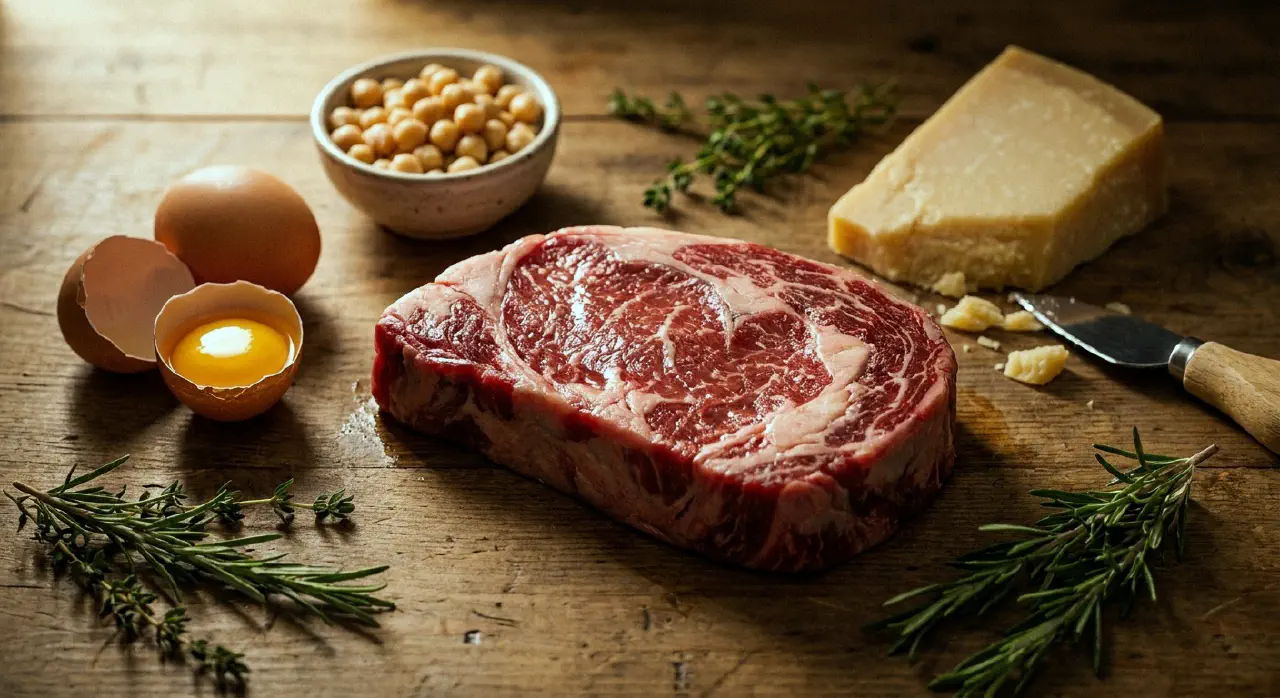
Proteins are the most challenging and sensitive of the four food molecules. Unlike water, fats, and carbohydrates (all relatively stable), proteins drastically change behavior when exposed to heat, acid, salt, or air. This sensitivity is fundamental - proteins are the active machinery of life, assembling and tearing down molecules, transporting materials within cells, forming muscle fibers that move whole animals. Their inherent dynamism is what makes them so responsive to cooking conditions.
Amino acids: the building blocks
Proteins are chains of amino acids - small molecules (10–40 atoms) containing carbon, hydrogen, oxygen, and at least one nitrogen atom in an amine group (NH₂). About 20 different kinds occur in significant food quantities. Each amino acid has a distinctive chemical character, and the sequence along the chain determines every property of the finished protein.
Three roles in cooking
Browning and flavor: Amino acids react with sugars in Maillard reactions, generating the browned food aromas that define roasting, grilling, and frying. Their nitrogen and sulfur atoms introduce molecular dimensions impossible in caramelization alone - pyrazines (earthy, chocolate), thiazoles (meaty), pyrroles (aromatic), oxazoles (floral).
Direct taste: Individual amino acids and short peptides have distinct flavors. Glutamic acid (MSG) provides umami - the savory, brothy taste found in tomatoes, seaweed, aged cheese, and fermented products. Sulfur-containing amino acids break down when heated, contributing eggy and meaty aroma notes.
Protein behavior: Each amino acid’s side chain is either water-loving (hydrophilic, forming hydrogen bonds), fat-like (hydrophobic, avoiding water), or reactive (especially sulfur-containing, forming strong covalent cross-links). A single protein molecule has many different chemical environments along its chain - parts attracting water, parts avoiding it, parts ready to bond permanently with similar parts on other proteins. This diversity drives folding.
Protein structure levels
Primary: Amino acids linked by peptide bonds into a long chain - the carbon-nitrogen backbone with side groups projecting outward.
Secondary (helix): The peptide bond’s regularity causes the chain to twist into a spiral (helix). Few proteins exist as simple helices, but those that do form strong fibers - collagen in connective tissue is the most important culinary example, and the source of gelatin.
Tertiary (folding): The chain bends back on itself, bringing together amino acids distant along the chain. Side groups bond via hydrogen bonds (weak, temporary), van der Waals bonds (weak), ionic bonds, and strong covalent bonds (especially sulfur-to-sulfur). This folding gives proteins their characteristic shape and function. Globular proteins (like egg proteins) fold into compact, elaborate structures. Fibrous proteins (like collagen and muscle proteins) remain extended.
Proteins in water
All proteins absorb and hold water through hydrogen bonding, but solubility varies enormously. Milk and egg proteins are quite soluble (easily dispersed). Muscle proteins are held together by ionic bonds and are generally insoluble. Wheat gluten proteins absorb considerable water but don’t dissolve - their many fat-like side groups bond with each other, holding proteins together and excluding water.
Denaturation and coagulation
Denaturation - the unfolding of protein structure by heat (usually 140–180°F), acid, air, salt, or mechanical action - is the single most important protein event in cooking. Breaking the weak bonds that maintain folded shape exposes reactive side groups to the environment. The denatured proteins then bond with each other (coagulation), forming a continuous network that traps water and gives food thickness or firmness.
Gentle coagulation produces delicate texture - barely set custards, perfectly cooked fish. Continued heating creates stronger, tighter bonds, squeezing water out: the custard becomes dense, the fish tough and dry. This is why protein cooking is fundamentally about temperature control.
Enzymes: the paradox
Enzymes are specialized proteins that catalyze chemical reactions - a single enzyme molecule can drive up to 1 million reactions per second. In food, enzyme activity is usually harmful: browning cut fruit, softening fish flesh, breaking down vitamins, spoiling through bacterial enzymes. Beneficial cases (meat tenderizing, vegetable firming, fermentation) are the exception.
The cruel paradox: enzyme activity follows the same Arrhenius relationship as all chemical reactions - activity roughly doubles with each 20°F/10°C temperature rise. So as food heats toward the denaturation temperature that will finally stop the enzymes, they work faster and faster, doing more damage in the approach than at any other point. Two strategies follow: fast heating (boil vegetables quickly) minimizes the damage window by racing through the danger zone; slow heating (gradual meat roasting) maximizes the window deliberately, exploiting beneficial enzyme action before denaturation shuts it down.
See also
- protein-denaturation - the mechanics of unfolding and coagulation
- water-science - hydrogen bonding with hydrophilic amino acids
- lipid-chemistry - hydrophobic amino acids that drive protein folding
- maillard-reaction - amino acid + sugar browning chemistry
- carbohydrate-overview - the other major food molecule families
- gluten-science - wheat protein network as dough structure
- eggs - globular protein coagulation in cooking
- meat - muscle protein fibers, collagen, myoglobin
- cooking-temperatures - the Arrhenius rule governing enzyme and reaction rates